
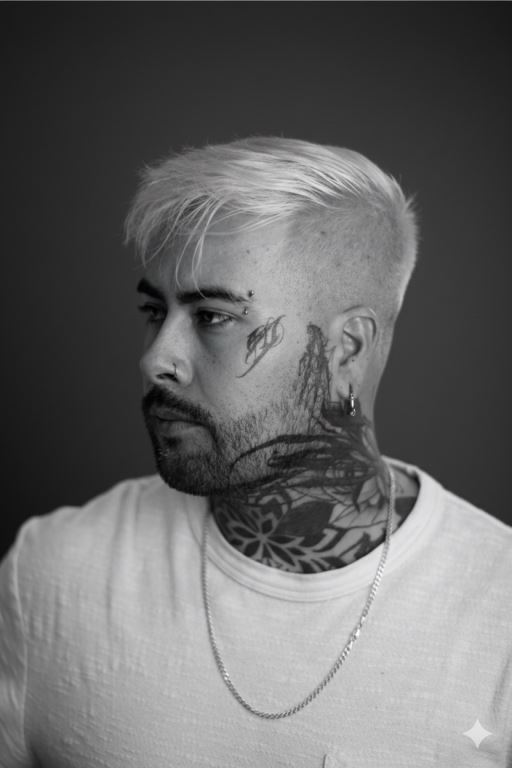
Interview with Alejandro Martinez
In honor of the eighteen anniversary of Skin
Artists Tattoo Magazine, we are spotlighting a group of top-tier
artists whose work challenges the traditional boundaries of body
art. Alejandro Martinez has been chosen for this celebration as a
leading figure in the evolution of abstract and organic blackwork,
recognized for his ability to merge human anatomy with aggressive,
flowing ornamentation.
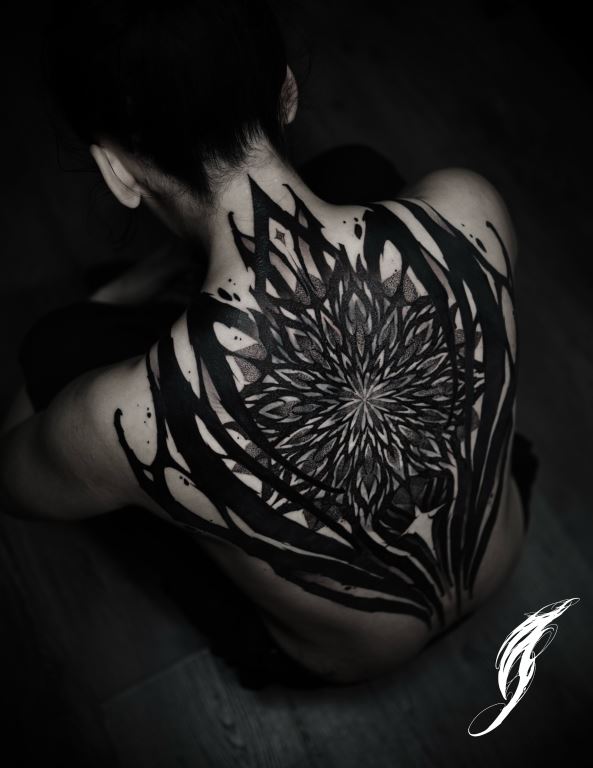
Alejandro’s style is visceral and highly recognizable, moving far
beyond the mechanical structure of traditional geometry. His
portfolio is defined by a masterclass in freehand execution, using
the natural movement of the body to dictate the path of his designs.
By blending solid blackout sections with fine, wispy linework and
geometric fragments, he creates a visual duality that represents the
transition between order and chaos.
The following interview is dedicated to exploring the future of
tattooing. We discuss Alejandro's move toward a more abstract and
intuitive form of blackwork, the importance of studying musculature
to ensure a perfect "wrap," and his vision for how ancient tribal
influences are being reimagined for the next generation of
collectors.
Q: To get started, could you introduce yourself and walk us
through your background? We’d love to know what first drew you
toward the world of art and creativity.
A: I started in 2014, balancing my studies with work. My curiosity
about diverse cultures led me to dedicate my free time to drawing,
until in 2016 I decided to turn tattooing into my profession.
Q: Chile has a very vibrant and distinct tattoo culture.
What was the specific moment or encounter in Santiago that made you
realize tattooing was the path for you?
A: I trained with industry leaders while at university, learning
everything from the mechanics of coil machines to technical theory,
thus consolidating my personal brand.
Q: In your early days, what was the hardest technical skill
to master in Blackwork? Was it the saturation of the blacks or the
flow of the lines?
A: I developed a passion for blackwork and geometry. My greatest
challenge was perfecting technical precision: flawless lines,
uniform solids, and organic flow over the body.
Q: Your current style is incredibly recognizable, visceral,
dark, and flowing. How did you move from traditional tattooing
styles to this abstract, organic form of blackwork?
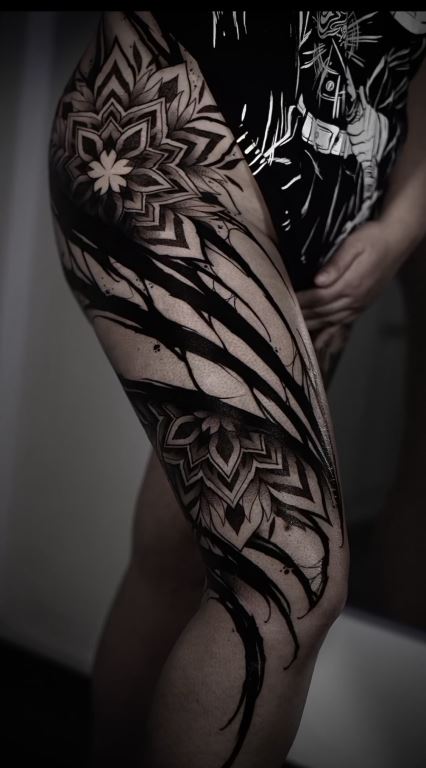
A: After years of creating mandalas and patterns, I evolved toward
freehand. Now, I use anatomy to "break" my designs, allowing the
piece to wrap around and play with the body's natural movement.
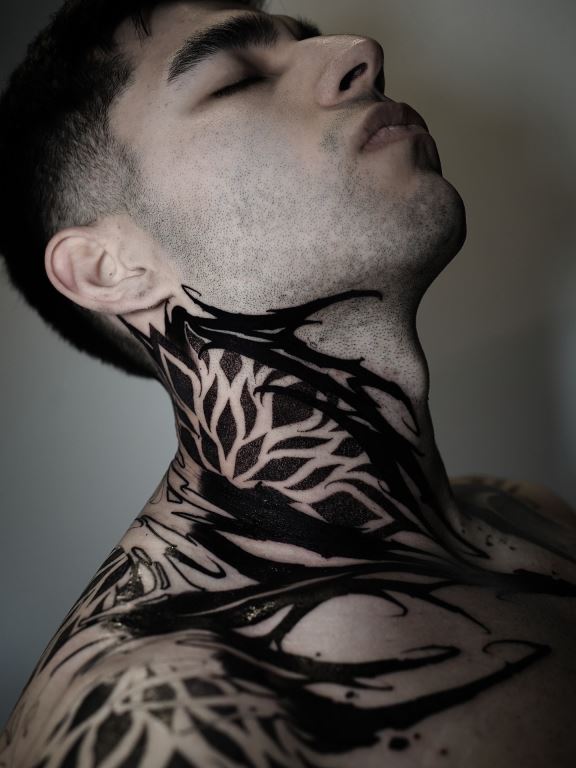
Q: Your tattoos seem to 'wrap' around
muscles and joints perfectly. How much of your design is planned
beforehand, and how much is freehanded directly onto the client's
skin to ensure that perfect flow?
A: I study musculature and bone structure. I use digital 3D models
as a reference and apply guide strokes on the canvas to ensure the
design highlights the client’s physique.
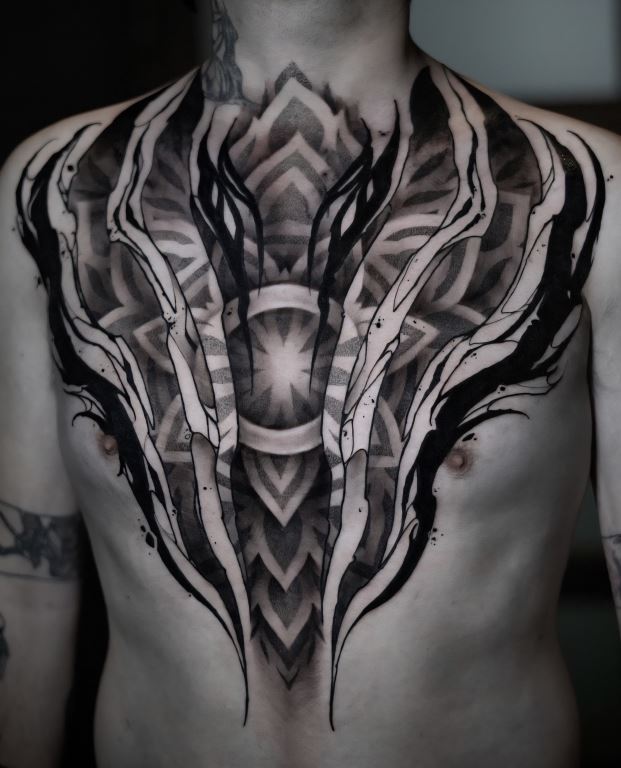
Q: I noticed you often mix solid 'blackout' sections with
fine, wispy lines or even geometric mandalas. What is the goal of
mixing these two very different visual languages?
A: My work represents the transition between past and present. I
combine the methodical structure of geometry with an aggressive
fluidity that symbolizes duality and constant change.
Q: Your work feels like a modern, aggressive evolution of
ancient tribal tattooing. What elements of traditional tribal art do
you respect, and which ones did you feel the need to break away from
to create your own style?
A: My style blends geometric ornamentation, neo-tribal for perfect
solids, and blast-overs for layers with history. It is a visual
balance between order and chaos.
Q: Bold blackwork is known for aging well, but
your style also includes very fine, sharp details. How do you
balance the 'impact' of the tattoo today with how it will look ten
or twenty years from now?
A: I design with the future in mind. I use high-end supplies and
conscious techniques to guarantee the tattoo looks impeccable ten
years later and beyond.
Q: Your style attracts a specific type of clientele. Do you
find that people come to you seeking a transformation or a 'rebirth'
through these heavy, dark designs?
A: I view tattooing as "transformation and rebirth." I aim for my
tattoos, with their dark and healing weight, to assist the person in
their process of personal liberation.
Q: You do a lot of high-visibility work on the neck and
jawline. What draws you to these 'extreme' placements, and how does
your design approach change when working on such a delicate, curved
area?
A: For faces, necks, and hands, I prioritize a fluidity that
respects the essence of the area while providing strength and
character by breaking aesthetic barriers.
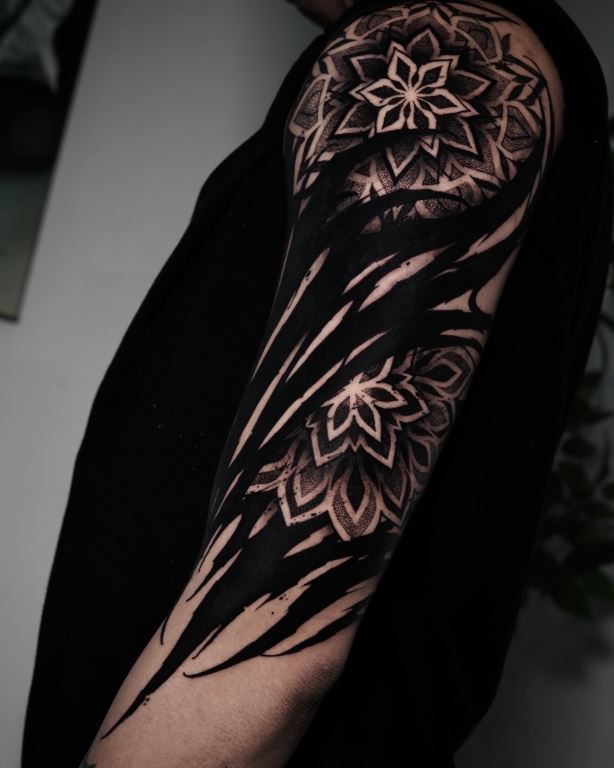
Q: When a client asks for a
high-visibility piece like a neck or a full torso what does that
initial conversation look like? Are you looking for a specific
'vibe' or energy from them before you agree to take on the project?
A: My art connects with people seeking an awakening. Many clients
choose my visual language to mark a new life stage or a sense of
maturity within society.
Q: Many people describe getting large-scale blackwork as a
'transformative' or even 'healing' experience. Do you feel that the
trust built during the session leads to a deeper emotional
connection between you and the person wearing your art?
A: These are built on trust and connection. Requiring multiple
sessions, these projects foster a deep bond that is reflected in the
power of the final work.
Q: You’ve recently served as a juror at
major festivals like Primavera Tattoo Festival and Arica Inkfest.
What do you look for in a piece of art when you are sitting on the
other side of the table?
A: I first evaluate the emotional impact of the tattoo. Then, I look
at technical execution: cleanliness, anatomical placement,
legibility, and long-term durability.
Q: You recently held an intermediate-level seminar with
Eiscar Mendoza. Why is teaching and sharing your 'vision' with the
next generation of artists important to you?
A: I firmly believe in sharing knowledge. The exchange of
information between artists is vital for the industry’s progress and
for leaving a positive legacy.
Q: Neo-Tribal and Cyber-Sigilism have
exploded in popularity over the last few years. How do you see this
'dark' aesthetic evolving? Do you think it will become even more
abstract, or will it return to more traditional roots?
A: I value the evolution of styles and the use of technology to
offer aesthetic proposals that meet the community's changing needs.
Q: From 3D body scanning to digital stenciling, technology
is changing the studio environment. Which new piece of tech has most
impacted your workflow, and what do you refuse to let go of from the
'old school' way?
A: I never stay stagnant. I am constantly seeking new tools and
innovations, integrating any advancement that elevates the quality
of my work and my professional environment.
Q: As someone who judges tattoo competitions, what is your
vision for the future of tattoo education? Do you think formal
seminars and ProTeam structures are the new 'apprenticeship'?
A: I urge new generations to strive for excellence. Tattooing today
is no longer just a craft; it is a high-level aesthetic,
professional, and therapeutic product.
Q: The industry is moving toward more sustainable, vegan,
and technologically advanced inks. What innovations in tattoo
equipment are you most excited about for the next five years?
A: Given the rapid advancement of AI and digital technology, my
expectation is that we continue to innovate together without losing
the ability to impress and build community.
Q: Alejandro, looking back at everything
you’ve built, from your early days in Chile to becoming a globally
recognized artist, what is the one thing you cherish most about your
work today?
A: I value the trust of my clients and the support of my loved ones.
My greatest fortune is being able to do what I love, traveling the
world and leaving a mark on the lives of others.
Q: If you could leave one piece of advice for an artist just
starting their journey in 2026, what would it be?
A: "Do not hesitate." Be creative, be consistent, be patient, and
smile at life.


