
Interview with Azat Kamaletdinov
Hello Azat Kamaletdinov! Thank you so much
for joining us today. To start, could you please tell us a little
about your background and what initially drew you to the arts? When
did you first recognize this unique talent? My passion for
drawing started in my childhood. I would envision whole worlds and
bring them to life on paper right away. But the real turning point
came later, when I first saw the work of great tattoo artists. It
felt like genuine magic. From that moment, tattooing became more
than just a career for me, it became an integral part of my life.
Q: Moving on to your career, how did you transition from
other forms of art into tattooing specifically? Can you describe
your apprenticeship or early days of learning the craft?
A: I started to draw at a children’s art school, where I first got
to know form, color, and composition. As for tattooing, I mastered
it completely on my own. There were no studios or masters in my
hometown to learn from, so I gathered information from forums,
studied techniques, and analyzed processes step by step. For a year,
I practiced at home on friends who supported me and had faith in my
success. Later, I moved to a big city and got a job at an ordinary
street tattoo shop. I didn’t have a mentor, and I acquired all the
skills I have today through persistence, practice, and a strong
desire to do my job better and better.
Q: What was your first professional piece
and how did that experience influence your direction?
A: The first studio where I worked was a regular street shop with no
stylistic divisions. I experimented with almost every tattoo style.
This gave me a good experience, but I soon understood that I didn’t
enjoy working from other people’s online images. I always wanted to
draw my own designs. Initially, I doubted that my drawings were good
enough to present to clients, but I continued to practice and
develop my skills. I remember my first tattoo based on my own
sketch, it was a skull wearing a cap with two wrenches, like the
Jolly Roger. From that moment on, I started focusing on my designs,
and after several years, I completely switched to tattooing only
based on my sketches. Additionally, I had the good fortune of being
noticed and invited to one of the top tattoo studios in Russia at
the time, NBK Tattoo Collective, while working at a regular street
shop. This marked a crucial step in my professional development and
reinforced my belief that I was on the right path.
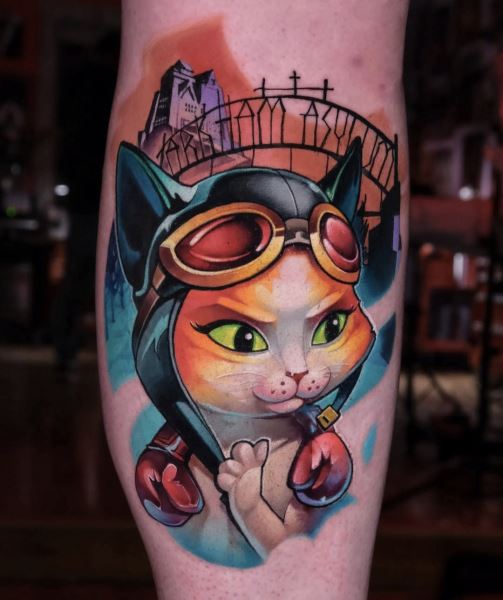
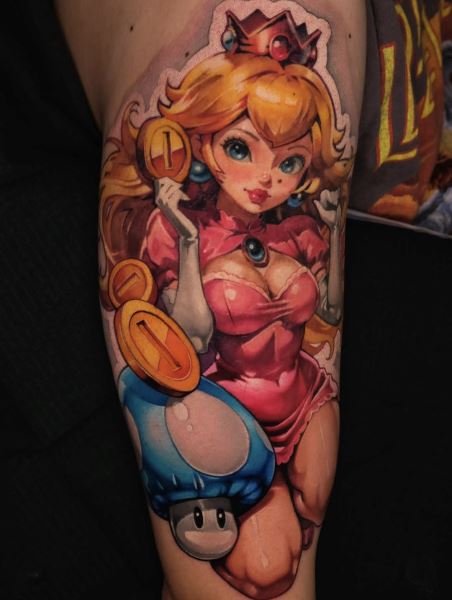
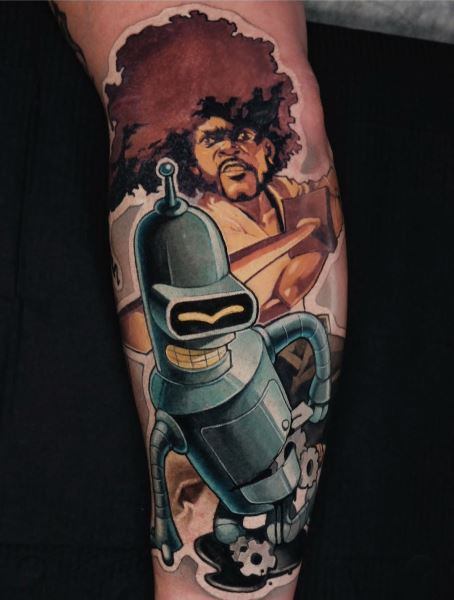
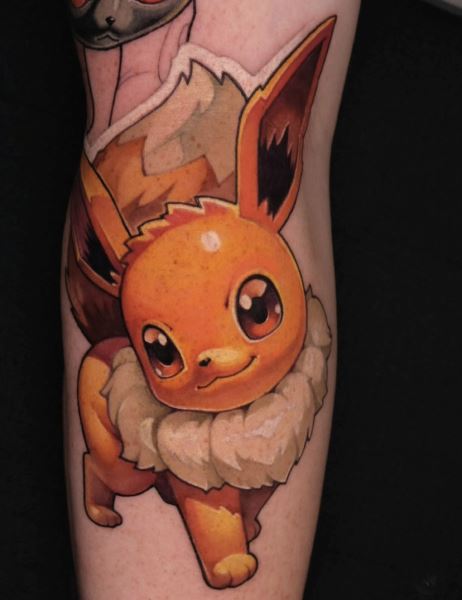
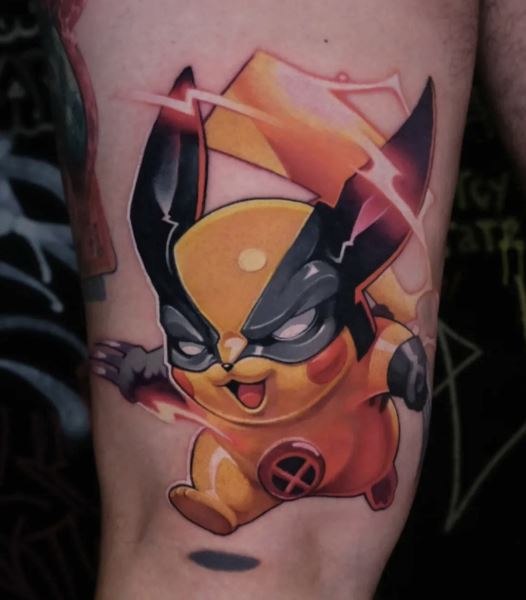
Q: Your work is incredibly dynamic, characterized by
brilliant color saturation, high contrast, and a distinct,
illustrative style. We see a strong presence of pop culture, like
Pokémon and Super Mario characters, rendered with almost animated
realism. How would you define your signature style?
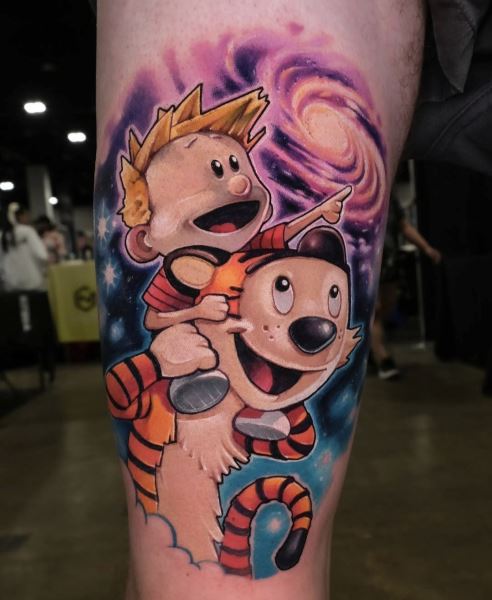
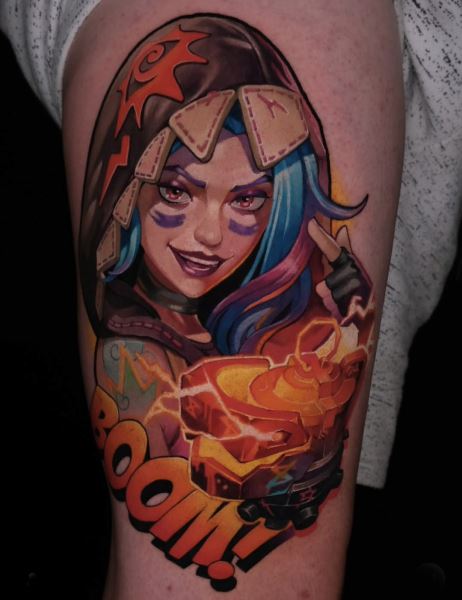
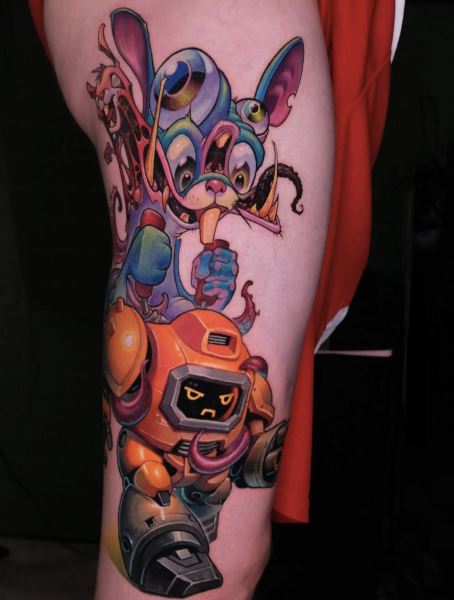
A: My first designs were inspired by new school, and for a long time
I worked in a style close to its classic form. However, as time went
on, I delved deeper into digital art, and my works began to become
more complex both in form and in color. Now, I find it hard to
classify my style under just one category. It is a mix of
illustration, pop culture and digital art, which has gradually
turned into what I create today.
Q: Where do you draw the most inspiration
for this signature style? Do influences come primarily from video
games, animation, comic books, or a specific movement within
contemporary art?
A: A diverse range of characters from video games, animation,
comics, and pop culture inspire me. I enjoy reimagining familiar
images and creating new designs based on them, incorporating all of
my experience in illustration and drawing.
Q: Given the distinct and highly specialized nature of your
style, how do you approach the initial creative vision for a new
tattoo? Do you encourage clients to provide reference images, or do
you prefer to create all designs from scratch based purely on their
concept?
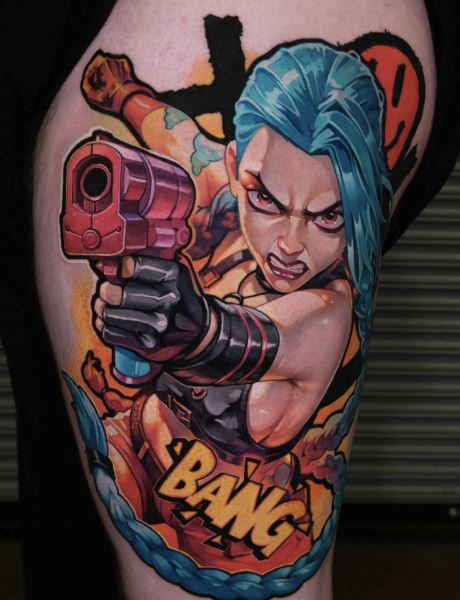
A: When clients provide references, I ask to see them, not to copy,
but to understand the mood and direction of the idea. If there are
no references, it is important to clearly describe the concept. The
main thing for me is to understand the task accurately. References
act as a starting point, and then I create a fully original sketch.
Q: If a client came to you and gave you
complete creative freedom, allowing you to choose the size,
placement, and subject matter, what would be your ultimate 'dream
piece' to tattoo?
A: In such situations, I have a folder with original designs, and
I’m happy to pick a project from it that I’ve long wanted to bring
to life.
Q: While your signature style is highly expressive and
cartoonish, have you ever taken on a project that, despite its
colorful playfulness or theme, was actually commissioned as a
memorial piece, a tribute to a person, pet, or significant life
event? If so, are there any inspiring examples you can share where
you translated deep emotion into your signature style?
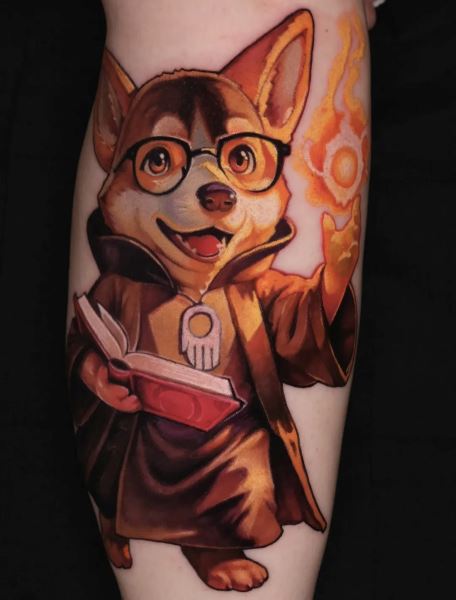
A: Yes, such projects do happen. People often ask me to make a
portrait of their dog, and some of these works were created
specifically in memory of their pet. Sometimes clients choose very
original images, for example, one of the most memorable was a
Rambo-style dog with a grenade launcher and a helicopter in the
background. Even when executed in a playful, vibrant style, these
works still hold deep emotions and special meaning for the person.
Q: What are your thoughts on color theory
and pigments when designing a piece, particularly for long-term
vibrancy? Are there specific inks, machines, or techniques you rely
on to achieve that characteristic 'pop' and durability in your
tattoos?
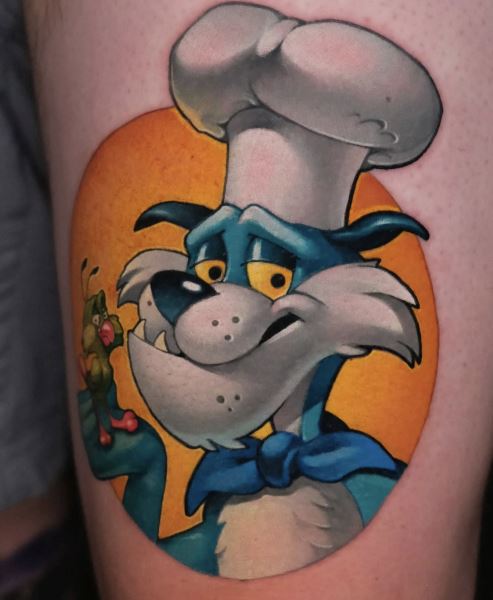
A: Color theory is one of the key factors in creating bright and
saturated tattoos. The right combinations of colors make the color
more intense. I frequently use complementary colors because they
amplify each other, bringing out the full brightness. The
application technique is also very important. If the pigment is not
applied tightly enough, it will look pale after healing. However, it
is important not to damage the skin, as too rough application can
make the color look dull and dirty. Striking the right balance with
a tight, precise application yields a bold and enduring result.
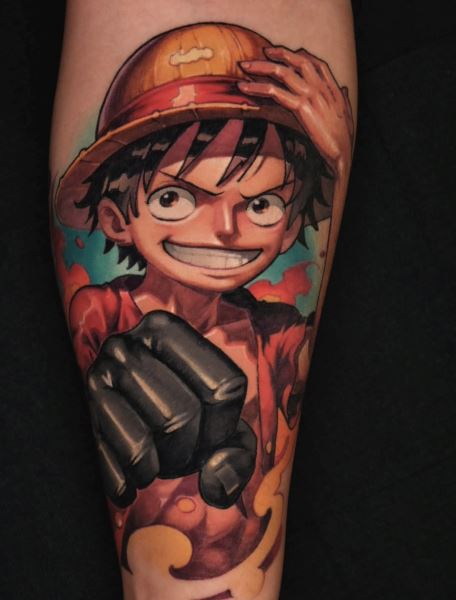
Q: Any favorite tattoo you did recently?
A: Among the latest and most memorable works, my collaborations with
Jesse Smith and Sergey Shanko. These were completely different works
and creative processes, but that's what made them so unique.
Q: Many of the incredible designs we see on your feed start
as digital artwork, often created using apps like Procreate. How has
the shift to digital design streamlined your workflow compared to
traditional methods? What specific features within Procreate do you
find most essential for translating a complex, colorful idea into a
design that is ready for skin?
A: Before I started using digital painting, I created all my color
designs using ordinary colored pencils. This took a lot of time, and
there was almost no way to fix anything, any mistake meant starting
over. Even before Procreate came along, I started working with a
graphics tablet and Photoshop. Digital art opened up many more
possibilities, making the process faster, more convenient, and
allowing for extensive changes and free experimentation. This
greatly improved the quality of my designs and accelerated the
process. The introduction of Procreate has made work even more
convenient. Essentially, it combines all the essential drawing
features of Photoshop in a simpler format. One of my favorite tools
is Gradient Map, which lets me instantly recolor a black-and-white
drawing with any palette and quickly find the right shade.
Q: Have you found a separate creative
outlet in producing and selling digital prints or original art based
on your tattoo concepts?
A: Yes, I print prints and stickers based on my designs, but I see
it as a natural extension of my work. I usually take them with me to
tattoo conventions, so anyone can pick up a print or a sticker pack
they like. It’s another way to share my art with people, not only on
skin, but in a form they can take home and enjoy.
Q: What do you see as the biggest trend or evolution
currently happening in the illustrative tattoo style, and what
advice would you give to artists trying to find their own signature
voice?
A: In my opinion, the most noticeable trend in illustrative
tattooing today is the movement towards greater artistic expression
and individuality. People don’t just want a clean copy of an image
anymore, they want something original, something with a real voice
behind it. My advice to artists who are looking for their own voice
is to develop their artistic vision. Tattooing isn’t just a craft
anymore it’s a form of contemporary art. The more you invest your
vision, experience, and style into each piece, the faster your
unique voice will become recognizable.
Q: The client-artist relationship is
critical, especially given the permanence of the medium. Beyond
discussing the design, how do you build trust and ensure open
communication with your clients, particularly during long or
sensitive sessions?
A: For me, everything starts with trust. It begins long before the
needle touches the skin. I always create a finished sketch in
advance so the client can clearly see how the tattoo will look on
their body. That way, our expectations are aligned, and there are no
surprises. It's also important for me to convey that the quality of
my work is my top priority. When I work, I’m fully present
completely focused, as if I were tattooing myself. Clients usually
feel that energy even at the stage of discussing the idea, and it
naturally builds trust between us. I always ask people not to be shy
about asking any questions, especially if it's their first tattoo.
And during the session, I try to adapt to whatever makes them
comfortable. We can talk, I can simply listen, or they can watch
something to take their mind off the process. What matters most is
that they feel safe and relaxed.
Q: In a modern, highly visible tattoo industry, ethical
practice is more important than ever. What, in your view, are the
three most critical ethical responsibilities a professional tattoo
artist has today, whether it relates to cleanliness, design
originality, or knowing when to respectfully turn a client away?
A: For me, the most important ethical duty is safety. When I first
started out, was fully focused on learning the rules of sanitary and
hygienic safety for both the artist and the client. This is one of
the most important aspects of this profession. I’ve always
maintained that the safety of the tattooing process must be the top
priority. Even if a tattoo is not successful, it is not as damaging
as the potential harm to health. That’s why I devote maximum
attention to this aspect. For example, I really like the disposable
holders I use they work great with InkJecta machines, a brand I’ve
been loyal to for years. Another important principle is respecting
originality. I believe it's wrong to copy someone else's designs. I
often see tattoos based on my designs, and while I'm okay with it,
it's not a good thing. I want to address customers who expect a
"cheap" copy of a beautiful tattoo. It's unrealistic. A master who
can replicate work well won’t waste their time copying someone
else’s, and the one who undertakes will most likely do it badly. As
a result, you’ll end up with a tattoo that’s both low quality and
unoriginal. The third important point is knowing how to politely
decline a client. Sometimes I have to do this. I believe it’s
essential to strike a balance between the client’s idea and my
creative vision. I always try to reveal the idea to the maximum in
order to get the best possible result. For me, it’s not just about
“getting a tattoo done” but to make it really cool. If I sense that
my vision clashes with the client’s and I won’t be able to fully
express my creativity, I prefer to refuse the job.
Q: Given the demands of consistently
delivering high-quality, custom work, are there occasions when you
experience creative blocks or encounter challenges in meeting client
expectations?
A: In the past, I've faced challenges when I strayed from my primary
specialization. But somehow, I’ve been incredibly lucky with the
people who come to me. It's said that we attract people who are
similar to us, and it seems to be true. Almost all of my clients
share the same vibe, and they come looking for something truly
special. I've observed many times that when their energy resonates
with mine, it's like magic happens. The client's interest ignites my
creativity, and as a result, one of the most powerful sources of
inspiration for me is the energy of the people I work with. Because
of that, I’ve never really struggled with creative blocks or
communication. Instead, my clients have become a major source of
inspiration for me.
Q: You are a resident artist at Monna
Lissa in Los Angeles, a studio known for housing some of the
industry’s top talent. How has being part of this renowned,
high-caliber artistic community influenced your own work and
professional growth?
A: It just so happens that I've been working alongside some of the
most talented and well-known artists in the industry throughout my
professional career. To me, Monna Lisa is truly one of the best
studios in the world, and I’m genuinely thrilled to be part of this
team. I've been following the work of Sergey Shanko, the founder of
the studio, for a long time, and I'm excited to accept his
invitation to join the team. Working at Monna Lisa has had a huge
impact on my creative process. It opened my mind, encouraged me to
experiment more with pop-culture elements, and helped me discover a
new direction that highlights my uniqueness as an artist. At Monna
Lisa, I learned to stay true to myself while also exploring new
things and growing as a tattoo artist. This experience has become a
major turning point in my artistic journey.
Q: Working in a city like Los Angeles,
which is a global center for arts, media, and pop culture, must have
a unique impact. How does the energy and artistic environment of
L.A., and specifically Monna Lissa, feed into the themes and
vibrancy of your illustrative tattoo style?
A: For a creative person, it is important that their environment
supports their energy. Los Angeles has this bright, uplifting energy
that matches my style perfectly. I feel very at home here, and the
atmosphere inspires me to be creative. My style is light, fun, and
positive, and LA embodies all of that. There is no unnecessary
conservatism here, and everyone can be themselves and enjoy life
without any restrictions. This freedom and openness inspire me and
help me grow.
Q: Tattoo conventions are an incredible way to connect with
both international peers and new clientele. How important are these
conventions to your annual schedule?
A: I truly believe that tattoo conventions are one of the best
places to connect with people and share experiences. I always try to
include the most important events in my schedule and start planning
my year with them. For me, conventions aren’t just about meeting new
artists, they’re also a chance to reconnect with old friends. These
events always provide a powerful energy boost and motivate me to
grow as an artist.
Q: Besides the standard conventions, do
you often seek out guest spots or travel opportunities to tattoo in
different cities or countries?
A: Before moving to the United States, I traveled extensively in
Europe. Now I have several guest studios with which I have developed
warm and friendly relations. I always enjoy coming there to visit
friends and work together.
Q: For those interested in booking a consultation or
appointment, could you please provide the location of your studio
and any relevant website or social media links?
https://www.instagram.com/delai_dzen
https://www.instagram.com/monna.lisa_
Q: A favorite career highlight so far?
A: This is a really difficult question, because so many exciting
things have happened lately that it’s hard to highlight just one.
There have been collaboration offers from brands, big wins at major
tattoo conventions, collaboration with incredible artists, guest
spots, and festival appearances. Each of these moments is meaningful
in its own way and leaves a strong impression. Life in Los Angeles
is so fast-paced that sometimes everything blends together into one
continuous flow, a stream of growth, creativity, and inspiration.
Q: What impact do you aspire to have on the tattoo
community?
A: I think one of the things that really defines me is how attentive
and detail focused I am with my work. Many people say that my
tattoos look incredibly clean, and that’s exactly what I aim for.
It’s important to me that every piece feels personal, carefully
thought out, and perfectly balanced. I also feel that this approach
has influenced other artists. I see that my work often serves as a
reference point and sets a new standard of quality that inspires
many people to continue their development. And that’s something I’m
truly proud of.
Q: Do you plan to stay long term in Los
Angeles?
A: At this point, I do not plan to leave Los Angeles. But creative
people are always open to new places and new experiences, so who
knows, things can change someday. Right now, LA is exactly where I’m
meant to be. I feel at home here, and the city gives me a strong and
yet a powerful charge for development.
Q: If you could go back and give your younger self advice
about pursuing tattooing, what would it be?
A: I would say, believe in yourself and don't stray from your path,
even if it feels like the whole world is against you and your
creativity. Everyone goes through hard moments, and maybe those were
the words I once needed to hear myself. I’m grateful I didn’t give
up and kept moving toward my dreams. The most important thing is to
stay true to your cause and keep moving forward, no matter what.
Interview: Ivana Kancheska
Date: 18/11/2025


