
Interview with Che Cho le Tatooer
Hello Che Cho le Tatooer! Thank you
so much for taking the time to do this interview. Please start by
telling us something about yourself and your background.
Hello! My artist name is Che Cho Le, I grew up in France, center of
the country. I´ve spent most of my childhood around nature. I was
also drawing a lot back then, I ended up doing my grade till legal
age then I left school, pretty early I wasn't so interested about it
to be honest. From the age of sixteen, tattooing was already on my
mind so it also came really early on in my life .
Q: Can you remember the moment you first recognized your
artistic talent?
A: Well I don't think I really recognized it, I started drawing when
I was five years old... I always had the need to express myself so I
never really thought about this. Back then my parents brought me to
an associative event and I immediately wanted to do comics books. I
remembered waiting a year because I couldn't write yet, so they
didn't accept me the first time. So I thought I just wanted to tell
stories back then which I end up doing with tattooing later on!
Q: How long was the process of self discovery and
development?
A: So as I said previously, my first contact with art was drawing,
especially comics books, I used to go to the bibliotheque to trace
some animals from French artists' books. I stopped drawing for two
years from when I was 15 to 16, I was doing a lot of photos and got
super into it before coming back to it when I discovered tattooing.
I really loved Kandinsky from a young age. Now I have too many
inspirations to put them on paper.
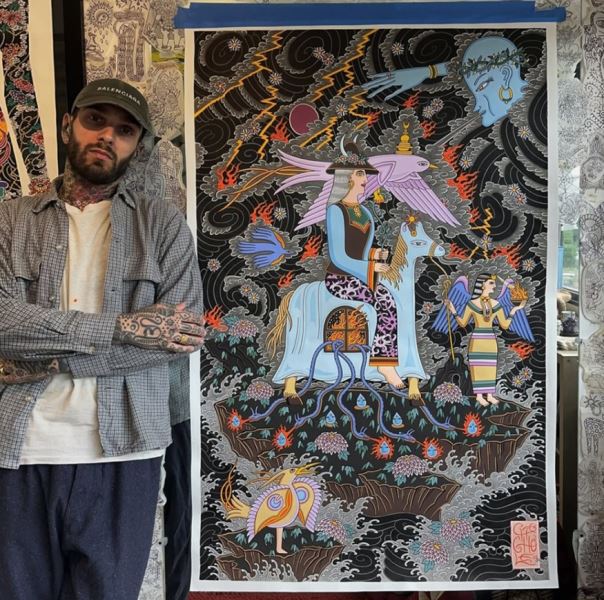
Q: What sparked your journey into the world of tattooing,
and when did it evolve from a passion into a serious career?
A: At 16 I entered a tattoo shop in my hometown, a friend wanted to
get tattooed (the owner used to be apprentice of Tin Tin, famous
tattooer and organizer of le mondial du tattoo) 5 minutes after
being in the tattoo shop I knew I wanted to tattoos and started to
work on a flash book on the same evening. So once again I didn't
really think about it. I got tattooed the day of my legal age,
prepared a tattoo book from 18 years old and then started tattooing
at the end of my 19s.
Q: What was the learning curve like when you started, and
did you teach yourself or have a mentor?
A: I met Guy le tatooer at nineteen and started an apprenticeship
with him from when I was twenty years old, I wanted to get a tattoo
and things happened pretty naturally. I actually wanted a small
tattoo and end up lining my whole front. After three sessions he
sold me my first machines and I started to tattoo friends in my
parents house on a wood door - I used as a tattoo table, funny
times. Then I tried a tattoo shop in France and after cleaning the
shop for a year I started traveling with him around Asia and moved
permanently to Bangkok when I was around 21 years old. I feel it
took me a few years to really understand how techniques and skin
works, but things came together when I moved to Mexico and got to
spend time with Guy for five years pretty much everyday.
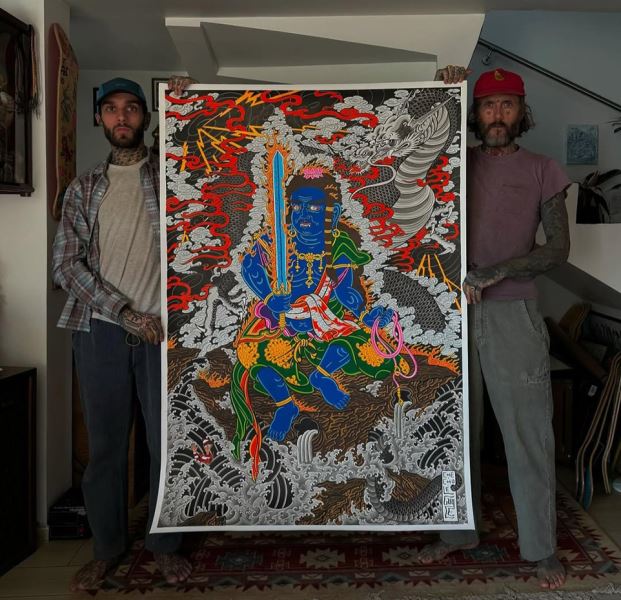
Che Cho Le Tatooer and Guy Le
Q: You do
some incredible work in the Japanese and Oriental styles. What is it
about this type of art that speaks to you most?
A: I think it came from my youth, I got really interest about this
side of the world, my mom was doing a lot of yoga and meditation and
I end up visiting India at nineteen. This is the first travel I
chose to do by myself outside Europe, I didn't know I will spend
around four years living and traveling in Asia few years after this.
So I will say the images and symbols speak a lot to me. I always
felt connected to the culture even if I'm not part of it... Japanese
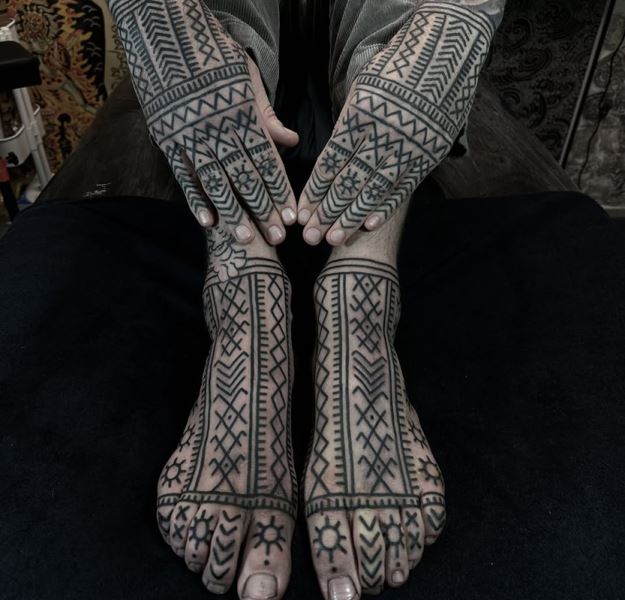
and tribal tattoos to me are the definition of how you can do
something by understanding and embracing someone's anatomy.
Q: These designs are known for their deep symbolic meanings,
like protection, love, and strength. Is there a particular symbol
you especially enjoy working with?
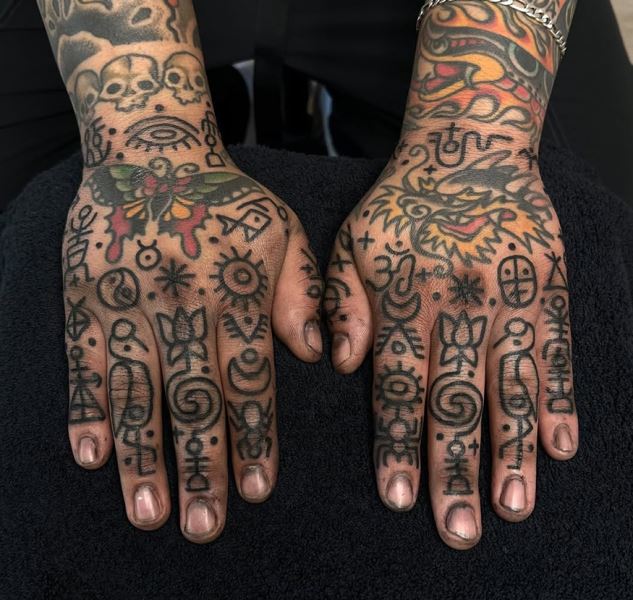
A: I really love gods and deities, especially Hinduism and Buddhism
but it can also be any Japanese or animal subjects. Saying this,
over time I really enjoy doing backgrounds, I found it harder to
understand but so much more challenging and interesting along the
years. I remember watching an interview by Horiyoshi 3 saying:
better to work on your background, so you can trace any subjects.
Guy gave me the same advice later on in my career.
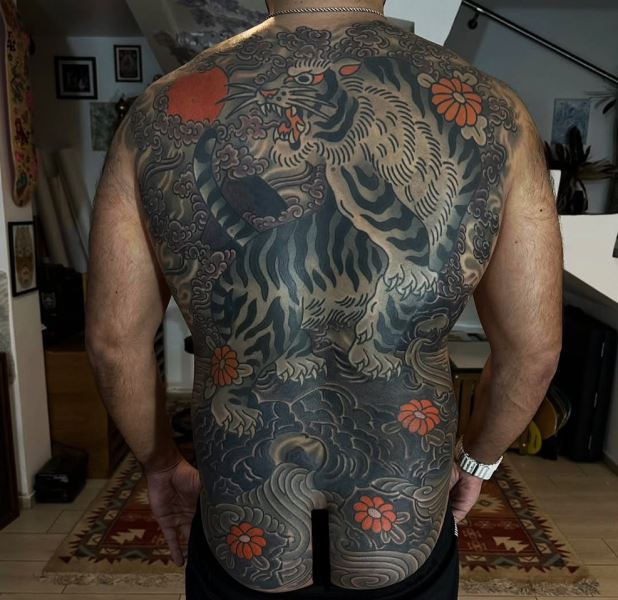
Q: Could you walk us through some of the core creative and
technical guidelines that define these styles, especially the
traditional Japanese approach?
A: I think any work you want to do in tattooing is a journey... To
understand something you should travel to the source. I've got an
apprenticeship from someone who always made me travel to comprehend
a culture before putting it on the skin. Not saying I did it for
everything but I usually try to study a lot when it is about
tattooing. To me, any tattoo should be solid, visual, and have a lot
of impact, you should make sure it will look good over time.
Q: Artists often seem to be on a continuous journey of
growth. What's your approach to evolving as an artist? Have you ever
thought about making a significant change to your style or
incorporating new techniques?
A: Hm, I think discomfort is in my nature, it is the only way to
grow in my opinion. So I think evolving for me is always trying to
push myself on a higher technical and creative level. I never really
thought about making significant changes but this comes from my
perspective about tattooing. To me it is a craft, I’m doing what
people ask me to - so it can be different style or subjects. Growth
comes also from your customers' ideas. I just try to be critical
with my work and determine what I could have done better on each
piece.
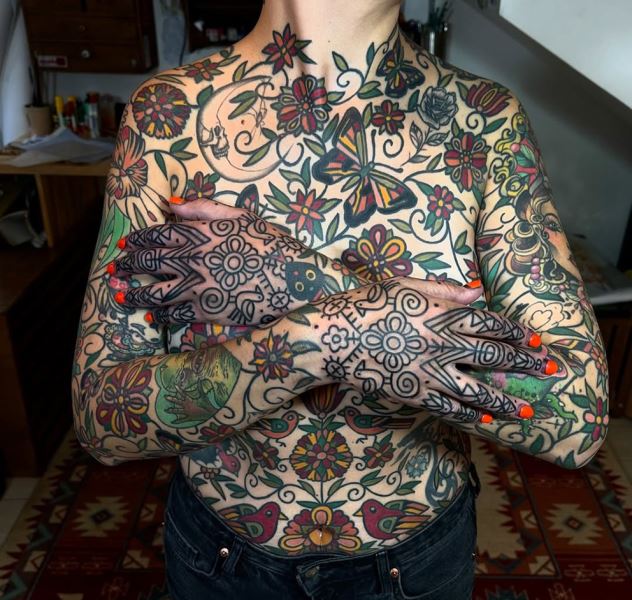
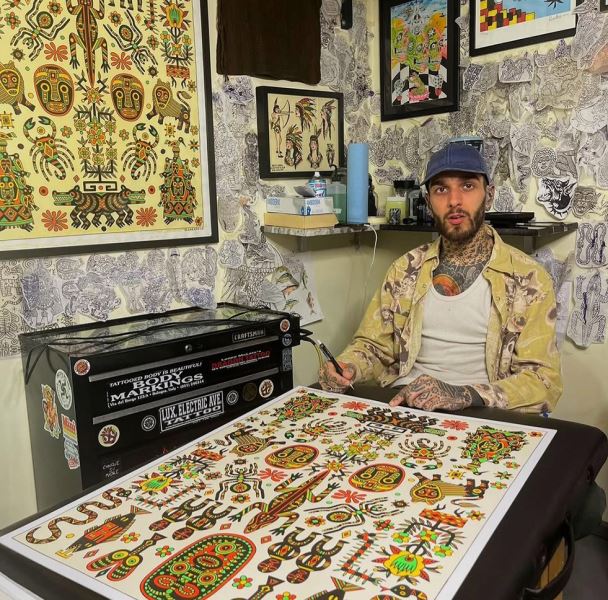
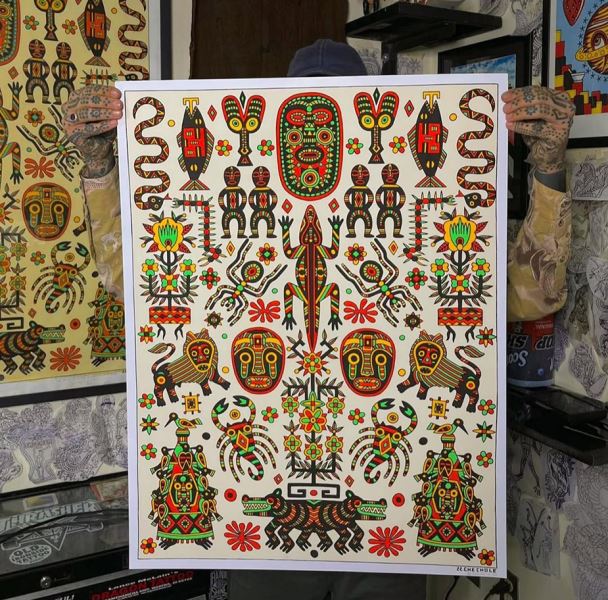
Q: I saw some of your beautiful tattoo prints and was so
impressed by the detail. Do you sell them, or is it more of a
personal passion project?
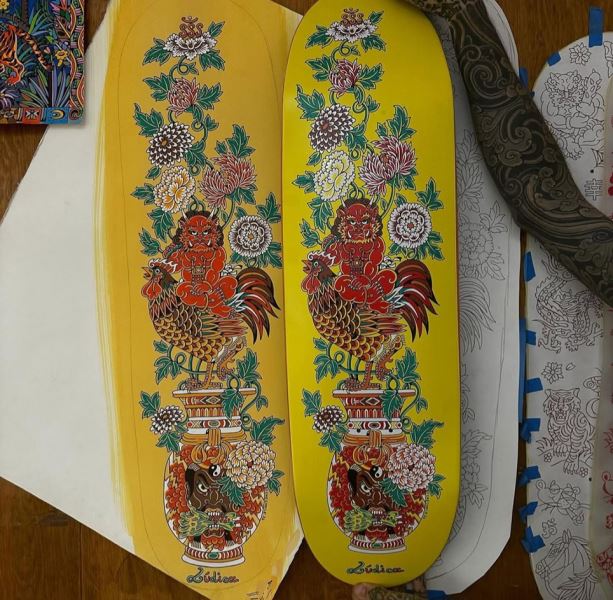
A: Thanks for the kind words. I spent a lot of time on them . Yes, I
sell most of my paintings on instagram (@checholetatooer) I used to
paint more before tattooing full time but both are really connected
to me. I will say it is more part of tattooing than a side project
cause both help me understand each other.
Q: Now tell me about your flash book. How many flash sets
are there and when did you come up with this idea?
A: Well, I had over 4 flash book in my life, I used to paint 2/3
sheets a week... For this book I didn't use any flash, only stencils
I did on my clients. I never really tattoo a flash, I don't know, to
me a tattoo should be for someone not for me. It is good to give
ideas to people but better to meet them and come with something more
personal. From 2020 to 2024 I tattooed a lot and I saw my mentor
putting his work together into books every 5/7 years so I told
myself why not me. I think it is a book for tatooer, you can rework
the designs or give some ideas to your customers. It is always good
to inspire and be inspired not to copy or be copied...
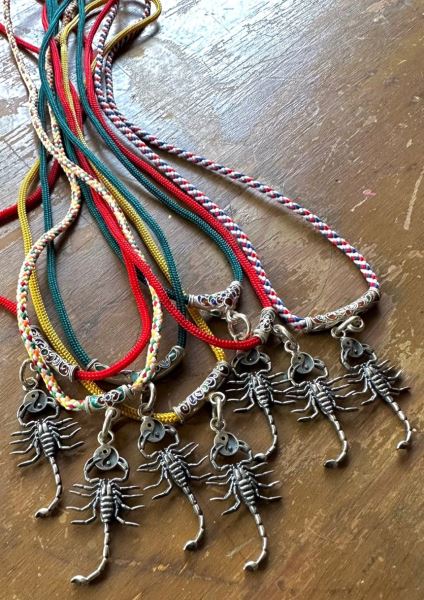
Q: I was also impressed by the jewelry you sell. Are you the
designer, and can we expect to see more of your work in the future?
A: You might talk about the Scorpio necklace, this was a project I
did between Thailand and Mexico. I bought a few parts during my
travels then designed the pendant on paper and made people doing it
in 3d with some silver I got from Nepal.
It was cool to make the pendant, I had to choose each piece of rope,
silver, then the pendant and make a few unique objects. On the
second question, well, I don't know maybe yes maybe no... I don't
have any projects on this for the moment but I'm always open to
collaborate or do something different.
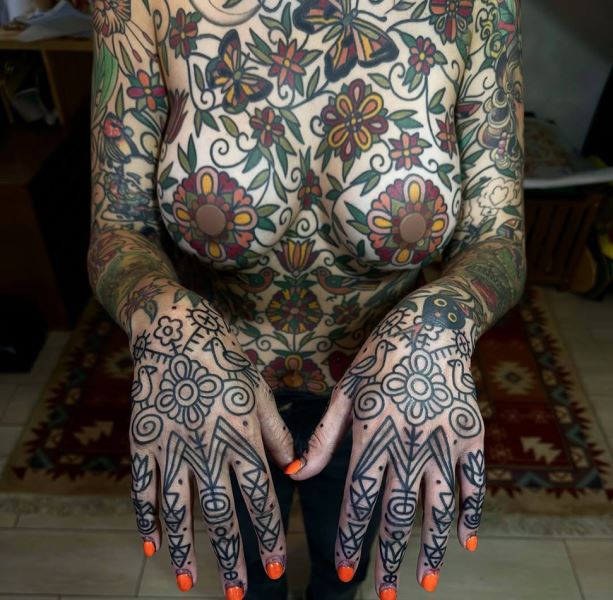
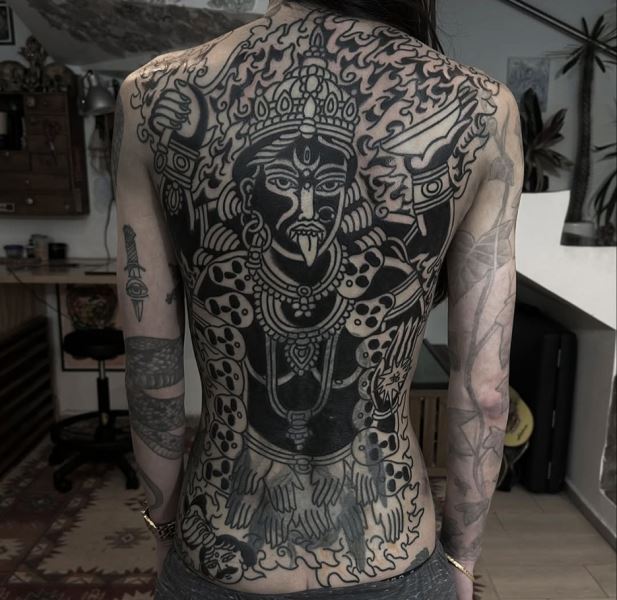
Q: Your large-scale pieces, such as full sleeves and back
pieces, are incredibly impactful. Could you share some insight into
the typical timeframe for completing a project of that size?
Additionally, what is your process for collaborating with clients on
the design and what does the preparation phase usually involve for
such extensive work?
A: So on big projects I usually do two to five sessions... I did
some back pieces in two sessions but I love to go for five, even
more if I could to be honest. It really depends on the size of the
person and the tattoo we plan to do. I'm usually pretty fast at
tattooing so it helps during the process. Most of my work is really
about defining what people want to have. Then we look at books or
references and start the process. I never really prepare something
before I know my client. I like to meet people, talk and try to
understand who they are and what they want. I also freehand a lot so
they can see how the design will look on their skin. The design can
be prepared before a session if I already met my client and took
some measurements but for background or tribal I'm doing everything
on the day.
Q: Can you share a memorable client story that highlights a
positive impact you made?
A: Wow, so many stories to be honest, had a lot of bad stories but
99 percent of the time a lot of good stories. I've worked in a lot
of places and environments so I've experienced many kinds of people.
This year I moved to work at home in a private shop and it makes me
understand how giving time and energy to customers is important.
Because at the end of the day, you give someone a moment, his or her
moment to be important. Society goes so fast nowadays and no one
takes the time to listen or communicate. Tattooing should be a
ritual between two persons before being anything transactional
because we still put something on people for life. I just finished a
collaboration with a friend during a convention and the customer
(who happens to be his best friend) cried after seeing his backpice
done in two days. This kind of moment makes me really happy, you can
change someone's life and energy by doing a tattoo.
Q: Given the demands of consistently delivering
high-quality, custom work, are there occasions when you experience
creative blocks or encounter challenges in meeting client
expectations?
A: When people don't know what they want. I never really understood
it because you can get so many designs... This to me is difficult
because I can find idea if you give me a base but sometimes people
don't know, they just want to get tattooed. I always do custom work,
I pay special attention to give every design or idea the same energy
even if I feel less connected to it. I will say not many creative
blocks but challenges yes! Every tattoos is an opportunity to push
yourself and do better, so it should feel challenging or
uncomfortable otherwise you don't grow as an individual and artist.
Q: What's the best way for potential clients to contact you
regarding consultations or appointments? Can you share your studio's
location and any relevant website or social media links?
A: I think the best way is to contact me on instagram (
@checholetatooer) or by mail (checholetatooer@gmail.com). My studio
is in Mexico City in Roma sur, I don't do many consultations or
visits before appointments.
Q: What qualities do you value most in an artist, beyond
their artistic skill?
A: Authenticity, because you go farther by being authentic. I feel
we are so into looking at each other on the internet, we forget to
ask ourselves questions. When I met Guy around 2019 he didn't had
internet so it felt to me he studied tattooing and his basics but
still, really tried to do it on his own way. Today I try to have the
same approach and be inspired by what I choose to look at,
especially by books. Then the second point will be how you are as a
person and human and treat others before being an artist. Because
how you behave comes first at least to me, I don't have any interest
for your work if you're a bad person with no integrity. Last thing
will be creativity, and the ability to renew yourself when your work
starts to be similar day after day. As I said previously, art or
tattooing to me should feel uncomfortable. You should have a long
term vision.
Q: What's your take on the local tattoo scene? Are you
seeing any exciting developments, like new artists, styles, or
events?
A: I've been traveling a bit around the world, I feel the Mexican
tattoo scene is really focused on realism and fine lines so I don't
know really if people are doing great Japanese work except 3/4
people in the country. No disrespect, this is just my point of view.
I have always been more focused on the outside world, especially now
when I'm on my own. So I will not really give an opinion on this
since I'm not part of it. I feel more enthusiastic about other parts
of the world.
Q: How often do you attend tattoo conventions? In your
experience, how valuable are tattoo conventions for artistic growth
and building client relationships?
A: Well I didn't really do much before 2023 I just started to attend
a few this year. I think it is challenging, any challenge is
interesting. You get to know yourself. I remember Guy Le telling me
how you should show your work to the world, it is a way to give
yourself flowers for your hard work. So definelity valuable a
experience, you get to know people, see different ways of working
and communicate. For clients I don't know, people want to meet you
during a busy event. Maybe not the best way, since I love to take
time to give everyone a proper discussion. Last convention I did was
a good opportunity. I did a collaboration with Jm Lajoie. I got to
understand a different way of tattooing. It is really cool to work
with other people, you learn a lot in a short time.
Q: Have you had the opportunity to work as a guest artist in
other studios? Could you share a bit about what that experience was
like for you?
A: Yes, I started to work as a guest artist when I was twenty one
years old. Most of the time I've been working with people through
friends or my mentor so it's been good to discover places. Being in
a different country is a different energy, my tattoos are also
changing I don't do the same work in Asia and Europe or Mexico, I
don't know how to explain, I just have a different feeling because
it is a different environment. But I have a lot of good memories,
specially guesting around Asia was amazing. I was young and I got to
know so much about the culture and the history of tattooing over
there. I love to work as a guest artist even though, sometimes I
miss the comfort of working at home.
Q: What are your thoughts on the American tattoo scene, and
are there any specific aspects that interest you professionally?
A: I think from a young age I got interested in the American tattoo
scene. I remember watching tattoo age on vice when was seventeen.
Super high level of tattooing and great history! Yes I'm interested,
there are a lot of artists I'm looking forward to learn from and
shops I would love to visit. I feel traditional tattoos from the USA
use a lot of black, there is also a lot of great Japanese work.
Those are few aspect I still want to approach in tattooing. I'm
definitely interested in many places and people over there.
Q: The US has a diverse tattoo landscape. If you were to
explore opportunities there, are there any regions or cities that
stand out to you?
A: To be honest I juste want to visit and see what speak to me, I
think LA, NYC, are amazing places. But I've been also into visiting
Michigan or New Mexico, Arizona, some people speak about Oregon as
well... I don't know, the country is so big and you can find good
shops almost anywhere.
Q: Do you have any favorite American tattoo artists you
would like to work with in the future?
A: So many people! I been talking on internet with Julian Bast he
has been one of my favorite tattooers for a while. But I love Greg
Letron, Chrismarchetto, Mike Rubendall, Kiku Punk and many others.
Q: If you could go back and give your younger self advice
about pursuing tattooing, what would it be?
A: I will say: Having faith into what you can become and be patient
about it. Second, believe in your vision and have higher esteem of
who you are and what you can accomplish. Third: don't try to imitate
other artists, you get better by being authentic. Last is for now,
put your energy into motion and be more into action!


