
Interview with Chris Bintt
Hello Chris Bintt! Thank you so much
for taking the time to do this interview. Please start by telling us
something about yourself and your background. What sparked your
initial interest in art? I’m not sure what sparked my
interest in art if I’m honest. No one in my family was particularly
‘arty’ or ‘creative’ in any way. I took art at GCSE level and
enjoyed creating realistic pencil drawings of portraits for family
members and friends. At that age though I wasn’t aware of tattooing
as an art form and didn’t really see much future in art so it kind
of felt to the wayside whilst other interests took over for a while.
Q: At what point did you realize that skin was the medium
you wanted to work with? Was there a specific moment or a mentor
that pushed you toward a professional apprenticeship?
A: I’d have to say that when I began getting tattooed around the age
of 18-19, that’s what sparked my interest in art again. I realised
that I could potentially create a career from my interest in art and
decided to pursue an apprenticeship from the local studio where I’d
been getting tattooed. I started drawing again and gathered a
portfolio of pencil drawings and ‘tattoo flash’ designs that
resonated with me. I booked in to get a sleeve done at the studio
and then after a few appointments and a lot of begging I was finally
accepted as the new studio apprentice!
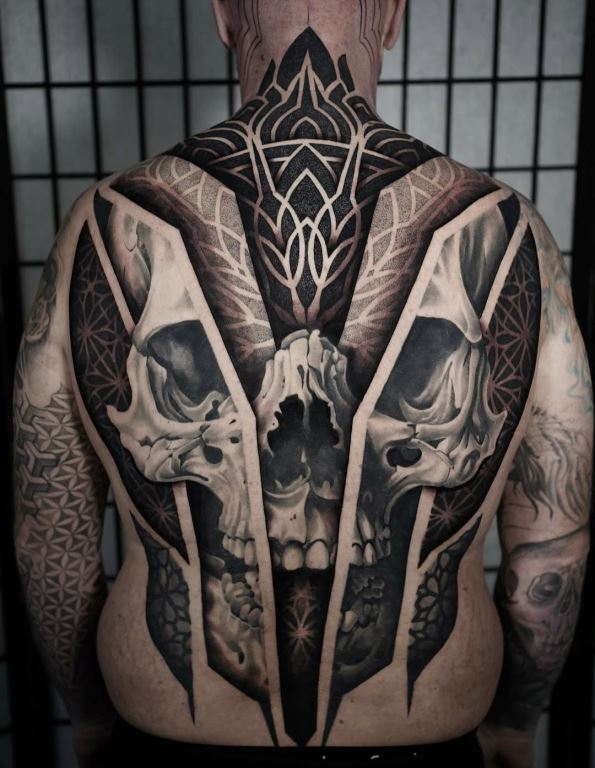
Q: Many artists start with 'traditional' styles. How long
did it take for you to move away from general tattooing and find
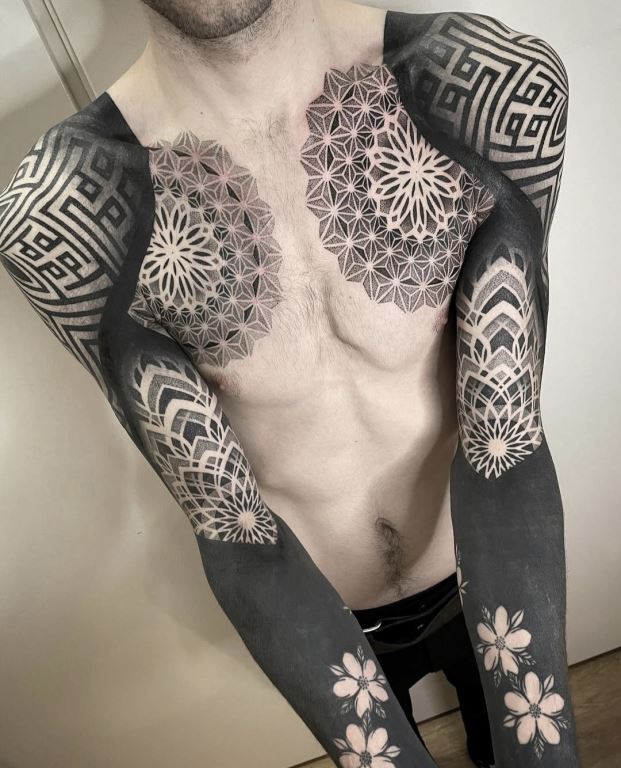
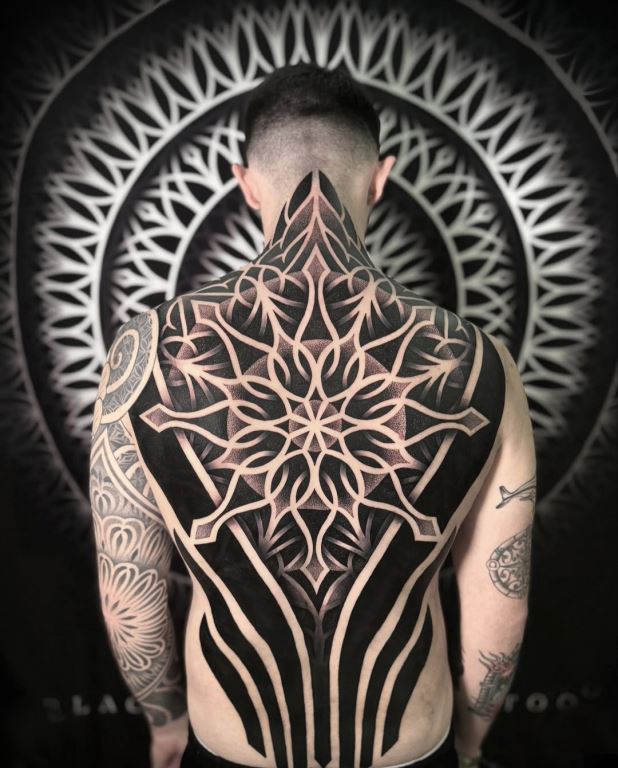
your calling in such complex, technical Geometric and Blackwork
designs?
A: I’d say around five years into my career was when I started
experimenting with the geometric style. I’d noticed it starting to
gain popularity online from artists such as Dillon Forte and Corey
Divine from the USA and something about the intricate detail
resonated with me. At the time I was drawing neo-traditional designs
with lots of color but desided to start including mandala work and
snippets of patterns into my designs. This slowly snowballed and the
more tattoos I began to do in this new style, the more popular they
became and the more requests I received for them. From there, I
stated to draw my designs bigger and more detailled. I was drawing
sleeves and back pieces instead of one hitters and my style started
to evolve from there.
Q: Your work is famous for the way it flows with the body's
natural lines. When you look at a blank 'canvas' like a back or a
leg, do you see the patterns immediately, or is it a long process of
mapping out the muscle structure first?
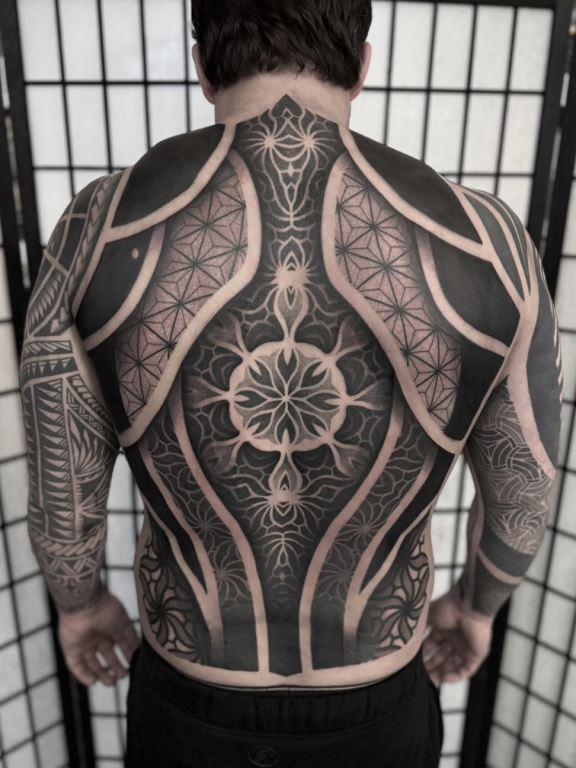
A: I like to draw a design to use as a reference so we have
something to go with. If I’m tattooing a leg sleeve, I might just
design the front and back of the leg and then have the idea in my
mind of how they connect, at this point I like to freehand the
design to make it work with the individual body shape of my client.
I’ll often refine or change the design as we go as I feel that the
flow is the most important part of the design. All of the elements
that I use, the patterns and mandalas, there’s room for change there
so I like to work with the client and let them have some input into
the design too, it’s their tattoo afterall so I don’t like to
dictate the entire piece to them. Often their suggestions might give
me a new idea or direction to take the design.
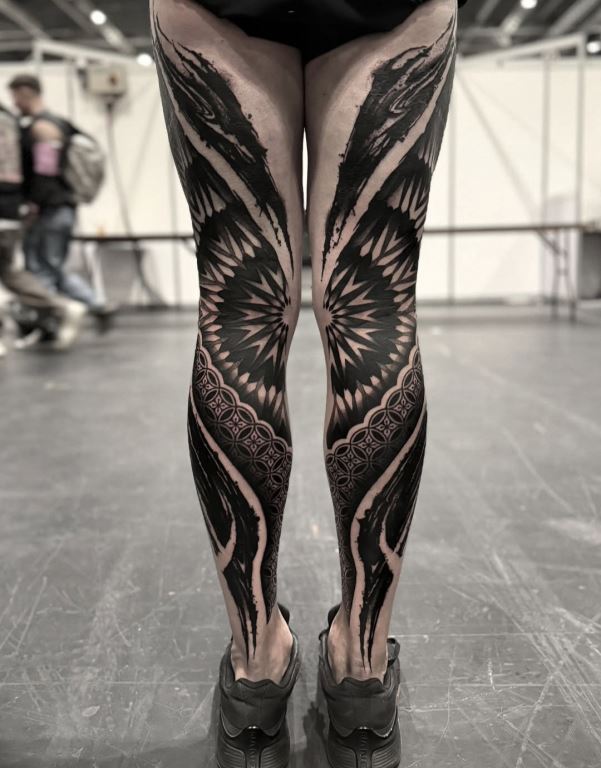
Q: You use heavy saturation and negative space brilliantly.
What is the most common misconception people have about large-scale
blackwork tattoos?
A: I’d probably say is that a lot of clients often expect the
blackwork sections of the tattoo to take a lot longer than they
actually do. I think a lot of my clients are scared of having too
much black in their design. I love to use a lot of black and high
contrasting in my designs. The black helps to balance the lighter
tones and also add weight against the areas of the skin that I leave
negative. One of the most common things clients say to me is that
they dont want ‘too much black’ in the designs but it’s essential to
make some designs work. I always say that the more black they have
in a design, the quicker it’s gets done and that means that
ultimately they’re saving money haha. That’s one way I try to
convince them to have more black!
Q: With geometric work, there is zero room for error. How do
you maintain your focus and precision during those grueling
6-to-8-hour sessions?
A: I’d probably put it down to experience. I’ve done this style for
so long now that it becomes second nature and I don’t struggle to
maintain focus. I also don’t see my work as ‘work’ so it’s always
easy to get lost in a project when you’re really enjoying yourself!
Q: Geometric tattoos require extreme precision. How do you
adjust your line weights and dotwork density to ensure that these
intricate patterns stay sharp and don't 'blur' as the tattoo ages
over 10 or 20 years?
A: I could talk for hours about this one so I’ll keep it short and
simple. I use a mixture of regular needles and cartridges, pen
machine and Dan kubin machines. I let the machines do the work and I
don’t put much pressure behind my hand. But it all comes down to
experience and knowing what machine and needle set up to use when
working with different skin types and on different body areas. It’s
inevitable that all ink will bleed slightly over time but if you get
it into the skin efficiently and with as little trauma as possible
the you’re giving the ink the best chance of holding true over time.
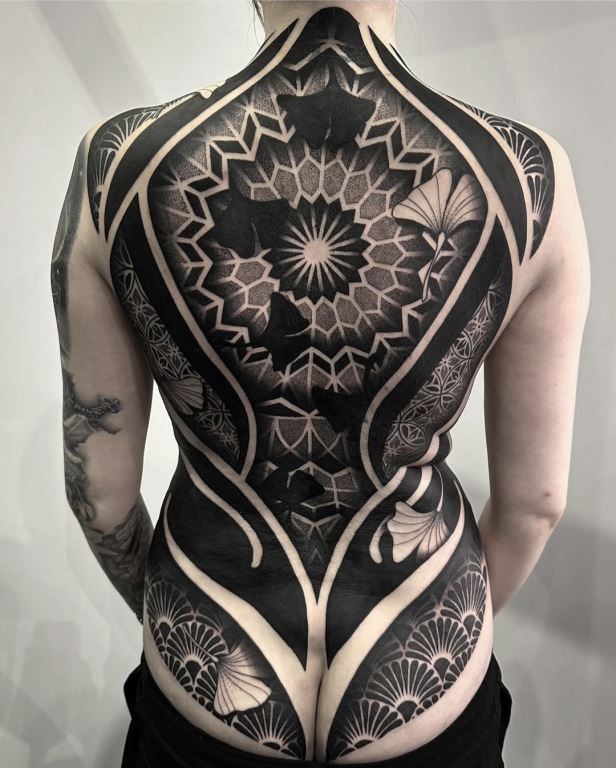
Q: Sacred geometry is rooted in universal laws and spiritual
history. Do you see your work purely as a visual 'ornamental' craft,
or do you incorporate specific spiritual meanings into the patterns
you choose for your clients?
A: I’ll hold my hands up and say I’m in no way spiritual at all. I
just really enjoy the way that this style interacts with and
compliments the body’s natural shape. I guess it is quite meditative
when you’re doing a long dotwork session and it’s always nice to get
into the rhythm, but ultimately I just love the way the finished
tattoo looks on the body.
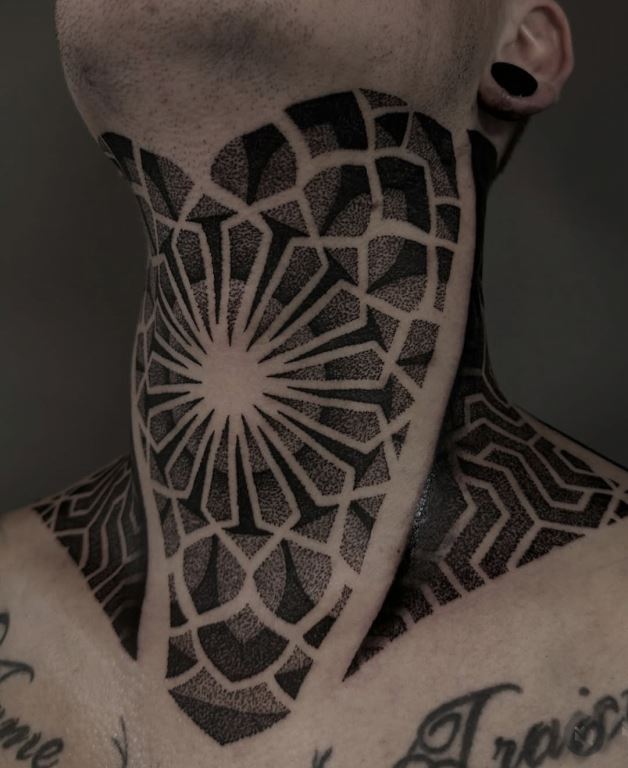
Q: Sometimes you use very fine dotwork gradients, and other
times bold, thick linework. What dictates that choice, is it the
size of the body part, or the 'energy' of the design you’re trying
to create?
A: I like to use a variety on needles and techniques to create
different textures and effects in the skin. If I’ve had a week of
doing mostly dotwork tattoos, then I’ll suggest to my next client
that we incorporate some heavier work using linework or darker
sections, this is in part to keep things varied for me to keep it
interesting and also so I don’t forget how to pull clean lines haha.
But no, sometimes we will choose the next part of the design based
on what we’ve already tattooed in the previous session. I like to
use patterns and mandalas that complement each other and fit the
area of the body that we’ll be working on.
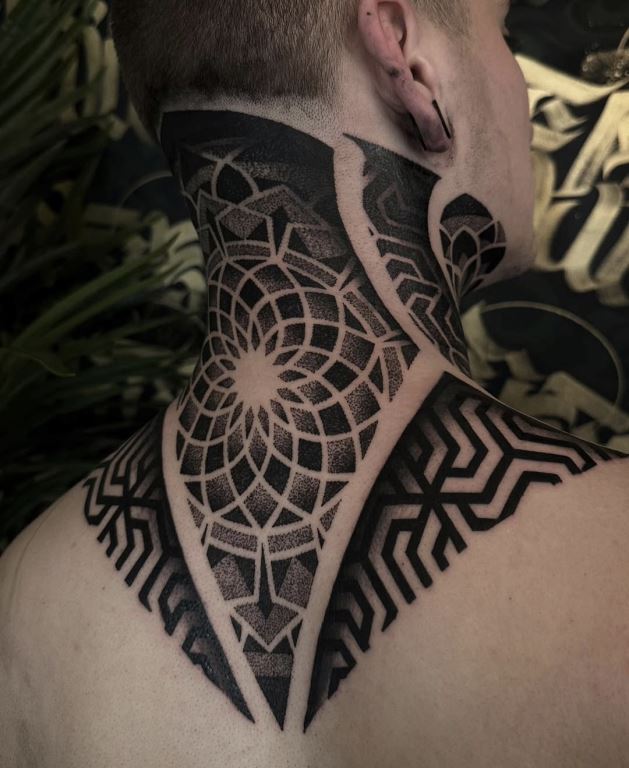
Q: If we look at your portfolio from five years ago compared
to today, the scale has grown significantly. Is your style naturally
trending toward 'full-body' suits, or do you still find beauty in
the smaller, geometric pieces?
A: I’ve intentionally tailored my style and workflow to cater
towards the larger pieces. In the past when I opened my diary I
would always book in the larger day sessions first and then any
smaller projects got whatever spaces I had left. I also only started
designing larger scale tattoos to help push my work in that
direction. I much prefer putting all of my focus into one piece per
day. I really enjoy watching a project evolve and making connections
with the client as the sessions progress, it gives me great
satisfaction when the piece is complete and all of the dedication
that your client has given finally pays off and they can see your
vision and the finished tattoo on their skin! I’d love to do a full
body suit but it’s extremely rare to find a client willing to given
their whole body to one artist, but hopefully one day I’ll have the
opportunity!
Q: There is a certain boldness almost a "warrior" feel to
heavy blackwork. What kind of energy or feeling do you want a person
to project when they are wearing one of your massive blacked-out
geometric pieces?
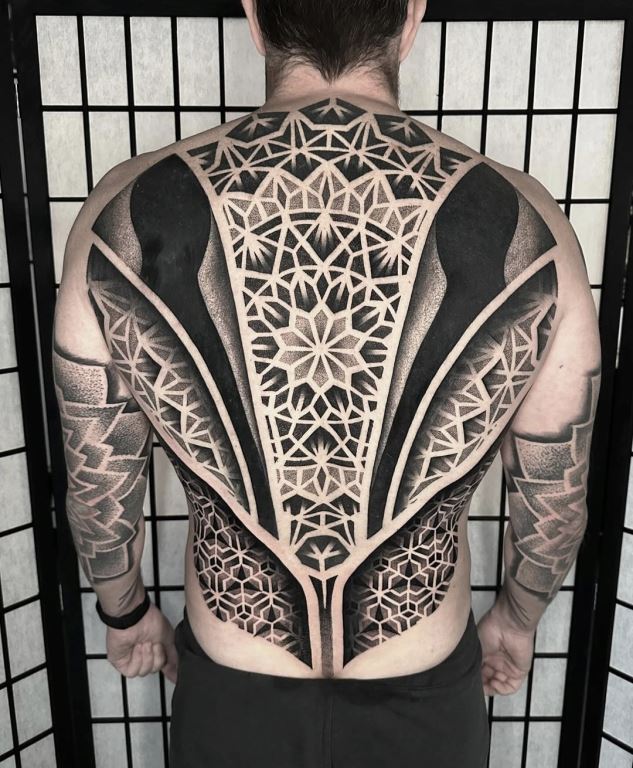
A: Exactly that! I feel like the solid blackwork/neo-tribal style
looks awesome on the skin and it definitely gives off a feeling of
wearing ‘armour’. I’ve even begun my own heavy blackwork blastover
bodysuit project with a Japanese twist. My good friend
@mistercoletattoo is the guy who’s doing it for me. We used to work
together and he’s been tattooing me for so long that he’ll actually
be covering his own work with this new blastover project! Sitting
through the sessions myself reminds me of the dedication that my
clients show me every day. It’s a humbling thing to go through.
Q: Trends in tattooing come and go, but geometry has existed
for thousands of years. Do you choose this style because you want
your work to look as relevant in 50 years as it does today?
A: Referring back to an earlier answer, I’d say that it was the
geometric style that chose me, rather than the other way round. I
began using small bits of pattern work in my designs here and there
and then that just snowballed into the style which I’m now known
for. But I also do agree with you that geometry and pattern work has
existed amongst all civilisations for millennia so I feel that it
will stand the test of time and look as bold, powerful and relevant
in 50 years as it does now. I've experimented with other styles in
the past but have always felt that dotwork and geometry is where my
passion lies and that’s why I’ll continue honing my skills and
perfecting my designs and techniques in this style of tattooing.
Q: Because your work is so large and specific, clients have
to give you a huge amount of trust. How much of the "soul" of the
client goes into the pattern, and how much of it is your own
artistic expression?
A: Whenever I present a design to a client, I’ll always say that the
patterns or mandalas that I’ve chosen for the design can be
substituted for ones that they feel more connected with. As long as
they like the overall feel and flow of the design then I’m happy to
collaborate with them and we can switch out certain elements for
others as we make progress through the tattoo. I’ll give them my
input and opinions as to why I think some things work and some
things don’t. If there’s anything I’m strongly opposed because I
know it’s not going to work right for the design or for that
particular body place then I will put my foot down. But ultimately I
feel that my clients do value my opinions and take my advice on
board and that’s something that I’m very grateful for.
Q: When you aren't looking at skin, where do you find your
patterns? Are you looking at cathedral architecture, patterns in
nature (like honeycomb or shells), or perhaps ancient textiles?
A: All of the above! As I’m answering these questions I’m currently
on holiday with my wife in India. I’ve seen some awesome inspiration
in the old Portuguese architecture in the Kerela region and from
patterns in fabrics and textile shops! As tattooing is such a huge
part of my life, subconsciously I’m constantly on the look out for
inspiration wherever I am.
Q: You’ve collaborated with many different artists. What is
the most surprising thing a fellow artist from a completely
different style (like realism or traditional) has taught you about
your own aesthetic?
A: One of the most surprising things I’ve picked up from artists
working in completely different styles is how much emphasis they
place on fundamentals. Watching realism artists work, they’re
incredibly disciplined with composition, placement and knowing when
to stop. It made me look at my own work and question whether certain
elements actually needed to be there, or if I was just adding
complexity for the sake of it. Pulling things back and being more
intentional with every line has only strengthened my aesthetic.
Different styles on the surface, but the mindset behind them is very
similar.
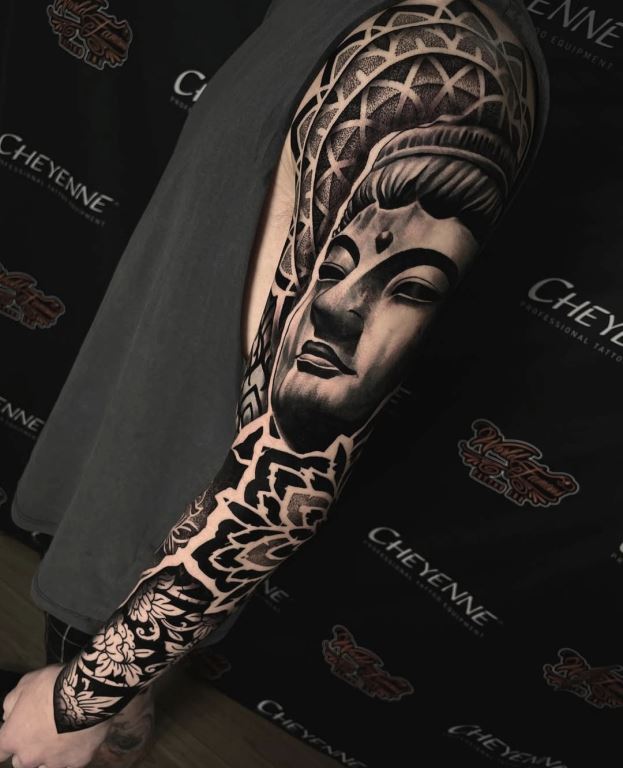
Collaboration Tattoo with Rich Harris
Q: You do a lot of large-scale work that covers significant
portions of the body. Have you noticed a shift in your clients'
personalities or confidence after they undergo such a massive
physical transformation?
A: It’s quite hard to answer as it’s always bittersweet when I
finish a large project. Often that’s the last time I’ll see that
client again or at least for a very long time before they decide to
book back in for another tattoo. I’ve covered some heavy scarring or
self-harm scars in the past and you can see that the client is
extremely happy that they are moving on from their old self and have
this new piece of art to solidify their transformation. It’s a great
thing to be part of. I often get clients message with healed photos
or saying how they’ve had tons of compliments, at the end of the
day, as long as they’re happy with the tattoo then so am I!
Q: Is there one specific client story that stands out,
perhaps someone who underwent a major life change or found a new
sense of identity through the tattoos you gave them?
A: Linking back to the last question. I did a peony/mandala sleeve
on a client to cover some heavy self harm scarring. A few years
later and they returned to have their other arm tattooed with a
similar but heavier design, again to cover self harm scars, and
during the time between both sleeves they had transitioned. I like
to think that the tattoos helped during this difficult time in my
clients life and that they will act as a reminder to them of their
strength and courage.
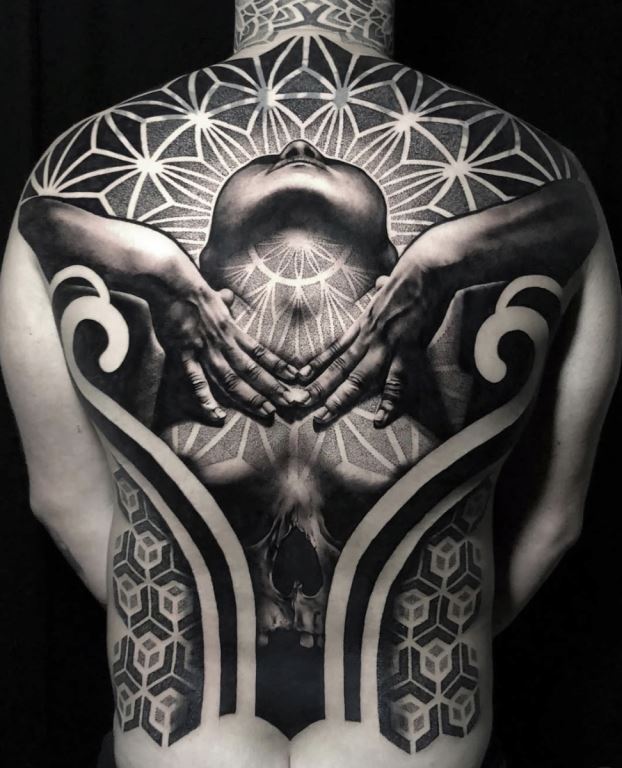
Collaboration Tattoo with Rich Harris
Q: Blackwork is intense on the skin. Do you have a
'signature' aftercare routine you swear by to ensure those deep
blacks stay solid and don't get patchy during the peeling phase?
A: Dry healing and drinking plenty of water! I use tattoo armour
pads for the first 24 hours to allow the skin to expel excess ink,
blood and plasma. I then ask my client to keep the tattoo clean and
dry for 4 days, after this time they can apply a small amount of
aftercare cream. All throughout the healing process they should
drink 3 litres of water daily. This way of healing has delivered the
best results in my personal experience so I’ll continue to give this
advice to my clients.
Q: You founded Black Tapestry Tattoo in 2022 with a focus on
"comfort and practicality." What was missing from the shops you
worked at previously that you felt was essential to build for your
own clients?
A: As you mentioned, the tattoos I’ve created have gotten bigger and
older over the past five years. The previous studio I worked in was
amazing and the team was the best but the tattoo work area was just
too small for the tattoos that I was doing. I often need my client
to change positions throughout the day and this got quite tricky due
to the limited space and the set up in that studio. For me to be
able to create the best work that I can, I need plenty of space,
certain tattoo furniture (I use a plinth bed as I often stand up to
tattoo which is helpful during long sessions) lots of natural light
etc etc. ultimately I was ready to create a workspace that was
tailored to my way of tattooing that would be comfortable for both
myself and my clients and I feel that I’ve achieved that at Black
Tapestry.
Please write down your studio location and website/social
media links. Also let us know if you are available for bookings.
Black tapestry tattoo
23 Wharf Street
Deptford
London
SE83GG
www.bintt.co www.blacktapestrytattoo.co.uk @bintt and
@blacktapestrytattoo
My diary for April-June opens on February 1st (I open it every 3
months)
Q: Moving from a resident artist to a shop owner is a
massive career shift. What has been the most surprising challenge of
managing a team and a brand versus just focusing on your own
needles?
A: Juggling my time! For the first year and a half I managed the
entire shop, from the cleaning to the emails and the social media,
to the marketing and the branding, even organising the bills,
licensing and other expenses was very demanding, it took a lot of my
time and I felt like I was working 7 days a week for a while! All of
that is necessary if you want to create something truly unique to
your vision, it’s also extremely rewarding seeing all of your hard
work pay off. We now have a studio manager who can help with all of
the admin side of running the business so that I can focus more on
tattooing and designing again. The artists I work with are amazing,
we all organise our own diaries and social media so they don’t need
much managing from my side. We all just get on with it and enjoy
what we’re doing and I can’t ask for more than that!
Q: You now offer 12+ hour online courses and in-person
seminars. At what point in your 15-year career did you feel "ready"
to start teaching others? Was there a specific moment where you felt
you had mastered the craft enough to mentor?
A: I’ve attended quite a few workshops and seminars from other
artists and one of the reasons I wanted to open my own studio was so
that when I was ready, I would have the space to host my own
seminars. In all honesty I still have a bit of impostor syndrome and
never really felt like I should be teaching other people, but quite
a few artists asked me if I would ever be doing a seminar, and I’d
seen other artists from different backgrounds with a similar amount
of experience to me hosting their own seminars so I thought f*** it
I’ll give it a go! I spent a long time figuring out what I was going
to talk about and how to plan the day, and I got some great feedback
from my first workshop but I felt that I didn’t have enough time to
properly share everything I wanted. I then went to @blacksymmetry
3-day workshop in Portugal to see how he delivered his information.
It was great to see his ethics, passion and workflow and it gave me
the confidence to extend my workshop into a 2-day event. I try to
host one every 4-5 months at the studio and I plan to take a few
extra days off tattooing this year so I can improve my workshops and
add as much value to them as possible. I would say that teaching
people also drives me to learn more myself, not just to understand
the ‘how’ but also the ‘why’. It’s a really exciting way to keep
pushing myself to evolve not just as an artist but also as a person.
Q: The tattoo industry used to be very secretive. Why do you
believe it’s important for modern masters to be transparent and
share their technical workflows (like stenciling and voltage)
through digital platforms?
A: I think that by sharing knowledge and experience, we elevate the
entire tattoo industry as a whole. Artist take their craft more
seriously, they invest time and money into themselves, their level
of tattooing gets better and ultimately their clients see this,
appreciate it and then benefit from it. It’s about delivering the
best tattoo possible for your clients. Showing that you are
confident, understanding their skin, reducing trauma and giving them
a great experience. I recently requested to participate in a
workshop but the artist refused me on the basis that I teach my own
workshops. I’m not sure why this made a difference to them but I
feel that gatekeeping information isn’t beneficial for the industry.
If an artist is willing to invest in themselves to learn certain
techniques so they can improve their own work, but then they are
denied this education, they may just attempt the tattoo regardless
and damage the client's skin. Sharing knowledge is a great way to
ensure that artists who are serious about this industry and
passionate about their craft can grown, improve, and continue to
share this great art form that we call tattooing!
Q: You are a regular at conventions like Milano and
Brighton. How does the "pressure" of tattooing at a major convention
in front of hundreds of people compare to the quiet focus of your
London studio?
A: I’ve done plenty of conventions now and the most important thing
is being prepared. At conventions I’ll try to do either a front/back
piece which is easy to stencil and doesn’t require my full studio
set up. If I’m not doing one of these projects then I’ll just
continue on something I’ve already outlined. It’s important to make
sure that your convention is as stress free as possible. Make sure
that you have all of the equipment that you’ll need so you don’t
come unstuck. If you’re well prepared then you’ll be calm and the
tattooing part just comes naturally. I don’t really get nervous
tattooing in front of people as I’m confident in my ability and I
try to just enjoy the atmosphere, meeting new artists and talking
tattoos!
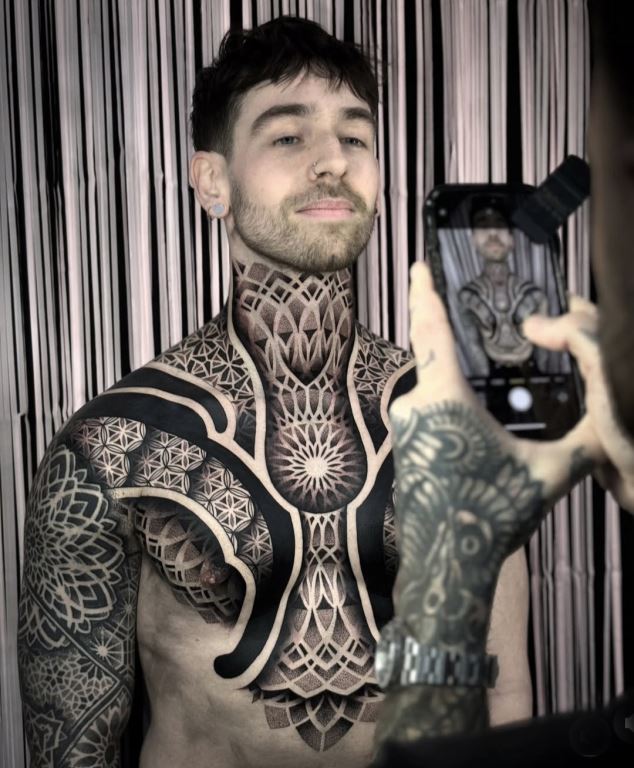
Q: You recently won 1st place for a "Large Ornamental
Tattoo" at UK Tattoo Fest. Does winning awards still give you the
same rush as it did when you were starting out, or has your
definition of "success" changed over the years?
A: I’ll be honest, I am quite competitive. This is one of the
reasons I love to attend conventions, not only to network, talk
tattoos and soak up the vibes, but also because I want to win
something haha! I’m sure it’s the same across all tattoo styles but
I genuinely do believe that everyone I’ve met in the ‘geometric’
scene are all really lovely people, very genuine and I’ve made some
great friends through tattooing. I’d say that ultimately success
isn’t just down to the awards you’ve won but also down to the
friendships you’ve made, the influence you’ve had and the respect
you’ve gained, and I believe that this applies - whatever career
you’re in!
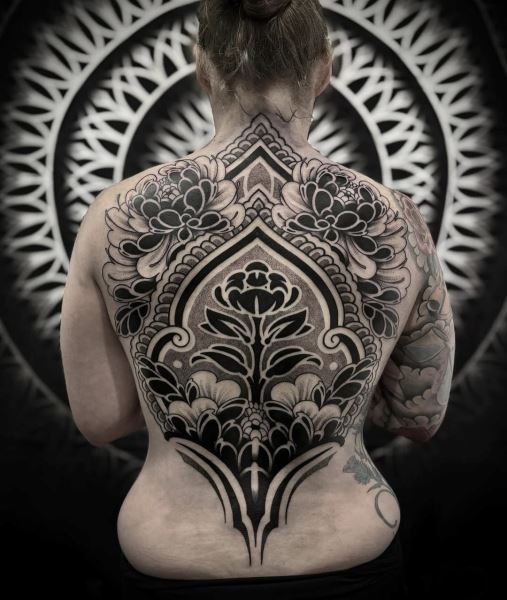
Q: You’ve built a massive following in the UK and Europe.
How do you perceive the US tattoo scene compared to the London
scene? Is there a specific American city whose architecture or art
scene inspires your geometric patterns?
A: I think that the US scene is kinda of like the UK scene but on
steroids! There’s just 10x the amount of amazing artists and 50x the
amount of clients ready to give you their skin! It seems that
clients in the US are a bit more open to heavy blackwork and large
scale pieces than they are here in the UK. I follow a lot of artists
from the states and some of the tattoos they’re posting are just
insane. I’d love to have clients willing to go bigger and bolder
with their tattoos but I think people here in the UK are a little
more cautious about jumping into the bigger projects. I’ve been to
Miami with my wife on our honeymoon and the art-deco architecture
there is amazing! All the buildings look so retro and colorful, the
angles and geometry of some of the buildings, I could look at them
all day!
Q: If you were to open a second location for Black Tapestry
Tattoo in the States, what kind of vibe or environment would you
want to create there?
A: I’d love somewhere overlooking massive rolling hills or the sea.
Lots of natural light and huge windows inviting the calming aspects
of nature inside. I’d love a large space with lots of inspirational
artwork, giving room for ideas to develop and grow. The building
that my studio is in here in London is right on the River Thames but
unfortunately my room doesn’t look onto the water.
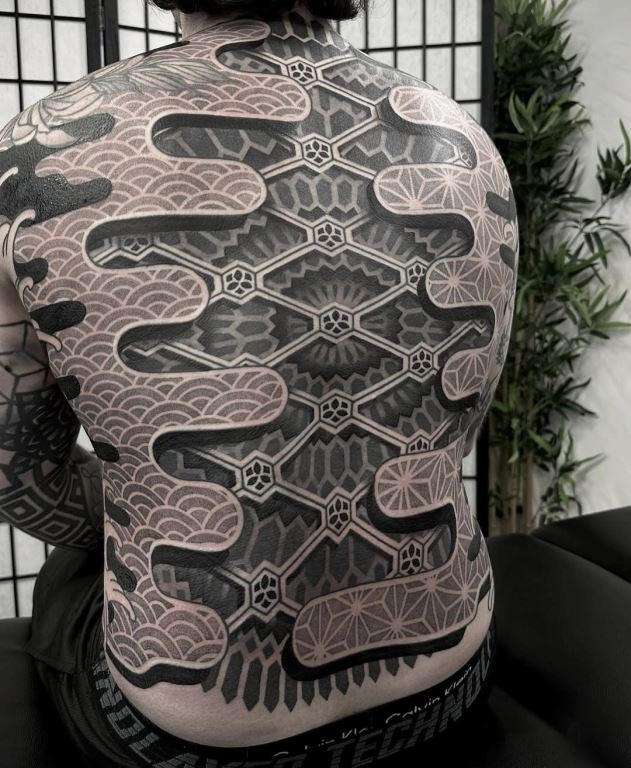
Q: Many artists see a 'New York Residency' or a 'Los Angeles
Studio' as a career milestone. Is a permanent or long-term presence
in the USA a goal on your current roadmap, or do you prefer the
'traveling artist' lifestyle?
A: I also share that view of the states being a career milestone!
This is one of the reasons I’m applying for my American visa at the
moment. I’ve tattooed in the UK for 15 years now, I’ve even had a
couple of clients fly over from the states to be tattooed by me.
I’ve worked countless conventions, won a few awards, hosted
workshops and now feel that I’m ready to take my work further afield
and accomplish some new goals! I don’t have a plan to move to the
states, not yet anyway. My wife and I have just bought a house and
we have a few animals to look after, but I’d never say never! If her
work ever opened an office in the US then I’d be super keen to move
out there for a couple of years! But for now, I just plan to visit
for a couple of weeks every few months and see how it goes!
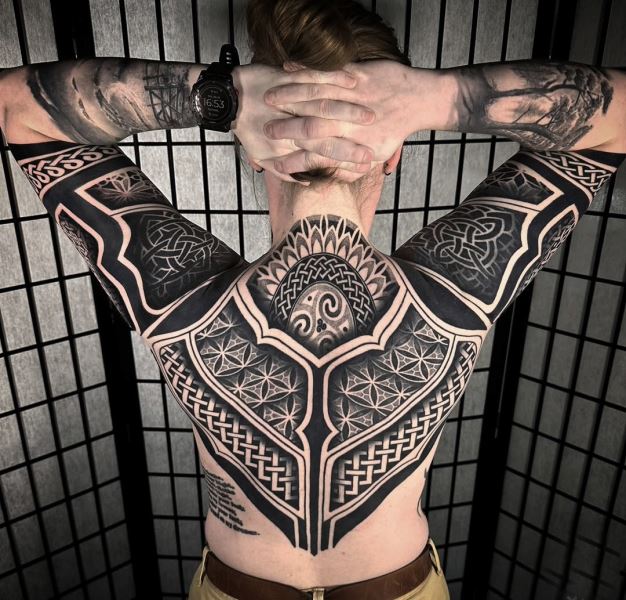
Q: Are there specific American studios or legendary artists
you are looking forward to collaborating with once your visa is
finalized?
A: Too many to name! I’d love to work with Mitch Kotch at the Sleepy
Reaper, his work is dope. My buddy Neeno has a studio near Niagara
Falls. He’s awesome and his work is similar to mine so I think a
collab would look mega, I’d also love to visit the Falls so I can
kill two birds with one stone! I’d also love to work at Russ Abbotts
studio, Ink and Dagger in Roswell, he’s a legend and has done so
much for the tattoo scene. Other artists include Cassady Bell, Brad
Wooten, Nathan Mould. There’s a few other studios such as The Grand
Reaper, Black Vulture Gallery and Tattoo Temple to name a few!
Q: Beyond just tattooing, what do you want your professional
legacy in the United States to be?
A: Beyond tattooing, I’d like my legacy in the US to be about
contributing something meaningful rather than just passing through.
I don’t really have any interest in being seen as a ‘celebrity’
tattooer. For me it’s more about building genuine relationships,
collaborating with artists I respect, and sharing knowledge where
it’s useful. If people associate my name with solid work,
consistency, and someone who helped raise the standard, whether
that’s through teaching, collaboration, or just showing up and doing
the work properly, then I’d be more than happy with that.
Interview: Ivana Kancheska
Date: 20/01/2026


