
Interview with Cindy You
The landscape of 2026, tattooing has moved far
beyond traditional boundaries, becoming a sophisticated dialogue
between the human form and digital-age aesthetics. Standing at the
forefront of this movement is an artist whose work feels less like
ink on skin and more like a second, shadow-infused anatomy. Based in
the heart of the U.S. scene but possessing a vision that feels
global, Cindy You mastered a style that is incredibly delicate.
Looking through her portfolio a striking collection of heavy
blackwork, liquid-like silhouettes, and intricate ornamental
geometry one is forced to rethink what is possible with a single
needle and a deep understanding of negative space. Her designs don’t
just "sit" on the body; they wrap, flow, and evolve with it,
creating a sense of permanent motion. Welcome Cindy You! Thank you
for taking the time to do this interview.
Q: Your current work has such a distinct, surrealist 'melt'
to it. When you first started, were you always drawn to this dark,
distorted aesthetic, or did you have a more traditional 'Old School'
beginning?
A: Actually, I started my tattoo journey in a fine line shop in New
York City, where I completed my apprenticeship. That experience
shaped my approach significantly, which is why many of my designs
still carry fine line elements. Fine line tattoos have a very
delicate and refined quality. They feel elegant, precise, and almost
whisper-like on the skin. I really appreciate that subtle beauty. At
the same time, I sometimes feel this kind of work can be too
visually quiet. Unless you look closely, the design can almost
disappear from a distance. Because of that, I started pushing my
designs toward stronger shapes and bolder visual structures. I still
keep the elegance and precision of fine line work to create
contrast, but I want my designs to carry more presence, something
delicate up close, yet powerful enough to command attention from a
distance.
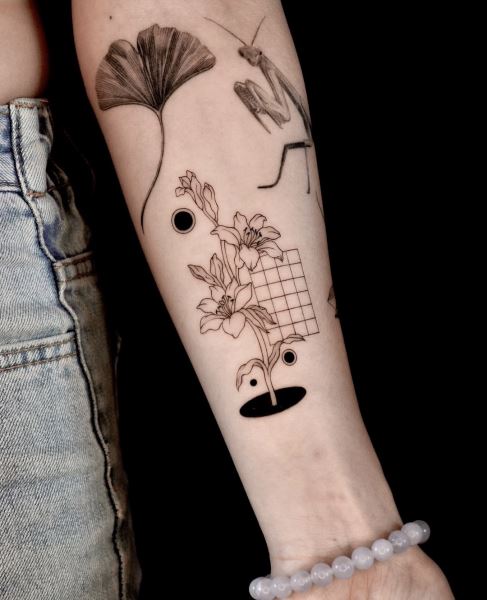
Q: Your tattoos follow the human anatomy
so perfectly specifically those large-scale chest and limb pieces.
How much of that is meticulously planned digitally, and how much is
freehanded to fit the specific 'topography' of the client?
A: For larger pieces, I usually start with a digital sketch to plan
the overall composition. But when designing tattoos, the first thing
I always consider is the placement. The body really determines how
the design should move and flow.
My training in art school also gave me a strong foundation in
drawing, which allows me to adjust the design directly on the skin.
Sometimes I redraw or freehand parts of it so the tattoo responds
better to the client’s anatomy, making each piece unique. Digital
planning gives me a starting point, but the final composition often
happens on the body. My goal is always to make the tattoo feel like
it naturally belongs there.
Q: Tattooing is as much about physics as it is about art.
What was the hardest 'technical' hurdle you had to clear during your
apprenticeship to allow your creative vision to finally flow?
A: During my apprenticeship, the hardest technical challenge was
learning how to control the machine and achieve consistent line
quality. Tattooing might look similar to drawing, but the skin
behaves very differently from paper. You have to understand the
right depth, hand speed, and needle pressure simultaneously. For me,
the biggest difference between tattooing and drawing is controlling
the depth. When I draw on paper, I can use pressure to change the
thickness of a line. Tattooing works differently, I need to ensure
the needle depth stays consistent with every line. Otherwise, after
healing, the line can look broken or patchy. It takes a lot of
practice to develop that level of control. Once those technical
fundamentals became more intuitive, it finally allowed my creative
ideas to flow more naturally in the work.
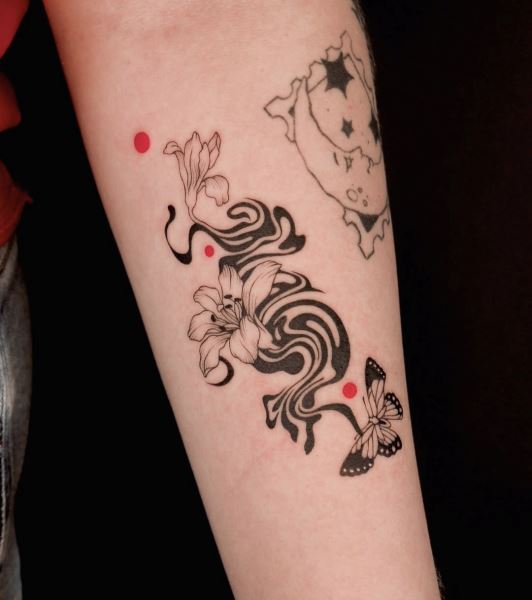
Q: At what specific moment did you stop
feeling like a student and start feeling like an artist with a
distinct voice that people were specifically seeking out?
A: I think that shift happened gradually rather than at one specific
moment. In the beginning, like many apprentices, I was mostly
focused on learning the technical side of tattooing and trying to do
things correctly. Over time, I started noticing that some clients
were coming to me specifically for my designs rather than just for a
tattoo. They were interested in my style and were willing to trust
my ideas and compositions. That was the moment I realized people
were not only looking for a tattoo, but for something that came from
my perspective as an artist. I still remember my instructor, Yuko
Shimizu, said in college: “Your brain cannot be stolen.” I think
what really makes an artist different is the way they build their
own way of thinking and seeing the world. When clients begin to
trust that vision, it gives you the confidence to develop your voice
even further. That’s when I started to feel less like a student and
more like an artist with my own direction.
Q: Blackwork has evolved massively in the last few years.
How do you define your specific niche within this 'dark' aesthetic,
and how do you keep it from feeling like a trend?
A: I see my work as a mix of blackwork and organic abstraction. I’m
interested in using bold black shapes and flowing lines to create
designs that move naturally with the body. Instead of treating the
tattoo like a flat image, I think about how it wraps around muscles
and bones, almost like it grows with the anatomy. In my work, the
“dark” aesthetic is less about being aggressive or heavy, and more
about structure and contrast. Adding black isn’t just about making
something darker. It’s really about building structure, creating
contrast, and balancing light and shadow within the composition. At
the same time, I’m always trying to evolve my designs. I constantly
update my visual language and experiment with different elements
because I want each piece to feel unique and original. I try not to
repeat myself or create designs that feel generic. I’m not
interested in following trends. If anything, I hope my work can
develop its own direction. I don’t want to become part of a trend,
if there has to be a trend, I would rather create one.
Q: Getting black that solid and 'velvety'
is a feat of engineering. Do you have a specific ritual or technique
for packing pigment to ensure it heals without patchiness,
especially on those massive blackout sections?
A: Packing solid black smoothly is definitely one of the more
technical parts of tattooing. For large blackout areas, I focus a
lot on consistency making sure my machine speed, hand speed, and
needle depth stay very steady throughout the process. Overlapping
passes and keeping the hand movement even helps the pigment settle
more evenly. Skin tension and stretching are also very important,
especially for large areas. In the end, achieving that smooth,
velvety black really comes down to patience and experience. You
learn to read the skin and adjust your technique so the tattoo heals
solid and even without patchiness.
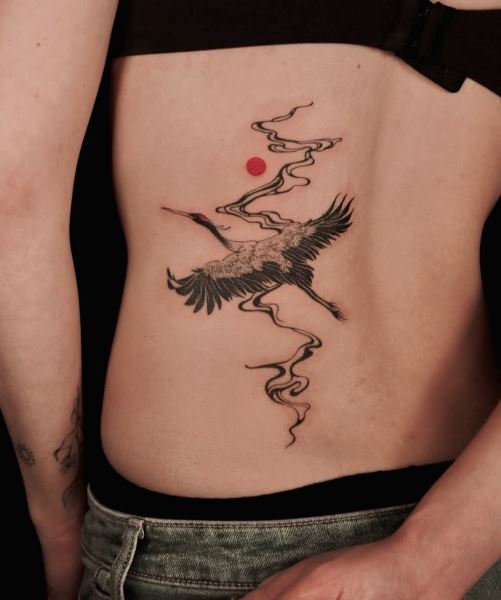
Q: I see a lot of architectural flow and
organic textures in your work. Who are some artists outside of the
tattoo world that fuel your imagination?
A: A lot of my inspiration actually comes from outside the tattoo
world. Two artists who have influenced me a lot are Piet Mondrian
and Aubrey Beardsley. I remember seeing Mondrian’s work at the
Museum of Modern Art, and I was really amazed by how powerful such
simple geometric shapes could be. With just lines, rectangles, and a
very limited color palette, he was able to create a strong sense of
balance, rhythm, and structure. Beardsley’s work, on the other hand,
features a very dramatic use of black and white. His bold contrasts
and flowing lines show how expressive black ink can be. Even though
my tattoos are more organic and fluid, these influences shape how I
think about composition, contrast, and structure balancing strong
graphic elements with movement so the design flows naturally with
the body.
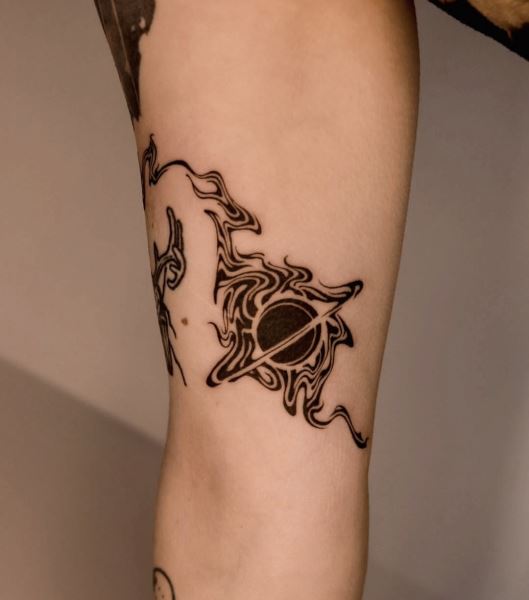
Q: We've seen 'Blackout' tattoos evolve
from cover-ups to a primary art form. Where do you think this
'all-black' movement is going next? Are we going to see more
white-on-black layering or more focus on textured 'skin-breaks'?
A: I think blackout tattoos have already moved beyond being just
cover-ups. More artists are starting to treat them as a primary
visual language, where black becomes the foundation of the
composition rather than just a background. In today’s
hyper-connected world, aesthetics can’t remain singular, what
resonates with people is always evolving and becoming more diverse.
Moving forward, I think we’ll see exploration in many different
directions. Some artists are experimenting with white-on-black
layering and graphic contrasts, while others are focusing more on
textures and intentional skin breaks, allowing the natural skin tone
to become part of the design.
Q: Any favorite tattoo you did recently?
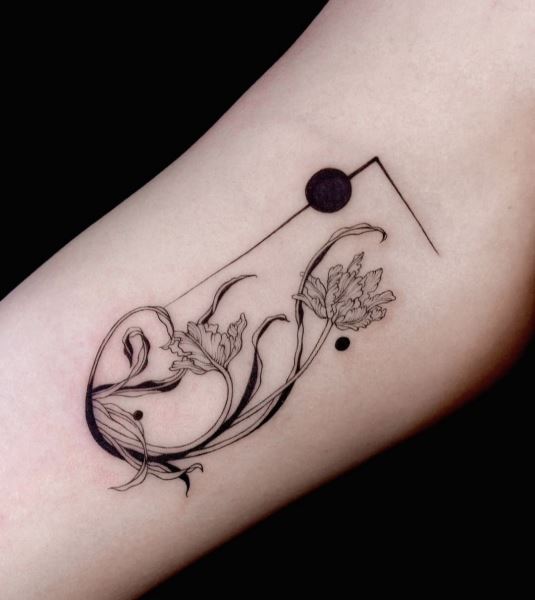
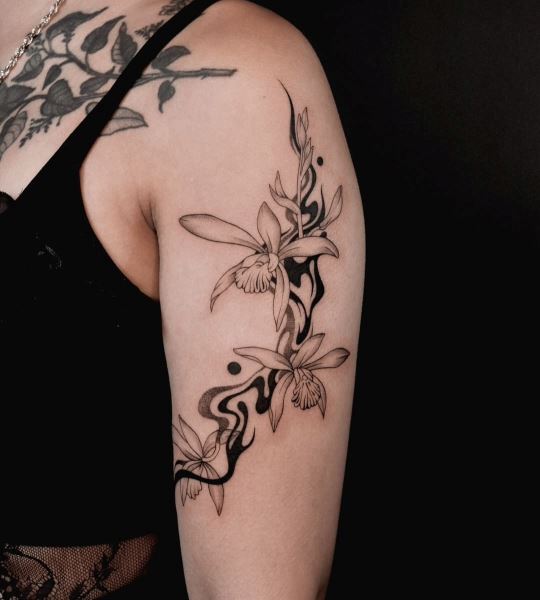
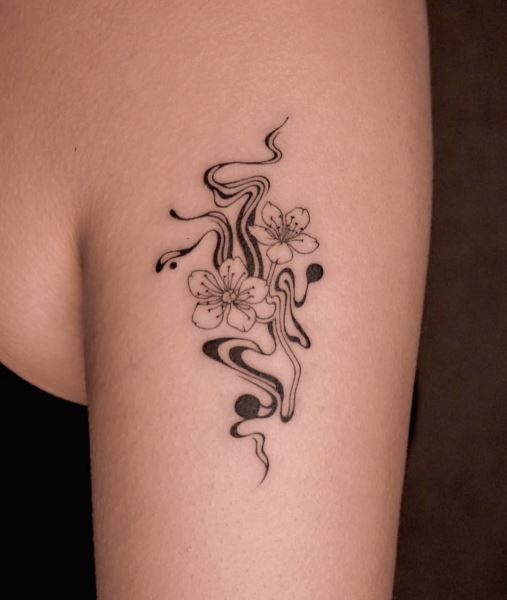
A: One of my favorite recent pieces is a floral design I did on the
upper arm. When the client first picked it, it was actually a flash
design, but I customized it slightly to make sure it flowed
naturally with the placement and the shape of the arm. I really
enjoyed how the composition follows the curve of the shoulder and
arm, allowing the design to move with the body rather than sit flat
on the skin. In this piece, I combined delicate botanical elements
with organic black shapes. The flowers bring a sense of softness and
detail, while the flowing black forms create structure and movement.
I like the contrast between the light, airy linework and the solid
black areas; it gives the tattoo both elegance and visual strength.
For me, designing tattoos that adapt to the body is always the most
rewarding part of the process.
Q: A lot of your pieces look like organic
shadows or fluid ink dropped into water. Is there a specific
'glitch' or 'liquid' element you try to achieve that separates your
work from the more rigid, geometric side of the (Post-Modern
Darkness) PMD movement?
A: I really appreciate the PMD movement. Many artists in that style
use geometric shapes in a way that still follows the natural flow of
the body, and I learned a lot from studying how they integrate
structure with anatomy. When I experiment with adding geometric
elements into my work, I often think about those approaches. At the
same time, I personally tend to work more with fluid and organic
forms. The human body is full of curves and movement, so I’m
naturally drawn to shapes that feel softer and more adaptable, forms
that look like shadows, liquid ink, or something growing along the
body.
Q: PMD requires a 'velvet' level of black saturation. In the
current USA scene, where styles are constantly being copied and
diluted, what are the technical 'secrets' to achieving that
perfectly healed, deep-space black that defines the top tier of this
school?
A: Consistency is the most important part, maintaining stable
machine speed, hand speed, and needle depth throughout the process.
Every client’s skin behaves a little differently, so you have to
constantly adjust your technique to make sure the black heals evenly
and stays solid over time.
Q: PMD collectors are often very
dedicated. How much of these massive, abstract layouts is a
collaboration with the client’s personal 'vibe,' and how much is you
having complete creative freedom to 're-sculpt' their body?
A: I think it’s always a balance between the client’s vision and my
creative direction. Most clients come to me because they already
connect with my aesthetic, so they usually trust my judgment when it
comes to the design. If a client has a very clear vision, I’m happy
to follow their ideas and translate them into my style, because in
the end the tattoo will stay with them for the rest of their life.
If they’re not completely sure and give me full trust, then I have
more creative freedom.
Q: Navigating the U.S. tattoo scene in 2026, how do you feel
the community has changed? Is it becoming more of an 'art gallery'
culture versus the old-school shop vibe?
A: I think the U.S. tattoo scene has definitely changed a lot in the
last decade. I think the old-school spirit is still there, which
carries a lot of history and community, but at the same time
tattooing has become much more accepted in mainstream culture and is
increasingly seen as a legitimate art form globally. Because of that
shift, many studios now feel closer to art spaces than the classic
tattoo shop environment. Artists are developing very distinct visual
languages, and “collectors” are often looking for specific artists
in the same way people follow painters or sculptors. Social media
and the internet have also expanded stylistic diversity and made it
easier for artists to share their work globally.
Q: You have a big presence on the digital
stage. How do you balance the 'content creator' side of being a
modern artist with the deep, quiet focus required to actually do the
work?
A: Social media is definitely an important part of being an artist
today. It helps people discover your work and connect with you,
especially in the tattoo world where many clients find artists
online. At the same time, I try to remind myself that creating the
work always comes first. The quiet time of drawing, designing, and
tattooing is where the real ideas develop. For me, social media is
just a way to document and share that process.
Q: A tattoo is a permanent exchange of energy. How do you
protect your own creative energy while spending hours in such an
intimate space with a stranger?
A: For me, the connection with the client is a very meaningful part
of the process. I enjoy talking with my clients and learning about
where they come from, their life experiences, and sometimes the
story behind the tattoo they want. Those conversations make the
experience feel more human and personal rather than just a technical
process. At the same time, there are also moments when I enjoy
working in silence. When I’m fully focused on the tattoo, the world
becomes very quiet and I enter a kind of concentrated state. Outside
of work, I also try to keep a healthy balance by doing things that
help me reset and recharge. That way, when I return to the studio, I
can give my full attention and positive energy to tattoo and the
person receiving it.
Q: With the rise of AI-generated art and
new ink technologies, where do you see the 'soul' of tattooing
heading in the next five years?
A: Technology is definitely changing many parts of the creative
world, including tattooing. We’re already seeing AI-generated
designs and even fully hands-free tattoo robots appearing. I think
those technologies might eventually replace some very simple or
repetitive designs. But at the same time, I believe there will
always be people who value the human side of tattooing. The warmth
of human interaction, the trust between artist and client, and even
the small imperfections that come from a human hand are part of what
makes a tattoo feel alive. In the next five years, I think
technology will become more of a tool rather than a replacement.
Tattooing is not just about placing an image on the skin. it’s about
the experience, the conversation, and the shared moment between two
people. The soul of the craft will always come from that human
connection.
Q: Having navigated the scene here, how would you describe
the current energy of the American tattoo community? Is it more
collaborative or competitive in 2026?
A: I think it’s a mix of both collaboration and competition. With
social media and guest spots, artists are much more connected than
before, and people are constantly sharing ideas and learning from
each other. At the same time, the industry has become more visible,
so artists are also pushing themselves to develop a unique voice. Of
course, there are situations where people take designs without
permission and get them tattooed by another artist, but overall most
artists respect each other’s work and wouldn’t do that. Personally,
I still feel the community is quite supportive, even while everyone
is trying to grow and stand out in their own way.
Q: Tattooing in the USA is increasingly
being seen as a high-end luxury service. How do you balance keeping
your work accessible to the 'true collectors' while navigating the
rising costs of living and professional supplies in the States?
A: Tattooing has definitely become more recognized as a professional
and sometimes luxury service, especially as the cost of living and
supplies keeps rising. For me, the most important thing is to stay
honest about the value of the work and the time that goes into it.
At the same time, I really appreciate collectors who genuinely
connect with my work. I try to keep some flexibility in my projects,
sometimes through flash designs or smaller pieces so people who
truly love the work can still access it.
Q: With more artists than ever entering the professional
field in 2026, how do you navigate the 'noise'? Is the American
client base becoming more selective about choosing an artist over a
brand?
A: The tattoo industry has definitely become more crowded,
especially with social media making it easier for artists to share
their work. There are also many tattoo schools and online tutorials
appearing now, so people have more ways to enter the industry
instead of going through the traditional apprenticeship that used to
take years of practice and learning. At the same time, that also
pushes artists to develop a stronger personal voice. From what I’ve
seen, many clients in the U.S. are becoming more selective. Instead
of choosing a shop or brand, they often look for a specific artist
whose style they truly connect with. In that sense, the “noise”
doesn’t matter as much. If your work has a clear identity, the
people who resonate with it will eventually find you.
Q: Because of social media, tattoo styles
are becoming very globalized. Do you think we are losing 'regional'
styles (like the specific look of West Coast vs. East Coast, or
European vs. American blackwork), or is there still a distinct USA
'flavor' in your work?
A: Social media has definitely made tattoo styles more globalized,
so the differences between regions aren’t as strong as they used to
be. Artists can see and learn from each other instantly. But I don’t
think regional character has disappeared. Every place still has its
own cultural background and influences. I also think different
voices are important for the community, we’re all learning from
different artists and evolving our own work through that process.
For me, working in the U.S. means being surrounded by a very diverse
community, and I think that openness is part of the American flavor
in tattooing.
Q: The barrier to entry in tattooing is
changing. For a young artist today who has the 'look' but maybe
lacks the 'foundations,' what is the one thing they shouldn't skip
over in their training?
A: I think the most important thing is building strong drawing
fundamentals. Even though there are many shortcuts today, like
Procreate and AI tools, the foundation of tattooing is still
drawing. Understanding form, composition, and how shapes interact
with the body is essential. Those skills take more time to develop
than simple techniques, and they can’t really be rushed. For me,
that foundation makes a big difference. When your fundamentals are
strong, adapting your ideas to different bodies and evolving your
style over time becomes much easier.
Q: If you could go back to the day you did your very first
tattoo and give yourself one piece of advice not about the ink, but
about the life of an artist, what would it be?
A: I think I would tell myself to keep going, stay curious, and
focus on the work itself.
Interview: Ivana Kancheska
Date: 13 March 2026


