
Interview with Csilla Tattoo
Hello Csilla Tattoo! Thank you so
much for taking the time to do this interview. It is truly an honor
to have you here. You are so talented and I'm sure our interview
will inspire many young artist to try tattooing and follow your
steps. Great at drawing, great at painting and now tattooing...
Please start by telling us something about yourself and your
background. Do you have any formal art training or you are a self
taught artist? Thank you for the invitation; it's truly an honor to
be featured in your magazine! Briefly about myself: I've been
working as a tattoo artist for almost 10 years, and for the past 5
years, I've had my own salon in the city center of Nové Zámky,
Slovakia. Regarding formal artistic education: I would rather call
myself a self-taught artist. I never attended an art school, even
though I drew and painted a lot as a child, mainly faces and human
figures. The beauty of the human body and the image created of it,
body image, and its changes through different eras and styles
(realistic portraits, Baroque depictions of humans and torsos,
modern art, performance culture) and various media (poetry,
photography, film, pop culture, etc.) have always been an
inexhaustible field of research and inspiration for me. I dealt with
these topics during my university years as well (I graduated as a
teacher of Hungarian language and history) and later completed my
PhD in literature, where my primary research direction was the
concept of "Body, Images and Poetry." My book with the same title
was also published. For me, the body is a key concept, something
that can be read, analyzed, modified, and written on, in the literal
sense. And that brings us to tattooing. Tattooing is one of the most
beautiful applied forms of fine art, where I can work on a real,
living “canvas.” This is probably why I enjoy color realism the
most, and I primarily create realistic portraits, both in tattoos
and paintings.
Q: Was it hard to learn the basics?
A: The beginning wasn't easy because I was attending university and
working at the salon simultaneously. I didn't have the kind of
formal training that today's young artists have. There weren't as
many learning opportunities back then. There were no theoretical
foundations, and I started with many disadvantages and gaps in my
knowledge, though you only realize this in hindsight. Eventually, 10
years have passed, and here I am! :) I’m still constantly learning!

Q: There are many tattoo styles nowadays. How long took you
to figure out your creative style?
A: From the beginning, I knew realism would be my style, both in
color and black and white. I love all its complexities, colors, and
techniques. This is what I do the most, but I also really enjoy
dotwork pieces. I started with smaller designs, of course, but after
a few years, it became clear that this was my path.
Q: The tattoos really remind me of your beautiful paintings.
Are some of them a design for a client's tattoo? Honestly if I can
pick one l, I'll for sure. They all look amazing.
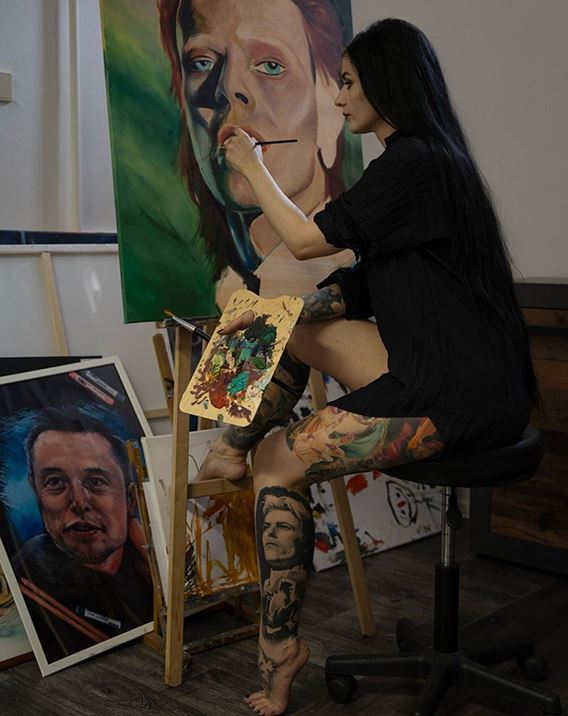
A: Thank you! Yes, there's one Bowie portrait that was based on a
digital painting I created, but I often use painting-like images as
inspiration because I love it when brushstroke-like lines appear in
tattoos. I don't have much time to paint, so I sneak these elements
into my tattoos.
Q: Tattooing is a service type of job, one can maintain
their style, but still the client's wants come first. Do you
negotiate with your clients when it comes to design or body
placement etc?
A: Of course! The harmony between the body and the tattoo is
essential for me. I customize every design to fit the surface,
ensuring it flows with the anatomy and body lines and looks
aesthetically pleasing on the wearer's body. Unfortunately, we often
see how little people understand basic things like which direction a
design should face, how large it should be on a given surface, or
whether it should be elongated, etc. I strive to create the best
possible outcome because a tattoo is something you wear for life,
not a piece of clothing you can change daily.

Q: Your color work is fantastic. I saw some beautiful black
and gray tattoos but, but the color tattoos are really cool. I like
the color palette used on each, the details just pop... amazing...
Honestly, how long it takes to complete a big color tattoo? I'm
talking sleeves or a back piece?
A: Yes, colorful designs are my favorites! I work relatively
quickly, but the time depends on the individual. An average-sized
thigh tattoo takes about two days, depending on the complexity of
the design, the type of skin, and the client's pain threshold. A
thigh or calf tattoo typically takes around four sessions.
Q: We all want that "fresh look" to stay forever, but the
skin heals and the ink in time will fade a little. That's a natural
process. However а good tattoo artist knows which inks to use so
even when the skin heals, the tattoo will still have that beautiful,
vibrant look. How important is to know how the inks will work on
(different) skin types and therefore their proper usage?
A: I believe this is an essential aspect of our work! You simply
need to know which pigments work best for different skin types (I’m
thinking of the Fitzpatrick scale) to achieve the best results even
after healing. The amount of melanin (specifically eumelanin, the
dark pigment) determines how dark or light our skin will be. You can
work on any skin tone, but you need to know how. If we analyze
things a bit more deeply at the skin level, the process becomes
quite easy to understand. Our skin’s melanocytes produce melanin in
the so-called basal layer between the epidermis and dermis (with a
protective function against UVA and UVB rays), while the tattoo
pigment is deposited into the lower layer of the dermis. Since
tattooing is an invasive process (the skin surface is damaged by
many tiny punctures), the color appears much more intense initially.
After the skin regenerates, the epidermis and the basal layer, along
with the body’s own pigment, cover the tattoo pigment, dulling its
vibrancy and shades. It's like pulling a brownish film over a
painting. That’s why it’s important to use the right color contrasts
and avoid too many pastel colors. Pastel tones are already muted,
and they work the least well on darker skin types, but also on the
body’s outer surfaces (due to sun exposure and tanning). You simply
need to know how to work with them.
Q: Do you have any favorite tattoo you did recently that
maybe took some extra time to finish, but in the end it look so
good, so the effort was worth it?
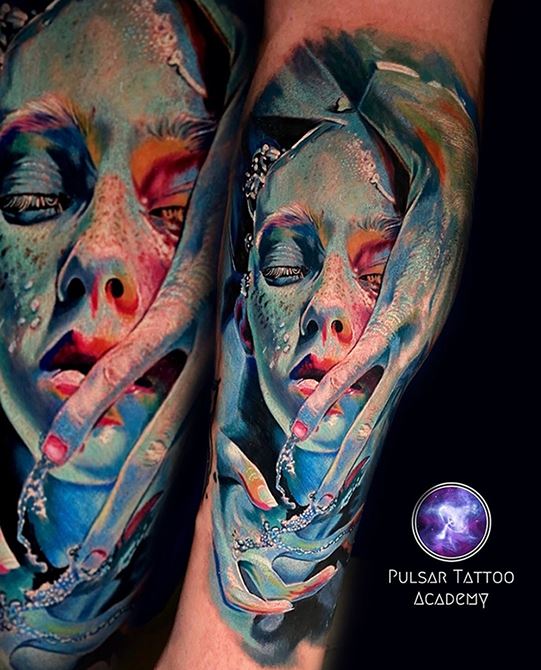
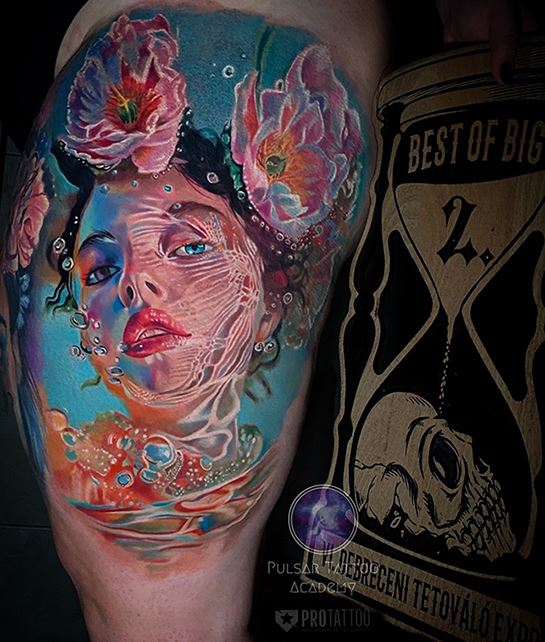
A: Yes, there were a few favorites - an astronaut, a portrait
underwater - but I really enjoyed creating some pieces because of
the color contrasts. Honestly, I invest as much time in each design
as it takes to bring out the best in it.
Q: Do you have like a sketchbook where you have some
ready-made designs for your clients who are nor sure what they want?
Do you accept reference images or the design has to be your own
masterpiece?
A: Both. I believe there needs to be a compromise here. Good
reference images from the client are always important, but of
course, we can suggest something if they’re not sure what to look
for. In many cases, I prepare one or two designs in advance, and
clients can choose from those. It's very important to me that my
clients wear something that suits not only their bodies but also
their personalities. For example, that's key in style selection too.
Not everyone can pull off colorful realism, you really have to know
how to wear it. I often suggest dotwork or black designs if the
client identifies more with those.
Q: Honestly, what do you enjoy more tattooing or painting?
A: Both! :) And teaching too! I love it when there's harmony, and I
have enough time for everything. Each one is different, and each
fills me up in different ways.
- Do you do custom paintings for sale? If yes, please write
how we can connect with you.
Yes, I do take commissions, or sometimes I sell finished pieces, but
I don’t have much time for it.
Q: There are many interesting designs in your portfolio. I
must say, my favorite are the beautiful portraits but there are also
some really cool new school and floral designs. What designs are
very popular in Slovakia?
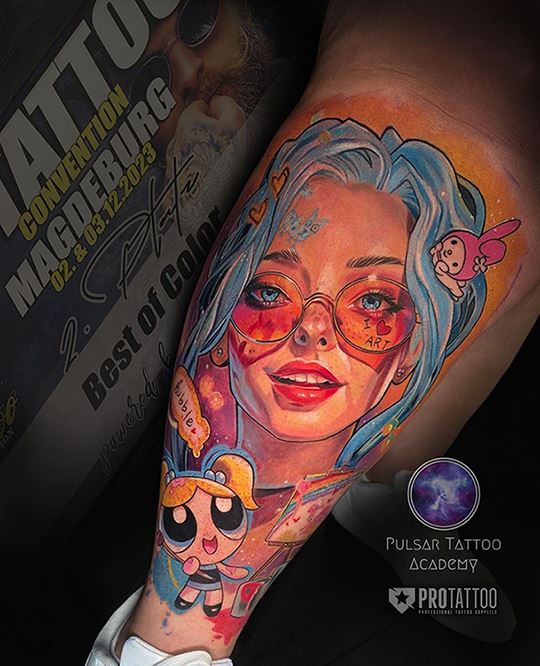
A: Thank you! The requests are quite mixed. Many people ask for
realistic portraits and animals, which I’m happy about. There’s also
a high demand for fine line and micro-realistic works. Flowers, in
any style, size, and quantity, are very popular because they’re easy
to combine and can be worn at any age. Recently, there’s been a
growing interest in blackwork and lettering too. We have many
talented artists around, so every client can find what suits them.
- Do you like the local tattoo scene?
Pretty much, yes. However, there could be more creative requests,
especially for larger designs, space-themed, fantasy, or sci-fi
pieces, where you can really do amazing things with colors.
Q: As a super talented artist, what are some of the other
creative things you do?
A: After obtaining my PhD, tattooing became my main focus, but over
the past two years, I’ve also been conducting training for both
beginner and advanced tattoo artists. Sharing knowledge is very
important to me, just like deepening what I already know and
constantly learning, even in multiple areas. Since I’ve never
formally studied painting at an academic level (something that’s
still on my to-do list), there’s always room for improvement. When
time allows, I paint outdoors or get together with highly talented
colleagues for a session of still-life painting, which is also a
great opportunity to nurture good, friendly relationships. I also
read a lot, nowadays mostly popular science literature (cosmology,
physics, biology, technology, futurology, transhumanism—anything
goes). My studio is even equipped with a small library. My hobby is
my work and learning, which motivates and energizes me, and my
thirst for knowledge is unquenchable. I also do permanent makeup,
but I’m particularly drawn to the Haistrokes technique, as it’s as
complex as realism in tattooing. It involves the most creativity -
achieving a natural look where the eyebrow tattoo is virtually
unnoticeable.

Q: Tattoo conventions are a great place to explore, meet new
people and fellow artists. You have so many awards! Congratulations,
totally deserved Csilla. How much these things mean to you and
motivate you to keep moving forward?
A: I love attending competitions, not just for the community but
because I always find inspiration from others! Whether it’s a
technical trick or a friendly chat, for me, the ranking isn’t the
most important thing anymore. Of course, it feels good when your
work is recognized, but there are so many talented tattoo artists
these days, and a lot of high-quality work is showcased at such
events. In the end, who wins often comes down to the jury's personal
taste. I’m happy when my colleagues are awarded because I know how
much work, planning, and creativity goes into each winning piece.
- Do you have any favorite award or a memory from a tattoo
convention?
Yes, my first Best of Show award will always be a cherished memory.
But my best experience this year was seeing one of my most talented
students step onto the podium to receive their award. It was a proud
and joyful moment for me as a teacher, and it filled me with pride!
Q: Talented and hard working as you are, there's no doubt
that more successes is what awaits you. Do you have any plans for
the future? What would be a great career highlight for you?
A: I always have plans. Firstly, I want to continue improving my
technical skills, and I’d like to expand my teaching. I aim to work
in more international studios as a guest artist, and eventually, I’d
like to expand my studio abroad. But I’m also open to spontaneous
opportunities.
Q: What do you like about being a tattoo artist?
A: For me, tattooing is one of the most beautiful forms of artistic
expression, where the artist can truly be creative. It’s the
pinnacle for me because the artwork is placed on living, breathing,
feeling human "canvas," who live their daily lives just like we do.
It’s not a stable canvas but a dynamic, changing body, so the
designs also become dynamic, changing and fading over time. That’s
why every design is so important to me. The precise placement
ensures that the wearer can identify with it. It’s not just about
creating a high-quality design but also about the process. The
communication and trust are crucial so that the client leaves with a
positive experience. What might be just a 15-minute job for me, like
a small script or tiny heart, is something permanent for the client.
They choose it for a reason and will wear it for life.
Q: Your advice for those who want to try getting into
professional tattooing?
A: First and foremost, attend courses, draw a lot, and invest time
and energy into learning! Develop, be creative, and stay humble!
There’s no other way!
Please write down your studio location and website/social
media links.
Pulsar Tattoo - Nové Zámky, Slovakia, Europe
https://www.instagram.com/csilla_art
https://https://www.instagram.com/pulsar.tattoo.art
https://www.facebook.com/pulsartattoo
pulsar.tattoonz@gmail.com


