
Interview with Daniel Choque Mamani
At Skin Artists Tattoo Magazine we have spent two
decades documenting the masters of the craft, and today we are
thrilled to feature an artist who is redefining the boundaries of
illustrative tattooing. Daniel Choque Mamani has built a staggering
reputation for his ability to fuse neo-traditional structure with a
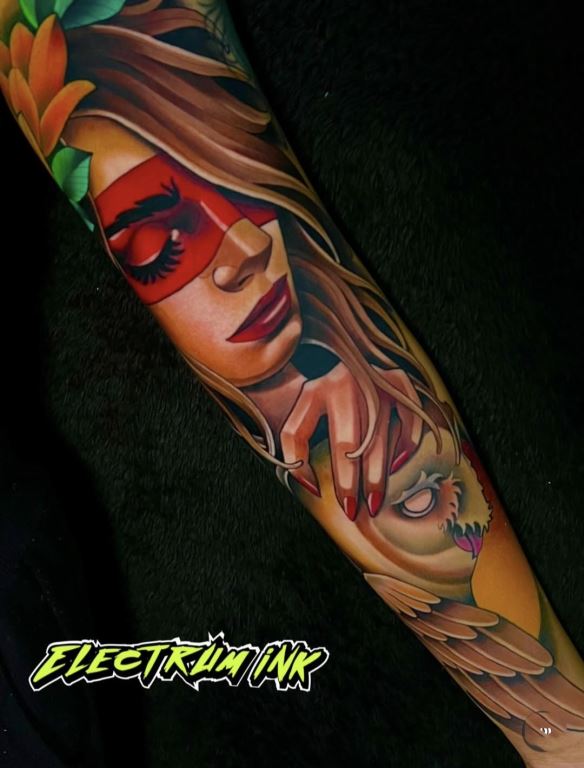
dreamlike, surrealist aesthetic. His work is a masterclass in
texture, from the velvet-soft gradients of his character portraits
to the sharp, graphic precision of his animal designs. As he
prepares to bring his signature 'vibrant-surrealism' to the United
States, we explore the mind behind the machine and the journey that
has led him to the pinnacle of the international scene.
Q: Looking at your portfolio, there is a distinct
"illustrative-surrealist" DNA. Can you tell us about the very first
time you felt you had moved past mimicking others and finally found
your own artistic voice?
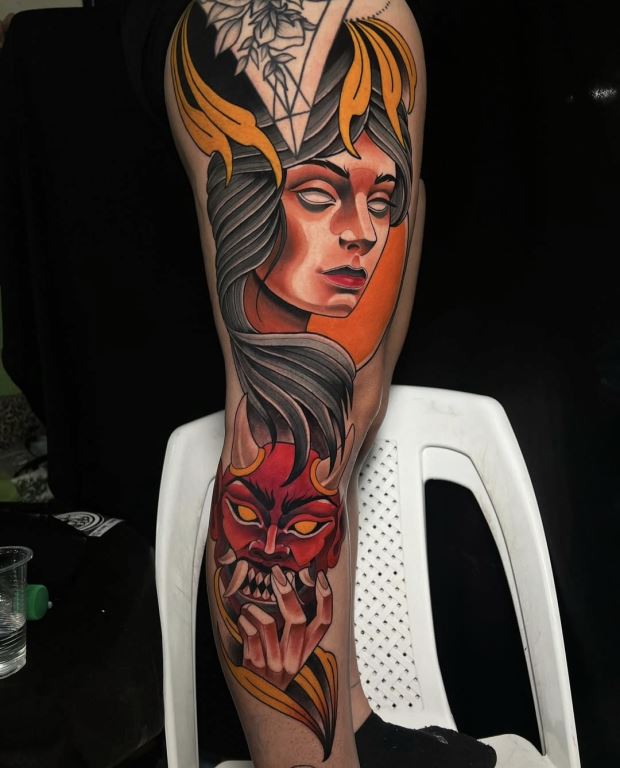
A: The first time I felt I was doing work that marked my own style
was at a convention in Africa where my intention was to show a
mixture of Art Nouveau style and the illustration of Colombian
tattoos and to design a tattoo that I felt more comfortable with and
that was easier to execute, trying to fit into the neo-traditional
style and thus give my designs their own identity.
Q: Your use of color is incredibly
saturated and smooth. What is your technical approach to "packing"
color to ensure it stays vibrant and doesn't lose its "glow" during
the healing process?
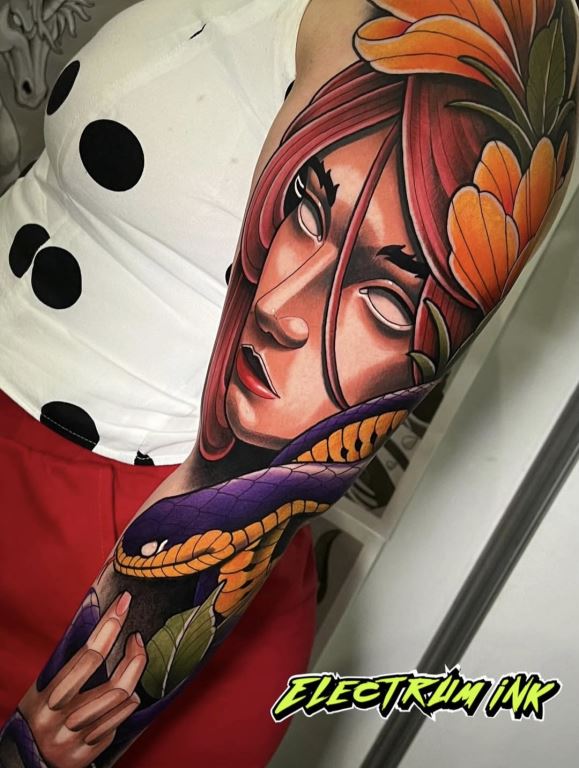
A: When filling in, I use an ancient technique that was used by the
first tattoo artists in history: injecting the needles at a
45-degree angle with a pushing motion. Another factor for good
saturation is the consistency of the pigment, since, in my
experience, it should be liquid, which facilitates good healing and
saturation.
Q: Many of your pieces feature surreal elements, eyes in
unexpected places, fusion of animals and objects. Where do these
dreamlike concepts come from? Is it art history, personal dreams, or
something else?
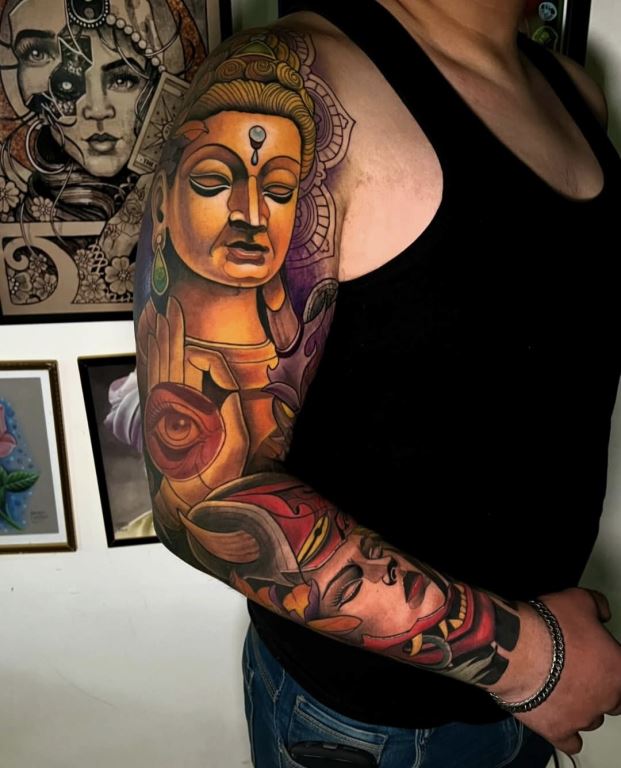
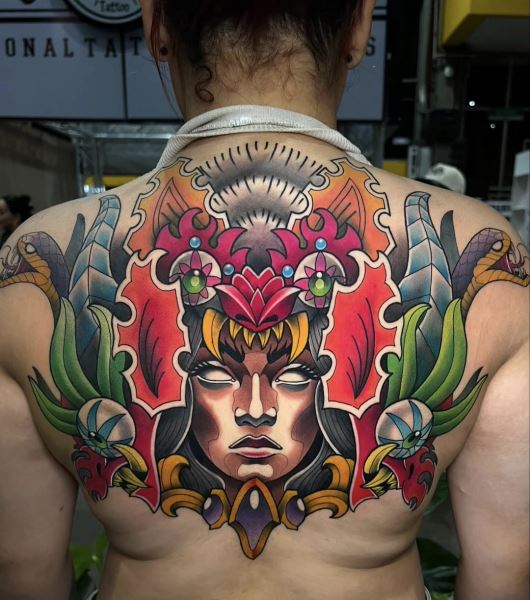
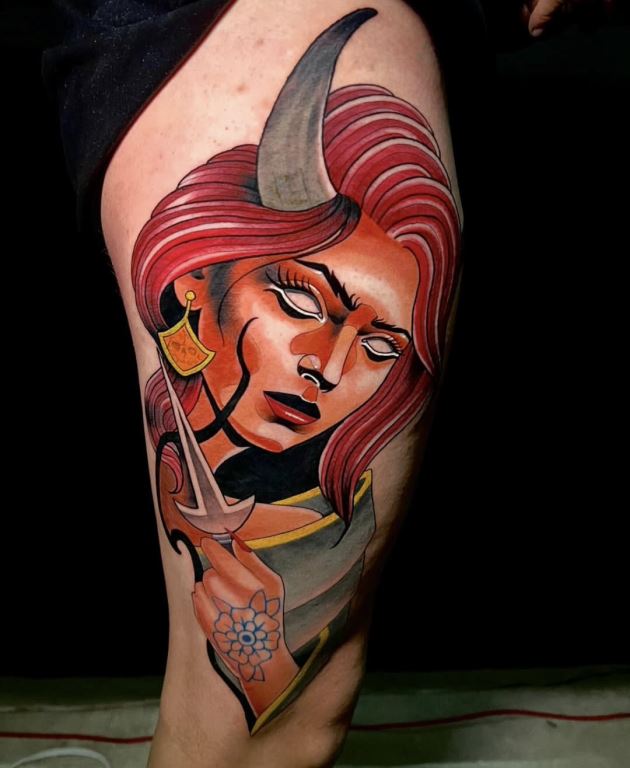
A: In my creative and design process, I try to ensure that the
characters I tattoo have a story, whether it's mythology from a
particular culture or a tale that will capture the client's
attention, mostly highlighting the female face because of how
attractive it can be in a tattoo.
Q: Your linework is remarkably bold and consistent. How much
do you think your early training contributed to the "graphic"
stability of your current style?
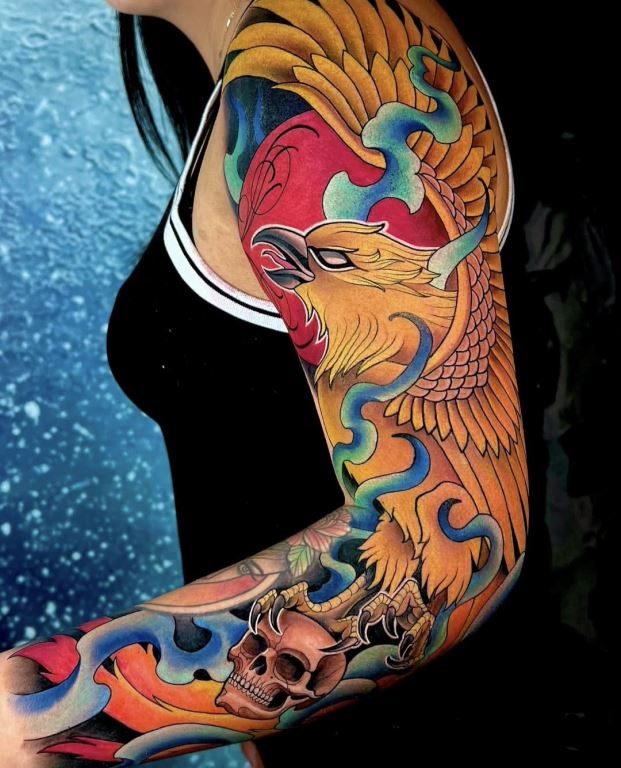
A: To achieve consistent and solid work, I believe what contributed
most to my success was studying Fine Arts at the Hernando Siles
National Academy in the city of La Paz. Taking subjects like
printmaking, which is closely related to tattooing teaches stability
and consistency in strokes. Painting helped me understand the use of
colors and their mixing, giving me a broad palette for tattooing.
Finally, drawing helped me work with volume and the use of light and
shadow.
Q: You utilize a "whip-shading" technique
that gives your work a vintage yet modern feel. How did you refine
this specific hand-motion to achieve such a perfectly peppered
gradient?
A: One of the drawing techniques that has helped me the most to work
on my gradients is the use of the pen, the same one that has allowed
me to create smooth blending in my creations and in tattooing, a
consistent hand movement with the machine at a low voltage and the
tones we are going to use are correctly ordered and using at least
six values of the same color.
Q: When creating complex compositions, like your large-scale
tiger or owl pieces, how do you manage the "visual hierarchy" so the
viewer’s eye knows exactly where to look first?
A: The human body has many visually important areas, and using a
main element makes these designs functional and aesthetically
pleasing for the person's daily life, regardless of the tattoo style
or design.
Q: You have a reputation for being a
"perfectionist" with your textures, from the shine on a character’s
eye to the soft fur of a wolf. What is the most difficult texture
for you to replicate on skin?
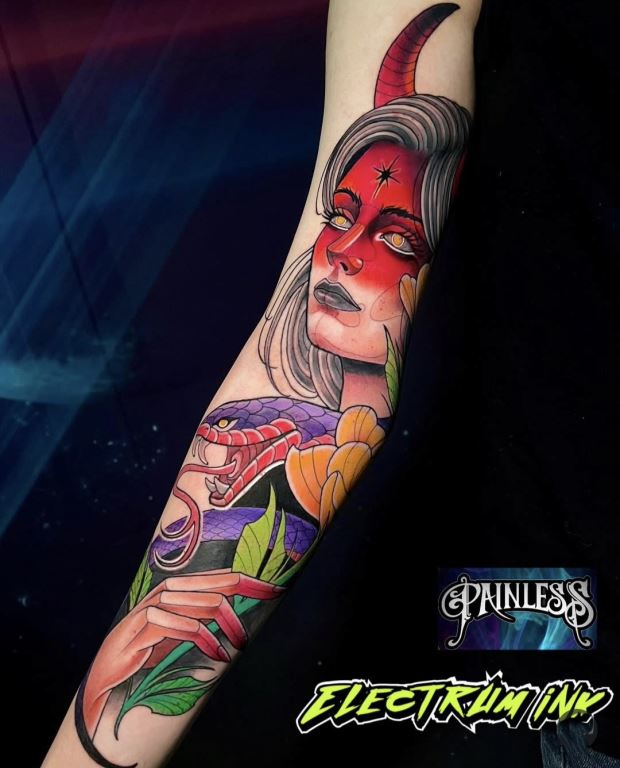
A: The most difficult texture to create in a tattoo, from my
perspective, is the thinness of the skin, since a sudden movement
can create a flaw that is not easily camouflaged. That's why a
constant and progressive movement is needed to achieve smoothness,
unlike animal fur, which needs to be messy and allows for
spontaneous work, thus achieving a more realistic visual effect.
Q: You’ve become a recognizable name across borders. At what
moment did you realize your art was being discussed by collectors
and fellow artists outside of your home country?
A: After a collector named John contacted me in 2024 via Instagram
from the US to commission an original piece, he wanted a unique
tattoo done by me. So, I decided to design a mask for him,
representing one of the most iconic dances of my country, Bolivia:
the Diablada. Within the artistic field, my constant participation
in both major and smaller events throughout South America has been a
significant advantage.
Q: Can you tell us about a specific
international convention or guest spot that completely changed your
perspective on what is possible in modern tattooing?
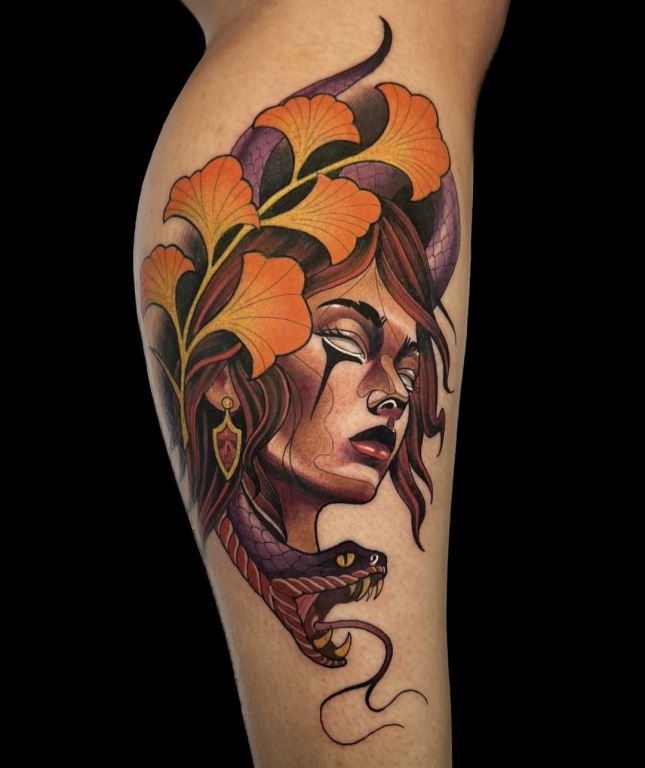
A: The Medellín Tattoo Expo 2022 was the convention that opened my
mind because at that convention I was able to meet tattoo artists
who had their own unique approach and characteristic styles. This is
because in competitions the rules are more flexible, allowing tattoo
artists to create new sub-styles or reinforce existing styles with
their own unique approaches.
Q: Sponsorships are a badge of honor for elite artists. What
does it mean to you to have the backing of major industry brands,
and how does that help you maintain your high standards?
A: Having your own unique approach helps brands and companies notice
your work. For me, as a Bolivian, it's difficult to get sponsorships
because, as of now, there are no regulations in place for tattoo
brands to enter my country. That's why, to get sponsorships, I had
to stand out at international conventions, and this caught the
attention of brands like Gecko, Electrum Ink Latam, Mr. Hide, New
Tech, and a local shop, LP Supply. Thanks to the support I receive
with the products they provide, I can continue showcasing my art
nationally and internationally, as well as receiving invitations to
conventions.
Q: You have a massive digital presence.
How do you use social media not just as a portfolio, but as a tool
to educate the next generation of illustrative artists?
A: When I realized that new and emerging artists in many countries
were following me, I took the initiative to create a YouTube channel
called Dartho Art, where I upload and explain my work process. It
serves as a reference for the next generations of artists.
Q: Tattooing at this level is a marathon. What does your
mental preparation look like before you start a massive,
multi-session project?
A: Before starting a personal project, I keep two things in mind:
first, that the person feels pain, and to achieve an optimal result,
the person needs to have good tolerance and second, to document the
entire procedure, including pigment tones, to see what reactions a
certain tone has and avoid variations in the large-scale piece.
Q: If a museum were to dedicate a wing to your work, what
would the title of that exhibition be?
A: If the exhibition were about my colorful tattoos, the name of the
exhibition would be: “Saturated Colors or More Romantic Among
Vibrant Colors.”
Q: What is the biggest sacrifice you’ve
had to make in your personal life to reach this level of
professional "extraordinary" status?
A: The greatest sacrifice one makes is missing out on special
moments, whether with friends, family, or a partner. In my case, it
was no exception, dedicating as much time as possible to the art of
tattooing.
Q: The U.S. has one of the most competitive tattoo markets
in the world. Why did you choose this moment in your career to make
the move to the States?
A: One of the reasons for coming to the U.S. is to showcase my work
and present my proposal, demonstrating that my country has an
artistic level capable of competing, with the United States being
the perfect country to develop my work.
Q: How do you think the American "collector" mentality
differs from the clients you’ve worked with in South America or
Europe?
A: On several occasions, especially in Medellín, I was able to work
with clients from the U.S. and something that caught my attention is
the creative freedom that people allow you and the ease of being
able to offer original designs, unlike Bolivia where I come from,
because of ideology tattoos are still frowned upon, for that reason
it is more complicated to find people who want an original design.
Q: Are there any legendary American
artists you are hoping to collaborate with or share a studio space
with once you arrive?
A: One of my dreams since I started in neotraditional music is to
work with Sam Clark, who is considered one of the creators of
American neotraditional music.
Q: What is the "American Dream" for you as a tattoo artist?
Is it a studio of your own, or pushing the boundaries of the art
form in the U.S. galleries?
A: My vision for the United States is to stand out with my style and
be able to work with higher-level artists, learn from them, and in
the future have my own studio.
Q: How do you plan to contribute to the diversity and
elevation of the American illustrative scene?
A: The way I could contribute is through the culture I bring from my
country, with striking graphic images that tell ancestral stories of
this region.
Q: Your clients often give you a lot of creative freedom.
How do you handle the responsibility of someone giving you "total
control" over a permanent piece of their body?
A: I think one of the biggest challenges as a tattoo artist is
knowing how to reach clients. In my opinion, the best way to work is
to explain why they should get a tattoo from me and why they should
choose an original design. It's often complicated, but with a good
portfolio, you can show the client your proposal and ideas.
Q: For your upcoming move to the USA, how
can collectors who have been following you from afar finally secure
a spot in your chair?
A: I work by appointment, since I dedicate the entire day to one
person from the completion of the design, the planning of the
placement where the tattoo will be done, until the conclusion of the
session.
Q: What is the one thing you wish every client knew before
they sat down for a session with a high-level illustrative artist?
A: I would like people to know that I dedicate 100% of my knowledge
to the skin, I strive to make very striking and functional tattoos
on the body, that age well and that they can enjoy their tattoo for
a lifetime.
Q: Where do you see the global tattoo
community in 5 years? Do you think the trend is moving toward more
traditional roots or further into digital-inspired surrealism?
A: The world of tattooing is constantly changing and evolving, so
what's "in" today might be different in five years, and that's the
beauty of art and tattooing, you can't imagine what will happen with
styles or new trends. But I'd like people to understand that a solid
tattoo will always have a greater visual impact and last longer.
Q: Finally, for the young artists who want to follow in your
footsteps to the international stage, what is the most important
"old school" skill they should never neglect?
A: The best thing an emerging artist can do is understand that
tattooing is art, and as such, it needs to be nurtured with training
in fine arts and other artistic practices that help you develop as a
tattoo artist.
Interview: Ivana Kancheska
Date: 12 March 2026


