
Interview with Danny Elliott
Hello Danny Elliott! Thank
you so much for taking the time to do this interview. Please start
by telling us something about yourself and your background. Do you
have any formal art training or you are a self taught artist?
I'm mostly a self taught and didn’t attend a university for
formal training. That being said, I was in advanced art classes from
age 12 to 18. Over that time my classes exposed me to a broad range
of techniques which helped me make a habit of constantly
experimenting and pushing through the uncomfortable to find my best
approach to any project. More often though, it was really a
dedicated hour each day to practice which was still drastically
outweighed by my time spent drawing outside the classroom.
Q: Why tattoo art? What got you hooked?
A: I was hooked from the first time I wandered into a studio at
midnight. It was my 18th birthday and I just wanted some script on
my side. I remember that feeling of apprehension and excitement
pulling open the heavy wooden door to Hellbent tattoos, flash lining
every wall, the strong smell of Greensoap and Pinesol mixing in the
air because they had just cleaned and weren’t expecting some asshole
kid to walk in that late. Still,they took care of me. It was right
then that I saw the magic tattooing holds. We connect with people in
a more personal way than almost any other profession, we work with
our hands to bring forth an artistic vision, and someone is marked
with that effort for life in a way that helps them feel more
complete. Tattooing is unique in that way. It’s powerful, it’s
spiritual, and it’s sacred in ways that other art forms can’t touch
- I couldn’t imagine doing anything else.
Q: There are many tattoo styles nowadays. As a beginner did
you try to tattoo in a lot of styles? How long took you to figure
out your creative direction?
A: Taking notes from all the experimentation with other mediums, I
definitely tried everything. At first I was just trying to
understand the mechanics of a tattoo machine, but then I spent
months at a time focusing on different styles. Six months on
Illustrative concepts, six months on free handing everything I
could, six months on Trad work, and eventually I felt confident
enough to approach Realism which had been my preferred style with
pencil and paper anyway. Things really started to click around five
years in when I focused on my strength there, and I’d say around
year eight my style really started to show itself.
Q: Tattoo realism? An awesome mix of cartoon style, graffiti
and realism, oh well... Very creative, super, fun style for sure,
would you give it a name?
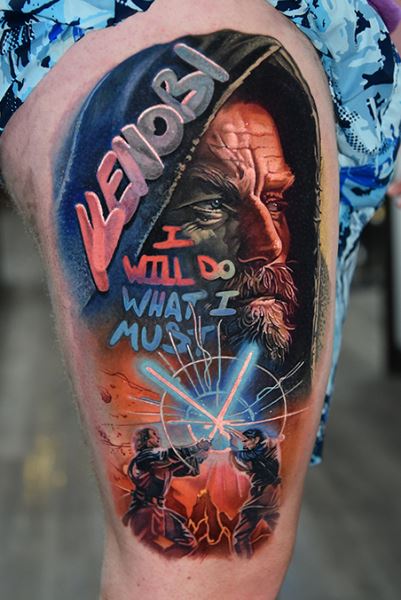
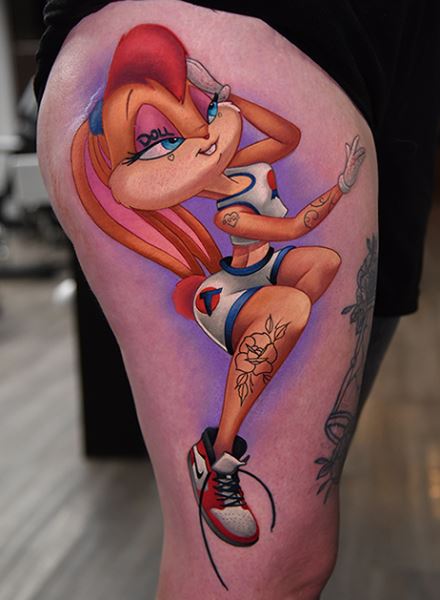
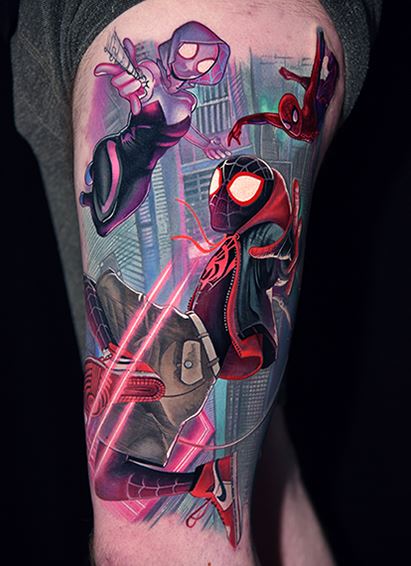
A: Thank you! Maybe “Experimental Realism” with a slight emphasis on
mental? haha If you saw some of my stencils you’d think they are
nonsense, but really I just try and make every concept unique
whether its with dynamic lighting, graphic elements, distortion
effects, etc. Realism is in high demand and there are so many
amazing artists with access to the same references, so it’s all a
way to make my work stand out.
Q: So we are talking here 100% unique designs. Do you draw
for each client before the session or you guys set up the design
during the session? What it someone just suddenly changes their mind
last minute before the session? Do you have any special rules for
this just to save time and energy?
A: My approach here has varied over the years but like anything it’s
a case by case basis. There are some designs I’ve gotten into lately
that required a lot of planning or others where I had a lot of
freedom and spent a lot of time before the session to get everything
right. In most cases though, to save time, energy and protect myself
against last minute changes, I’ve been designing with my client
together in person. It’s really common for me to meet my clients the
day of the appointment and I never want anyone to feel pressured
into getting the design they don’t like. While I guide the
direction, I find it helpful to return a sense of control and
creativity back to my clients while we collaborate together - it
helps ease their anxiety and it takes me to some interesting ideas
too. Most of my work requires multiple sessions anyway, so I let
everyone know ahead of time that the first couple hours of Day 1 are
reserved for designing together.
Q: I bet everyone sees your work and likes it! Seriously,
even people who like tribals and japanese designs. Are there some
people who come at your studio, want to get tattooed but they don't
know what they want? Ever refused to do a certain design?
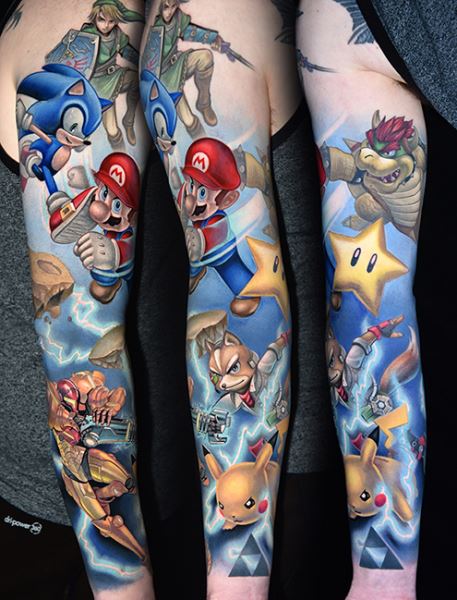
A: Thank you! I find that all my clients/fans are really just nerds
like me. If you’re into my work then you’re probably a gamer, movie
fanatic, or just really into some kind of pop culture. Working with
this subject matter has let me meet some really cool people. Most
people have an idea of what they want before they come to me, but on
the rare occasions that they just want a tattoo in my style, I
normally talk with them and try to get to know their interests a
little so I can make suggestions. I also ask them what tattoos of
mine are their favorites so we can design something similar that we
both know they’ll love. There are tons of things I refuse at this
point. I’m very fortunate to be in a position that I accept projects
based on how excited I am about them, what my current inspiration is
etc and even that can change from one booking cycle to the next. The
things that are red flags for me are concepts that are offensive,
things that are too simplified for my style like blackwork or
tribal, or ideas that are overly complicated. If it takes a full
page of text to explain an idea, it’s probably got too much going on
with too specific vision for me to feel comfortable moving forward.
No artist wants to be put in a creative box.
Q: Tattoo realism as style is amazing. It's that ultimate
test if someone can be technically a good tattoo artist. Even though
it could be creatively limiting still, a tattoo artist will find a
way to add a unique vibe to each design. I see that very clearly in
your work. Every tattoo is a unique masterpiece. Do you feel like
chosing to do realism this way gives you the creative freedom you
need as an artist?
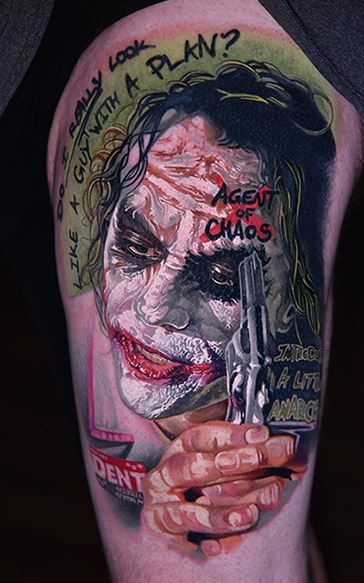
A: Absolutely! Too many people see realism and think of it as just
copying an image well enough to look the same. The real test is in
the choices we all make from there - thats where style and
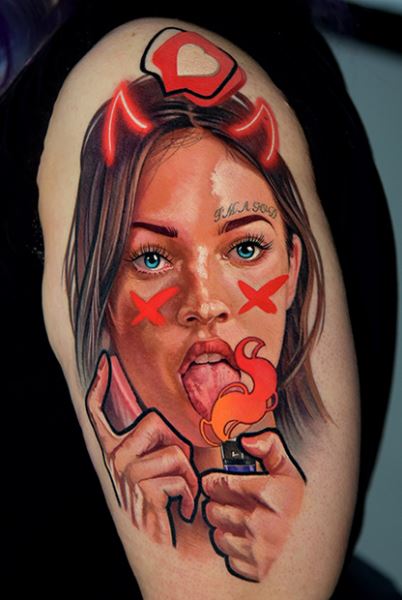
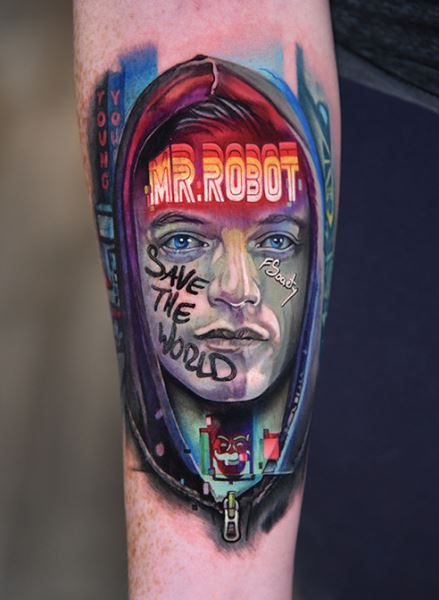
creativity shine through. Should we change the lighting to reflect a
different mood? Would a neon light source fit well or should the
lighting be ambient? Should I add detail here or blur detail there
for emphasis? Does the piece appear flat and need something else to
bring it to life? Does this image fit the body well on its own or do
I need to frame it somehow so it flows naturally? What are we trying
to say? These questions and dozens of others are ones I ask myself
continuously in the design process, the tattoo process, and I still
reflect on the piece in between sessions on larger projects. I find
my own creativity in this process of fine tuning the concept, and
the work itself feels so natural and meditative that I don’t feel
limited at all my the style - the only limit is your own
imagination.
Q: There is also a funny side... Some designs are a bit
sarcastic... hmm any favorite piece you did? I love them all so
don't ask!
A: Yeah a bit of sarcasm is almost never out of place, why not in a
tattoo? haha Honestly I love all of my work, I’ve had so much fun
these past few years (since around 2018) really getting to push my
own style whether it’s in a single session on something small or one
of the sleeves I’ve worked on. If I had to pick a single favorite
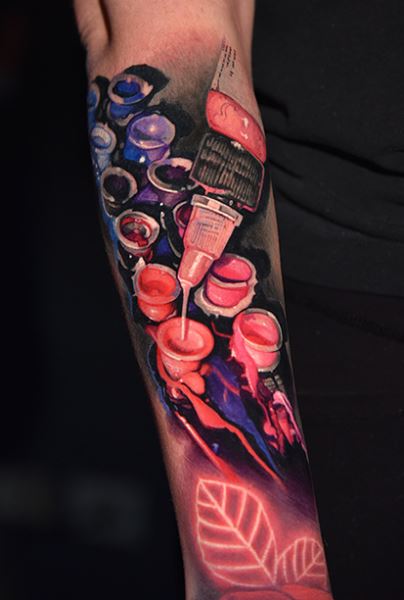
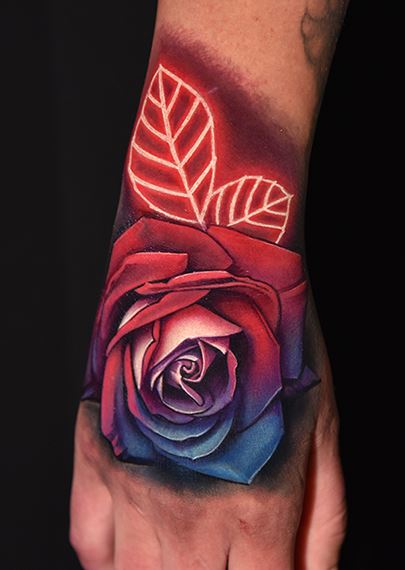
tattoo of mine, a top contender would probably be this forearm/hand
panel with Inkcaps being poured and a rose with neon leaf. It
allowed me to take my own reference photos with lighting that I
setup, I got to pick a unified palette for the whole thing, it’s on
another tattoo artist/ friend of mine too so I got to geek out about
it the whole time. I haven’t got her in for healed photos of the
whole panel yet but I’ll make sure to include both tattoos here
individually.
Q: Even the super talented can feel a little pressure
working on some designs or body placements. Some take a lot of time
to complete. Many sessions and a lot of effort. What was the longest
session and the most challenging tattoos you ever did? The brave
client? How did you manage to keep the good energy in the studio?
A: It’s really common for me to take on projects where we work two
days in a row, some of which have totaled 24 hours or more of tattoo
time with a 12 hour break after day one. I honestly do this a couple
times a month and while my clients are exhausted they rarely tap out
before we’re done. I have movies playing constantly to distract
them, and a fully stocked fridge and snack cabinet on hand to keep
them energized. No one enjoys being tattooed for that long, but I
find having a relaxed environment goes a long way.
Q: To "mark" someone for life gives you a great
responsibility but also a great joy and sense of importance and
respect. Being a tattoo artist is truly something special. I bet
nowadays this profession gives a lot more opportunities for work &
travel like guest spots, conventions etc more network and
recognition. Still very serious but a good, good job. What do you
like the most?
A: I like to call tattooing a unicorn job because finding this much
freedom with work, travel and actually feeling fulfilled is so rare,
but it’s real and the opportunities are endless. Even though it’s
only the product of a lot of work to actually make it happen, my
favorite part is that ability to travel and experience the world
myself. There’s so much to learn from every culture just traveling
normally, but getting to work in another country really is a
different level. I worked in Europe with my partner for two months
last year and simple things like figuring out the train schedule,
sorting out dinner after a long shift, finding the routine of the
local artists for ourselves - it all gave me a deeper appreciation.
Q: If you were starting today what would you do differently?
A: If I was starting today I’d invest all my extra money in tattoo
education. Even though it’s not that long ago, back in 2011 when I
picked up a machine for the first time resources were super limited.
Guy Aitchison created a textbook and both Nikko and Mike Devries had
DVD’s that I picked up, but other than that there was nothing and
you had to learn from your mentor or by getting tattooed. In person
will always be the best way to learn, but for someone starting out
now there are hundreds of youtube videos, Tik Tok and Instagram
tips, webinars, seminars, etc. all at your finger tips for both
tattoos and art in general. For someone starting out today the
opportunity to learn is infinitely higher, and we’re seeing artists
improve at an exponential rate because of it.
Q: Any plans for the near future?
A: Artistically I’m learning some new mediums, Copic Markers and
Digital Sculpting. They’re both vastly different but I’m excited to
see where those influences take my work. From a more personal
perspective I’m actually looking to make another move in the next
year or so. Colorado has become home over the past few years, so
I’ll always be back often regardless of where I take up residence,
but my partner and I are looking for a new day to day outside of the
US. There’s so much to see and so little time.
Q: Please write down your email and studio location. If you
are available for bookings let us know.
A: Flow State Gallery, is located in beautiful Denver, Colorado, and
the exact location of my private studio isn’t listed online to
maintain a relaxed and personal experience for all my clients. I’m
currently booked through the end of 2024, but you can always check
my Instagram for last minute availability, travel updates or when
I’m accepting new clients in general. For all inquiries please fill
out the contact form on my website:
DannyElliott.Ink
or Email me directly at:
DannyElliottInk23@gmail.com
Q: Any motivational words for those who want to try getting
into professional tattooing?
A: Any artistic craft demands a lot. It’s dedicated time to learning
and sacrificed time with hobbies, friends or family. Getting into it
requires all the energy you have, and be prepared to keep that up
for 5-10 years if not a lifetime. If that doesn’t scare you, read it
again. If you’re still determined, then be deliberate in your
effort. Commit to learning everyday, to 1% improvement everyday
whether it’s artistic, personal or professional, and keep pushing
forward. It’s a marathon not a sprint, and 13 years in I’m still
running.


