
Interview with Dmytro Shcherbakov
Hello Dmytro Shcherbakov! Thank you
so much for taking the time to do this interview. Please start by
telling us something about yourself and your background. What
sparked your initial interest in art? I’m Dmytro, a tattoo
artist originally from Ukraine and currently based in the U.S. My
background is shaped by movement, education, and a long relationship
with art. I started drawing at a very early age and kept drawing,
throughout my entire school life, including attending art classes.
Later, I studied interior and furniture design in Kyiv, where
drawing became not just a personal interest but an essential part of
my education. I then continued my studies in Warsaw at the Faculty
of Architecture, and it was there that I decided to bring all my
skills and interests together through tattooing. It’s been nine
years since I started my tattoo career, and my interest in it has
only continued to grow.
Q: When and how tattooing came into the picture? Was it hard
getting into the business?
A: Tattooing came into my life quite naturally. In 2017, while
studying architecture, I realized I wanted to combine drawing,
design, and working directly with people into one medium, and
tattooing felt like the most honest way to do that.
Getting into the industry wasn’t easy. It required time, discipline,
and a lot of self-teaching, but the challenge only confirmed that
this was the right path for me.
Q: What type of tattoos you used to do as a beginner and how
long took you to figure out your creative direction?
A: When I was starting out, I worked in many different styles. At
the time, no one really advised me to focus on one specific
direction, so I took on everything and used that period to build
technical skills across various styles. It took time to realize that
I needed to create, something more authentic. Around my sixth year,
I started clearly understanding which direction felt right - what I
enjoyed most and what worked best with the body. Even though it took
longer than it probably should have, that process gave me a strong
foundation and still shapes my work today.
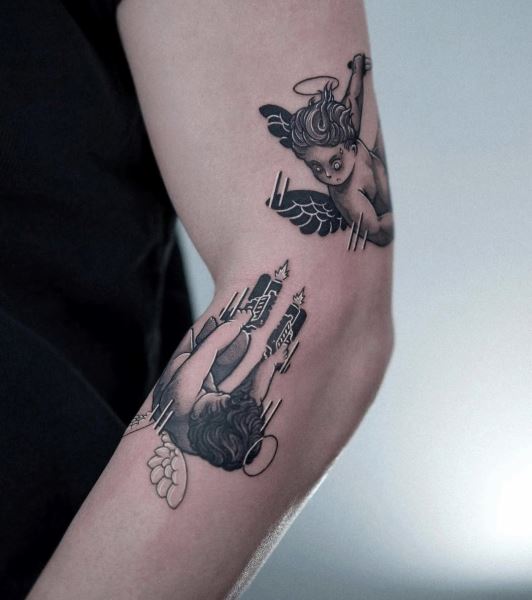
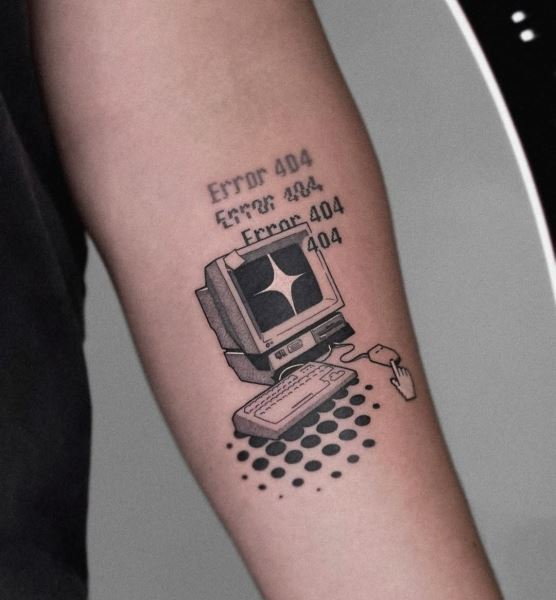
Q: Your work often incorporates "Error 404" motifs, and
glitch aesthetics. How do you balance these "cold" digital concepts
with the "organic" flow of the human body?
A: Composition is very important to me. I always build a design
around the client’s anatomy, working directly with photos of the
specific body area. Some elements, like flowers or tribal forms, are
naturally more anatomical and tend to follow the body’s flow very
well. Glitch aesthetics and “Error” motifs work differently. Since
glitches are visual errors on a screen, I often place them in a more
controversial way, slightly opposing the anatomy on purpose. That
contrast helps balance cold, digital ideas with the organic nature
of the body. Of course, there are always nuances, and to break rules
in a meaningful way, you first need to understand them.
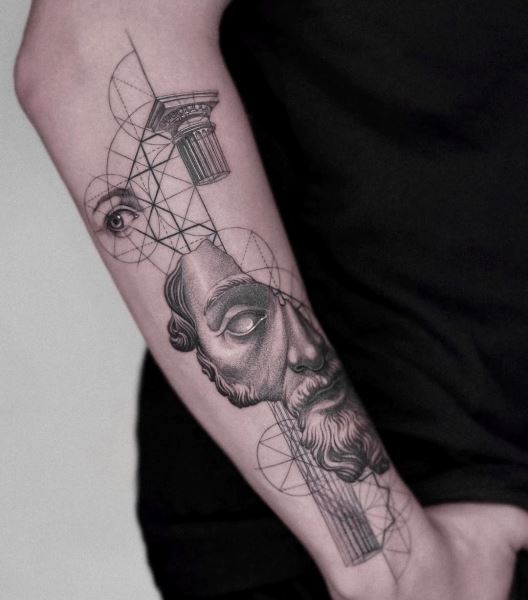
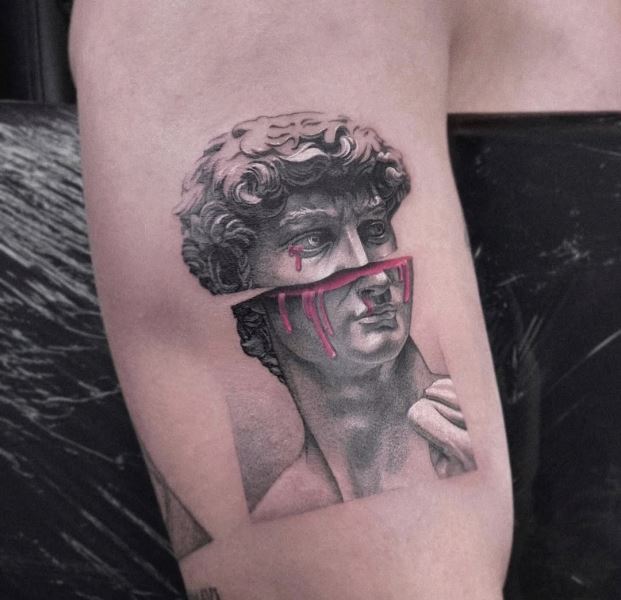
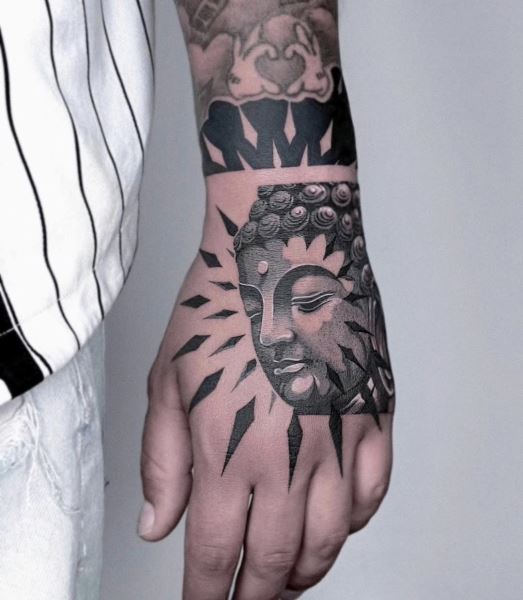
Q: You frequently pair classical imagery like Greek statues
and religious iconography, with aggressive, sharp Neo-Tribal lines.
What is the narrative behind clashing the ancient with the
futuristic?
A: For me, it’s not about the futuristic, it’s about the
contemporary. Through my work, I want to highlight that what we
consider modern today will eventually become classical in the
future, just as ancient culture is considered classical for us now.
By combining classical imagery with sharp, modern forms, I’m simply
reflecting that transition. It’s a reminder that time reshapes how
we perceive art, and today’s visual language is tomorrow’s history.
Q: Your handle and branding feel very industrial and urban.
How does the grit of city life (specifically Chicago) influence the
"Tattoo Graphics" style you’ve pioneered?
A: I actually come from a small town in Ukraine, so the urban
megacity vibe always felt like something from another world to me.
Growing up, I only saw it through a TV screen or later through my
first computer, and that distance made it even more fascinating. You
usually want what you don’t have. My branding isn’t directly about
Chicago itself, but more about brutalism in graphic design. Street
art, tattoo graffiti, and urban visuals have always existed in
tattoo culture, but they’re often tied to early-2000s hip-hop or
Chicano aesthetics. I wanted to move in a different direction - more
digital, more editorial, but still raw and street-driven.
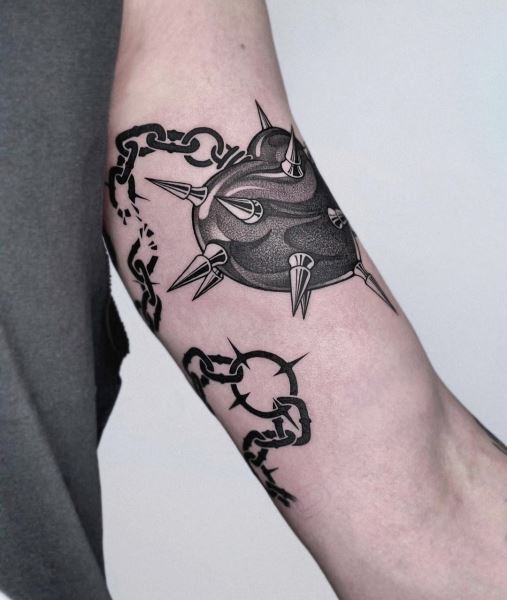
I use less calligraphy and more typography. Instead of making images
more realistic, I simplify them, the way graphic design does,
through brutalism and primitivism. So in a way, my work is
influenced less by the city I live in now, and more by how cities
once looked to me through old screens, distant, rough, and
inspiring.
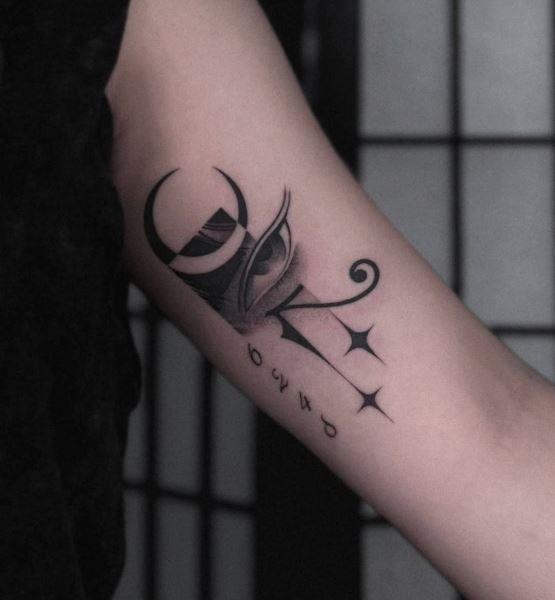
Q: You use a lot of specific starbursts, sparkles, and sharp
lettering. Do these hold specific meanings, or are they purely
architectural tools to guide the eye across the skin?
A: The sharp lettering comes directly from typography, as I
mentioned earlier, it’s a graphic design tool that I deliberately
chose for my work. The stars, however, are something I decided to
make my signature. I personally love them, they existed long before
us and will exist long after us. Celestial bodies are named after
gods, and we call the brightest people on the planet “stars.” Thanks
to a star, our planet has life, despite the danger stars themselves
carry. Any astrophysicist will confirm that every atom in your body
was once part of the cosmos, and I find that truly beautiful.
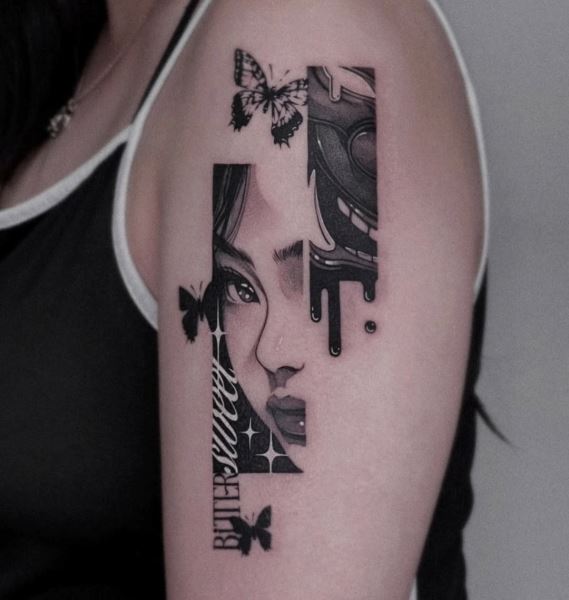
Q: You do a lot of work on highly visible areas. How do you
walk a client through the "commitment" of a piece that will
fundamentally change how the world sees them?
A: I don’t choose placement for my clients. If someone decides on a
specific area, that’s a personal choice and a conscious commitment
on their part. My responsibility is the quality of the tattoo
itself. Of course, if a design doesn’t work well with a certain
placement, I explain that openly and we decide together how to move
forward in the best possible way.
Q: How often do clients come to you with a personal story
behind these motifs, and how do you handle that emotional weight?
A: Yes, quite often. Some clients come to me with very personal
stories, usually connected to people or moments from their past or
present. Sometimes they know exactly what the tattoo should
symbolize, but don’t yet see how it should look visually. In those
cases, I’m always happy to help translate meaning into form, because
I understand how important that process is for them.
Q: Many of your posts are labeled "Concepts" or "Available."
Do you prefer the creative freedom of people picking your pre-made
visions, or do you enjoy the collaborative challenge of a client’s
specific prompt?
A: I really enjoy when a client comes with an idea and invites me to
develop a project specifically for them. That kind of collaboration
often leads to very meaningful results. At the same time, as an
artist, it’s always rewarding when someone connects with and chooses
one of my pre-made designs. Both approaches inspire me in different
ways, and I value that balance.
Q: Your "wraparound" pieces are very ambitious. How much of
that is freehand to fit the anatomy versus pre-designed digital
stencil?
A: Thank you! It really depends on the design. I usually start with
a sketch, apply it to the body as a stencil, and then adjust it
directly on the skin if needed, adding freehand elements when the
placement doesn’t feel right. I genuinely love working freehand. Now
I’m working on two sleeves: one is about 70% freehand, the other
nearly 90%. With experience, you stop being afraid of freehand and
start to really enjoy it.
Q: Your work relies on incredibly deep, saturated blacks and
crisp negative space. What is your philosophy on how these
high-contrast pieces will age over the next 10–20 years?
A: As I mentioned before, I try to simplify every design. I’m
confident that the simpler a tattoo is, the better it will look and
behave over time. This also comes from graphic design – I always aim
to keep tattoos clear and readable. As for longevity, I simply know
how to do it the right way.
Q: What would be the coolest design to tattoo?
A: It depends on the person, the circumstances, and personal
preferences. Often, spontaneous tattoos can become the most loved
ones, but just as often, the opposite happens. I don’t think there’s
a single right answer to this question.
That said, I wouldn’t recommend getting portraits or names of your
romantic partners tattooed :) Fate has a way of playing bad jokes
sometimes.
Q: How has social media changed the way you build a
reputation compared to the old-school "word of mouth" method?
A: I started my career at a time when social media was already part
of the industry, so I don’t really have a direct comparison to the
old-school word-of-mouth approach. What I can say for sure is that
social media today often forces artists to shift attention away from
the tattooing process itself in order to maintain an online
presence.
Q: You often tag other artists and shops. How important is
the "Artist-to-Artist" relationship in building a reputation that
isn't just about the clients, but about earning the respect of your
peers?
A: I tag the brands and tools I actually use in my work - that’s
simply about transparency and respect. When it comes to
relationships with other artists, I don’t build them for strategic
reasons or personal gain. I communicate and collaborate with people
I genuinely enjoy working and talking with, and that’s what matters
most to me.
Q: As you transition to a global stage with your upcoming
European tour, how do you balance your expanding international reach
while staying connected to the local Chicago community that
supported your early growth?
A: I’ve been tattooing for nine years, and only the last two have
been based in the U.S. Even before moving to America, I was already
doing multiple European tours and working across many countries,
with clients from all over the world. Because of that, my audience
has always been international, and balancing global and local
presence has never really been an issue for me - it simply been part
of my path from the beginning.
Q: Please write down your studio location and website/social
media links. Also let us know if you are available for bookings.
A: I’m currently based in Chicago at Logan Square Tattoo. My booking
schedule in Chicago is fully closed at the moment, but I’m hoping to
return toward the end of the year so clients may still have a chance
to book with me in 2026. I’ll be opening bookings for Europe soon.
All updates and availability can be followed on my Instagram at
@asphalt_ttt .www.instagram.com/asphalt_ttt or on my official
website: www.asphalt-ttt.com
Q: Does your "reputation" change when you are the "Guest
Star" in a new city versus being the "Resident" at Logan Square? How
do you adapt your professionalism to fit different shop cultures?
A: I don’t really think about it in those terms. For me, mutual
respect and professionalism are what matter most, regardless of
whether I’m a guest or a resident artist. I’ve never had issues
adapting to different shop cultures, wherever I work, my schedule is
always fully booked, and I approach every place with the same level
of responsibility and respect.
Q: A tattoo is a lifelong bond. What is your policy on
"aftercare as a relationship"? Do you keep in touch with clients to
see how those deep blacks and fine lines settle over time?
A: You can ask any of my clients, I always encourage them to stay in
touch during the healing process, and I genuinely appreciate it when
they send photos of healed work. I consistently emphasize that
aftercare and healing make up at least 50% of the final result.
Q: Every great artist has to say no sometimes. What is a
"red flag" for you in a client-artist interaction that tells you a
project won't be successful for either of you?
A: For me, red flags are mostly about respect and communication.
That includes disrespectful behavior, pressure to copy another
artist’s work, or being pushed into decisions that don’t feel right.
I’m also cautious when a client has no clear idea of what they want
and expects to be “surprised,” or when sessions are repeatedly
rescheduled without a serious reason. Sometimes I decline projects
simply because they don’t interest me creatively, that’s not a red
flag, just part of my professional boundaries. That said, I rarely
have issues with clients. Overall, the people I work with are great.
Q: You speak at webinars for newcomers. When you talk about
"professionalism," what is the #1 piece of advice you give about
treating a client like a human being rather than just "skin"?
A: I live by a simple principle: treat people the way you would like
to be treated yourself. During webinars, I don’t really lecture
about human relationships, I focus more on professional experience
and technical advice. If I had to give one key recommendation, it
would be this: communicate with your client. Ask questions, explain
things in advance, and genuinely listen to their preferences.
Q: Traditional tattooing is often tied to geography. Your
work feels "borderless." Do you think the global scene is moving
away from heritage-based art toward a more aesthetic, "unaffiliated"
visual language?
A: Traditional tattooing should never be seen as unaesthetic. I
genuinely love traditional styles and often draw inspiration from
them. At the same time, I believe an artist’s role is to create
something new. The global tattoo scene is naturally evolving, and
while heritage remains important, many artists today are exploring
visual languages that go beyond geography and labels.
Q: The internet has made it possible for artists to go
global without the traditional apprenticeship or "shop hierarchy"
path. What are your thoughts on how this "democratization" is
changing the global standard of quality?
A: Times change, and art changes with them, and that’s normal. I
don’t believe this shift directly affects the quality of tattooing.
It influences the ritual and structure of an artist’s path more than
the work itself. For example, artists working in American
traditional tattooing were inspired by classical Japanese tattooing,
a tradition that requires a very long and disciplined process of
mastering the craft. Despite this, American artists simplified the
approach and significantly reduced both the time and complexity of
the tattooing process. Today, that simplified approach is considered
a classic within tattoo art itself.
Q: A lot of Gen Z views tattoos as "character customization"
(like in a video game). How does this global shift in mindset change
the responsibility of the artist to provide a "signature look"
rather than just a "service"?
A: I see it simply as a challenge, and one that I actually find
interesting. I believe it’s almost always possible to reach a
balance between a client’s idea and my own creative vision. If a
client insists on a very specific design, then in that case I
approach it more as a service - as long as it’s not a direct copy of
another artist’s work. Some might call that cynical, but I see it
differently. Sending a client away with their request often means
they’ll end up with a lower-quality tattoo than what I could provide
myself.
Q: What is the most rewarding part of your day-to-day work
that keeps you inspired to pick up the machine?
A: Seeing happy, satisfied clients at the end of a session, along
with a strong final result. That moment never gets old and is what
keeps me inspired to pick up the machine every day.
Q: In a few decades, when the trends have changed and the
digital world looks completely different, what is the one thing
about being a tattoo artist that you hope stays exactly the same for
you?
A: Tattooing is handmade work, and that’s something I hope never
changes. No matter how fast time moves or how advanced technology
becomes, the value of human hands, skill, and presence will always
matter.
Q: Your advice for the aspiring artists?
A: Never give up!
Interview: Magnus Karlsson
Date: 06 February 2026


