
Interview with A.Funda Senoglu
It is our distinct pleasure to sit down today with
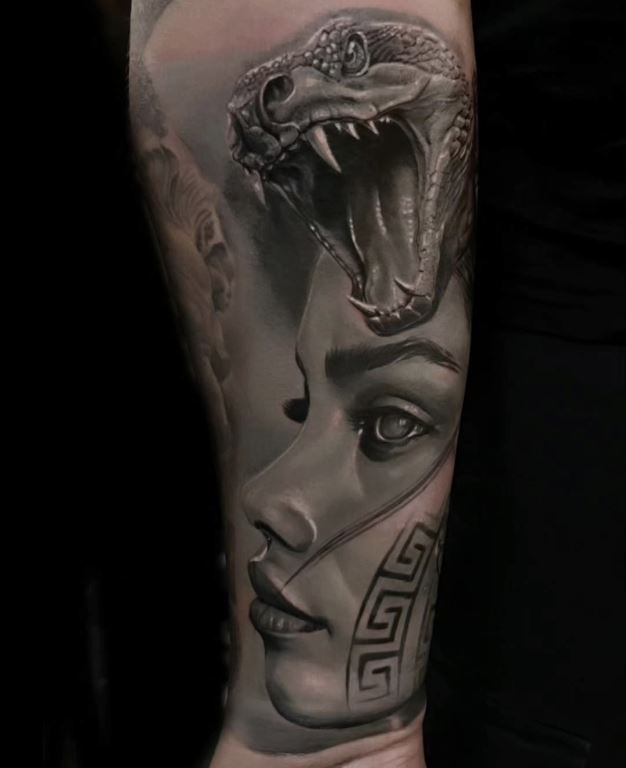
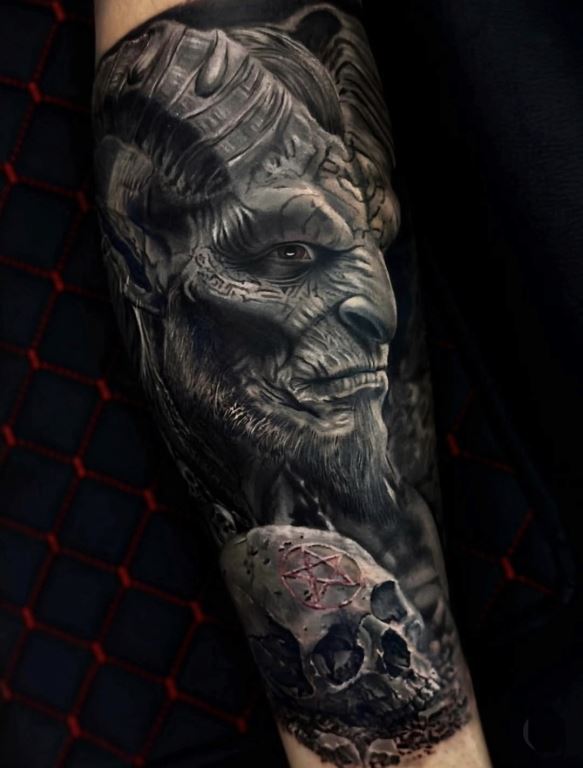
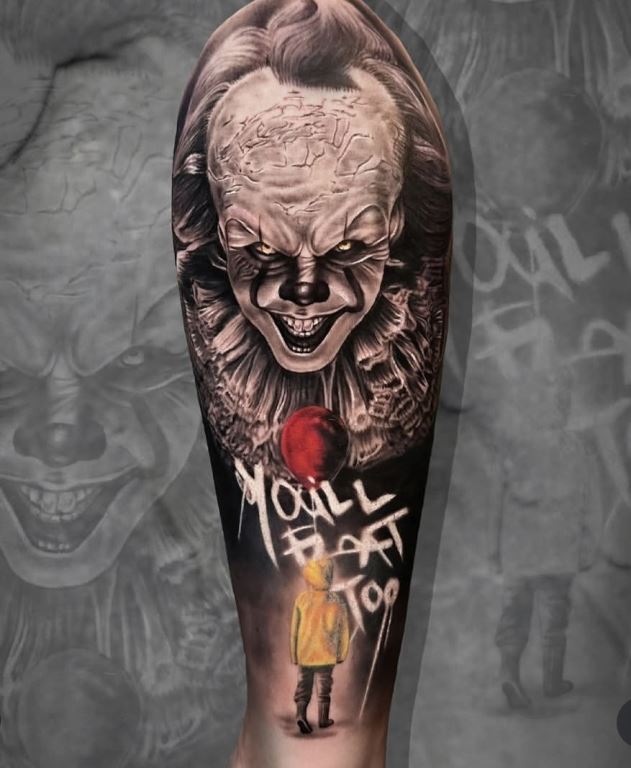
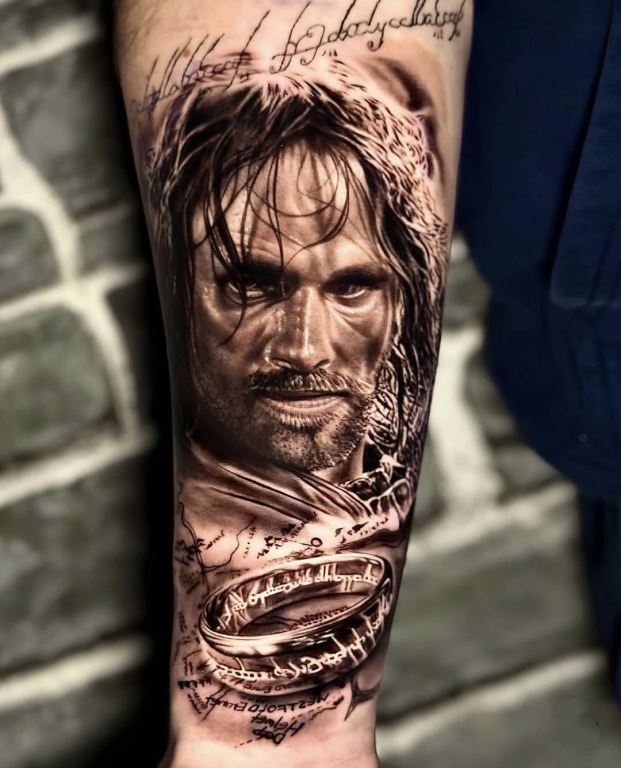
Ms. A.Funda Senoglu, a Turkish tattoo artist whose portfolio, stands
as a masterclass in dark, photorealistic artistry. Senoglu’s work is
characterized by dramatic depth and a monochromatic focus that
commands attention. While many artists dabble in realism, Şenoğlu’s
signature lies in her exceptional control of high-contrast light and
shadow, creating portraits and figures that feel as though they are
emerging from a rich, shadowy void, as can be seen generally in her
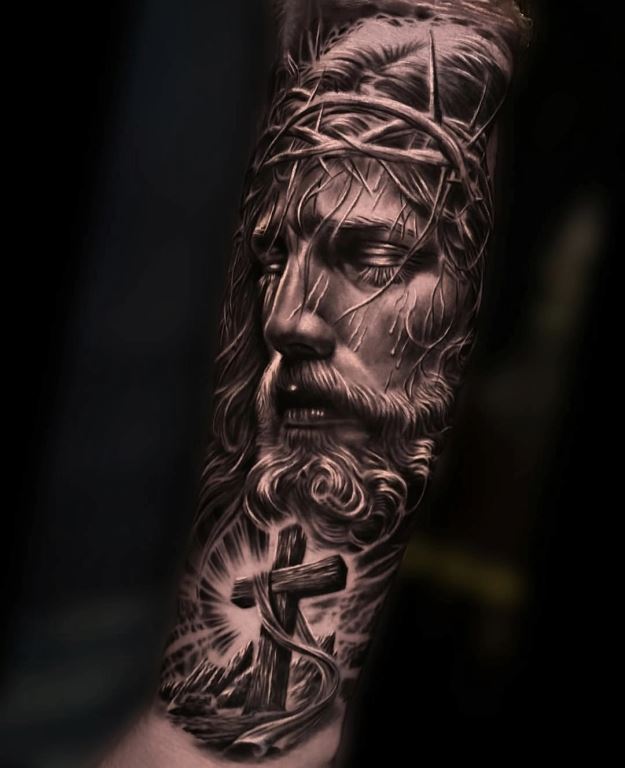
black-and-grey work. Her technique, evident across a variety of
complex subjects from human figures to mythical deities, is precise,
texture-rich, and deeply evocative, blurring the line between
classical sculpture and contemporary body art. We delve into her
journey, her evolving vision, and her place within the expanding
world of global tattooing.
Q: Your artistic style is incredibly developed and distinct.
Before you picked up a tattoo machine, what was your relationship
with art? Were you always drawn to darker aesthetics and
photorealism in traditional mediums like drawing or painting?
A: Art has been a part of my life since childhood. Drawing was
always more than a hobby for me, it was how I expressed myself and
found peace, especially during difficult times. I was always drawn
to realistic portraits, but what fascinated me most was not just
technical accuracy; it was emotion. I loved creating faces with
dramatic expressions and a sense of depth that could make people
feel something. Looking back, I realize my passion for realism and
emotional storytelling started long before I became a tattoo artist.
Tattooing simply became the next chapter of that artistic journey.
Q: How did you make the decision to move from classical art
or other career paths into the specific world of tattooing? What did
that initial transition look like for you?
A: Before tattooing, I spent many years working as a sales manager
for corporate companies. The turning point came during the pandemic.
Like many people, I found myself spending more time drawing and
exploring social media, where I discovered the work of incredible
tattoo artists. Their creativity inspired me, and I started asking
myself, “Could I do this too?” I began creating my own tattoo
designs with pencil, and the more I drew, the more certain I became
that this was the path I wanted to follow. I joined the Cleopatra
Ink Academy, where I received my first professional training, and my
family supported me from the very beginning. Looking back, the
pandemic led me to turn my greatest passion into my profession.
Discovering the art of tattooing was one of the greatest
opportunities of my life, and I will always consider it a true gift.
Q: Looking back at your first year of tattooing, what was
the steepest learning curve you faced, and what is one valuable
lesson from that time that you still carry with you today?
A: The biggest challenge wasn’t tattooing itself, it was me. I was
constantly chasing perfection and wanted to improve much faster than
was realistically possible. I was often my own harshest critic, and
that perfectionism sometimes affected my confidence more than any
technical challenge. Over time, I learned that growth cannot be
rushed. Every tattoo teaches you something, and real progress comes
from building one step at a time. Today, I still have high standards
for myself, but I’ve learned to trust the process. Looking back, I
realize that patience is just as important as talent.
Q: Were there any specific artists whose work initially
inspired you to pursue this craft?
A: When I first decided to become a tattoo artist, I wasn’t yet
familiar with the masters I admire today. At that time, I was
looking at tattooing through the eyes of a beginner, so I was
inspired more by great tattoos than by specific names. As I became
more experienced, my perspective evolved. I discovered artists whose
technical skill, creativity, and artistic vision deeply influenced
me. I believe that’s a natural part of growing as an artist, your
eye becomes more refined, your standards grow higher, and your
appreciation for true mastery matures with you.
Q: Your work consistently features an exceptional mastery of
high-contrast lighting and rich, dark tones. In general terms, how
did you cultivate your proficiency with contrast and dramatic shadow
play?
A: My approach has been shaped by one thing above all: watching
tattoos heal. Over time, I realized that my real focus shouldn’t be
how a tattoo looks on the day it’s finished, but how it will look
months and years down the road. High contrast plays a key role in
that. It helps the design stay clear, readable, and visually strong
as it settles into the skin. My goal is to create tattoos that age
beautifully, maintain their depth, and require as little touch-up
work as possible. For me, contrast is not just an artistic choice,
it’s a long-term commitment to the quality and longevity of the
work.
Q: Photorealism requires extreme precision. What is your
fundamental approach to capturing the 'essence' or 'soul' of a
portrait subject, ensuring it looks alive rather than just
technically accurate?
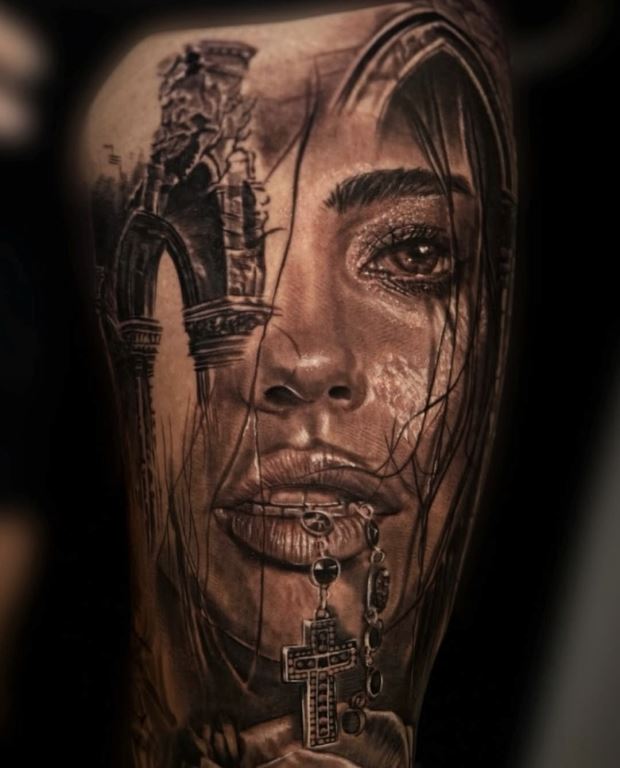
A: For me, the soul of a portrait lives in the smallest details.
Wrinkles, skin texture, subtle facial expressions, and especially
the eyes are what make a portrait feel alive. Technical accuracy is
important, but emotion is what creates a real connection. I have
always been drawn to dramatic expressions and meaningful gazes
because they tell a story without words. My goal is not simply to
reproduce a face, but to preserve the feeling behind it. I believe
those subtle details are what transform realism into something truly
alive.
Q: While you predominantly work in black and grey, when you
do integrate color, it is always dramatic and strategic. How do you
decide when a design demands a flash of saturated color, and how do
you approach the composition differently when you do?
A: I think my specialization developed quite naturally. I started
my career focusing on black and grey, and as people recognized my
work in that style, I was offered more and more projects that
matched it. I genuinely enjoy creating color tattoos as well, and I
continue to develop myself in that area. In most cases, the decision
to use color comes from the concept of the design and the client’s
vision. Sometimes I make suggestions, but for me, the most important
thing is choosing the approach that best serves the tattoo rather
than sticking rigidly to one specific style.
Q: The textures in your portfolio, particularly in things
like fur, feathers, and skin, are incredibly realistic. In a general
conceptual sense, what techniques or processes have you found most
effective for rendering complex, lifelike textures?
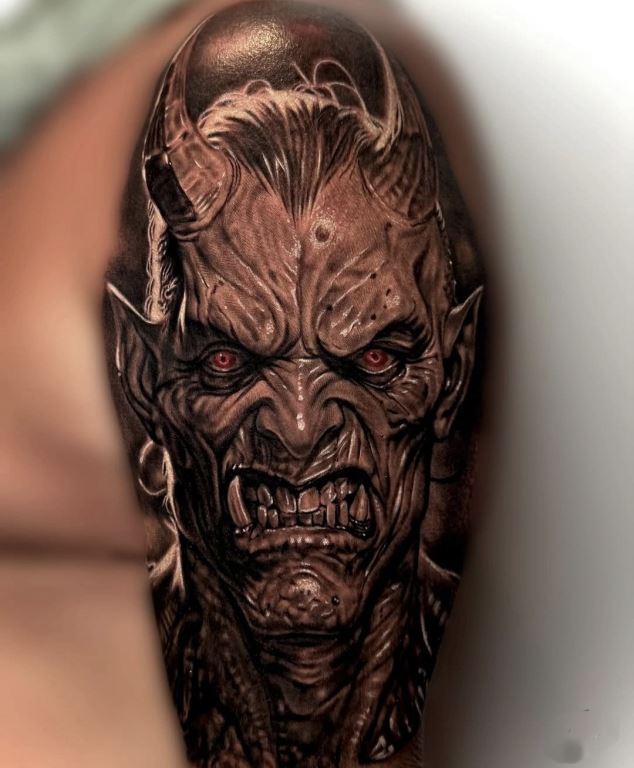
A: When I’m tattooing, I don’t think of it as simply copying a
reference I think like a painter. As a child, I loved watching Bob
Ross, and I admired the way he would say, “Let’s add a little detail
here,” as if he were bringing the painting to life. I still work
with that same mindset. Instead of trying to copy every tiny element
exactly, I focus on understanding what should naturally exist in
that area. I believe that is what makes textures feel more organic
and alive.
Q: Monochromatic art often has to work harder to maintain
clarity and readability over time. How do you, as an artist,
approach balancing technical, high-detail work with the long-term
integrity and durability of the tattoo?
A: When I create a tattoo, I’m not thinking about how it will look
when it’s freshly finished, I’m thinking about how it will look
after it has healed. That perspective influences every decision I
make. I pay close attention to contrast and avoid placing too many
similar tones next to each other, because I know some of those
subtle differences will soften over time. My goal is to preserve
clarity and depth for years to come. A tattoo should look beautiful
not only on the day it’s done, but long after it becomes a natural
part of the person’s skin.
Q: Is there a specific conceptual breakthrough you made
that, when you look back, really solidified your current direction?
A: My biggest breakthrough was making peace with myself. For a long
time, I was my own harshest critic, and that constant pressure held
me back more than I realized. Everything changed when I stopped
focusing on perfection and started enjoying the creative process. I
began approaching each tattoo with excitement instead of anxiety,
and I could immediately see the difference in my work. Learning to
appreciate my own abilities didn’t make me less ambitious, it made
me a better artist.
Q: When a client approaches you with a vague idea, what is
the most rewarding part of the collaborative process as you bring
that dark, photorealistic concept to life?
A: For me, the most rewarding part is transforming a simple idea
into something more meaningful without losing what the client
originally imagined. I always listen carefully to what my clients
want because their story and their vision are the foundation of the
design. Most clients describe their ideas in a simple way, which is
completely natural. My role is to translate those ideas into a
stronger artistic composition while staying true to what they want
to express. The best moment is when they see the final design and
realize it has become even better than they imagined.
Q: Have you had an opportunity to work as a guest artist or
attend international conventions, and if so, how have those
experiences influenced your perception of your own work?
A: Because of my busy schedule, I didn’t attend many tattoo
conventions for a long time, and looking back, I think that was a
mistake. This year, I finally attended a convention for the first
time, and it completely changed my perspective. Being surrounded by
hundreds of artists, exchanging ideas, and learning even the
smallest details from each other was an incredible experience. It
also made me feel like I was truly part of the global tattoo
community. I believe conventions are invaluable for both personal
and professional growth, and from now on, I hope to attend as many
as possible.
Q: What for you, is the ultimate measure of success for a
finished piece?
A: For me, the real test begins after the tattoo has healed. I’m
probably my own toughest critic, so the first thing I notice is what
could have been done better. If I can still clearly see the depth,
composition, and vision I had in mind and if I find fewer things to
criticize, I know I’ve created something successful. A tattoo should
continue to look strong and true to its original idea long after it
leaves the studio. That’s the standard I set for myself.
Q: Turkey has a unique culture and dynamic history. How does
being a Turkish artist living and working in Turkey inform or
influence your aesthetic, perhaps subliminally?
A: Absolutely. I live in Antalya, which I believe is one of the
most beautiful cities in the world. Here, the sea, forests, and
layers of history exist side by side. Because it’s an international
tourism destination, I meet people from all over the world every
day. Some days I work with clients from ten different countries,
each bringing their own culture, ideas, and stories. That diversity
constantly inspires me. It broadens my artistic perspective and
challenges me to create designs that connect with people from very
different backgrounds. Living in such a culturally rich environment
has shaped me not only as a tattoo artist, but also as a person. I
feel very fortunate to experience that every day.
Q: How would you describe the current evolution and maturity
of the tattoo scene within Turkey right now? Is the demand for
specialized, high-concept styles like yours increasing locally?
A: I believe the tattoo scene in Turkey has reached an impressively
high level. We have a remarkable number of talented artists, many of
whom come from fine arts backgrounds and approach tattooing with
genuine passion and professionalism. Every year, I see more artists
pushing their creativity and technical skills to an international
standard. I also believe a new generation of exceptionally talented
tattoo artists is emerging, and many of them have the potential to
become recognized worldwide. At the same time, clients in Turkey are
becoming more informed and are increasingly looking for artists
whose style truly matches their vision. I think the future of
Turkish tattooing is very bright.
Q: The global tattoo community is now extremely
interconnected. Where do you feel Turkish photorealistic artists
stand in the context of the larger European or global scene?
A: I think tattooing is different from many other professions
because we don’t work with a local mindset, we work with a global
one. Of course we follow artists in our own country, but at the same
time, we’re constantly learning from artists all over the world. We
see the same new techniques, design trends, and artistic movements
almost simultaneously. Social media has made our industry incredibly
connected. Turkish tattoo artists are very much a part of that
global community. We continue to grow alongside the international
scene, and I believe our artists are producing work that can
confidently stand on the world stage.
Q: Do you see significant differences in client expectations
and artistic freedom between your local clients and international
clients?
A: In my experience, people are actually much more similar than
they are different. Regardless of where they come from, most clients
simply want a tattoo that has meaning and is created with care. The
biggest difference is usually time. Local clients often have more
flexibility, so we can take longer to develop the design and
schedule multiple sessions if needed. International clients,
especially those visiting Antalya on holiday, usually have a limited
timeframe, so we have to fit both the design process and the tattoo
into a much shorter window. Each experience has its own challenges,
and I’ve learned to enjoy both.
Q: Tattooing is both physically and artistically demanding.
What does "creative rejuvenation" look like for you to avoid burnout
and keep your vision fresh?
A: Working in a tourist city means that some periods of the year
are incredibly intense. There are weeks when I work every single day
without a break, and that naturally becomes both physically and
mentally demanding. I’ve learned that taking time to rest is not a
luxury, it’s a necessity. Even a short break allows me to return
with a clear mind, renewed energy, and a fresh perspective.
Tattooing requires complete focus, creativity, and physical
endurance, so I believe every artist should make time to recharge.
Taking care of yourself is also part of taking care of your art.
Q: Looking toward the next five years, are there any
technical or conceptual challenges you still want to conquer, or new
territories in art you are eager to explore?
A: Absolutely. I still feel like I’m at the beginning of my
journey. There is so much I want to learn, experience, and achieve.
Every day I challenge myself to be a little better than I was the
day before. I don’t believe there is a finish line in art, there is
always another level to reach. That mindset keeps me motivated. I
have big goals for the future, and I truly believe that with
dedication and continuous learning, I can achieve them.
Q: What is the single message or feeling you hope your art
leaves with the world, both on skin and in memory?
A: More than anything, I hope my tattoos bring happiness every time
someone looks at them. My goal is to create exactly what my client
dreamed of, something they will proudly carry for the rest of their
lives. Tattooing is unique because it creates a lifelong connection
between the artist and the person wearing the work. Every beautiful
tattoo leaves a part of the artist with the client forever. Knowing
that someone can look at my work years later and still smile is the
greatest reward I could ever ask for. That lasting connection is
what gives my work its deepest meaning.


