
Interview with Giulia Covelli
Hello Giulia Covelli! Thank you so much
for taking the time to do this interview. To kick things off, could
you give us an overview of your background and what originally
inspired you to pursue art as your chosen creative path? I
am Giulia, 34 years old, Italian, although part of my family has
German roots. For as long as I can remember, art has been my way of
expressing myself, whether through drawing, dance, singing, or
acting. I have always been drawn to figurative art, and creating has
simply been the most natural way for me to connect with the world.
Q: What was the tipping point or the specific project that
made you pivot and dedicate yourself to art as a serious practice?
A: Art was something serious to me from the very beginning. There
was never a moment when I did not take artistic expression as both
the center of my life and the most natural path for my future
career.
Q: As you began your artistic journey, what were the styles,
periods, or specific artists that first captured your imagination
and truly shaped your aesthetic tastes?
A: I was strongly drawn to fashion design from an early age. As a
dancer, I used to sketch costumes for competitions: skirts, corsets,
lace, highlights, different textures. It still inspires me deeply.
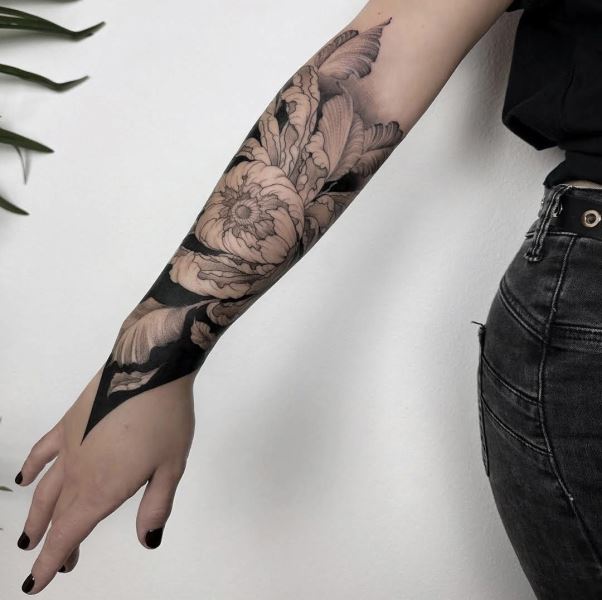
In painting, the Flemish masters of the 16th and 17th centuries
captivated me with their still lifes, floral compositions, and
portraits with dark, powerful backgrounds.
Q: When and how did tattooing come into the picture?
A: There was a specific moment when being an art lover and already a
tattoo client myself turned into the concrete idea of becoming a
tattoo artist. It happened in 2012, at a convention in Barcelona
where I was accompanying a friend who was getting tattooed. I spent
hours talking with an American artist who encouraged me to give it a
try. By the end of the day, I was holding my first tattoo machine.
That is where it began.
Q: Walking into a professional studio marks a big change.
What was the most significant challenge during your transition from
beginner to professional, and what specific source of inspiration
kept you driven through that adjustment period?
A: The real shift from being a beginner to feeling like a
professional came when I started seeing a consistent line of healed
tattoos that looked good and happy clients who kept coming back.
Those early years were challenging. You make mistakes, you compare
yourself to others, and you carry the emotional weight of wanting to
do things right. Confidence comes after years of effort, both
physical and emotional. I owe a lot to my mentor, Riccardo Bottino,
and to the experienced artists who worked beside me and helped me
grow. And of course to the clients who trusted me from day one and
still do.
Q: Your work has a distinctive focus on floral motifs and
ornamental designs. What specifically draws you to this aesthetic,
and what do these styles allow you to express that others do not?
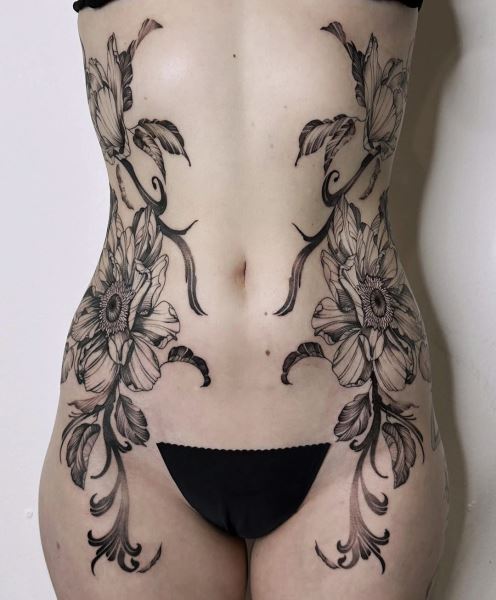
A: I have always believed that a tattoo is more than a symbol or a
story. It is a garment that cannot be taken off. When I tattoo, I
feel like I am dressing a body permanently, shaping something that
becomes part of a person’s identity. Floral and ornamental motifs
are the perfect language for that. They follow and enhance the
body’s natural lines, bringing harmony, balance, and beauty to the
skin.
Q: While your ornamental and floral work is very distinct,
are there any other styles or techniques that currently intrigue
you, and might you consider integrating elements of them into your
practice down the road?
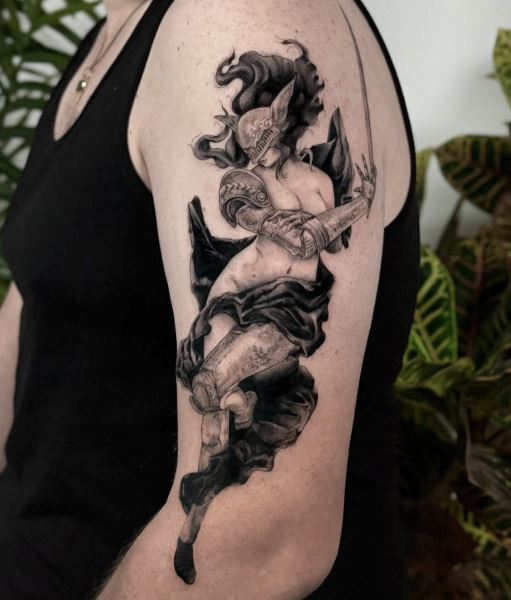
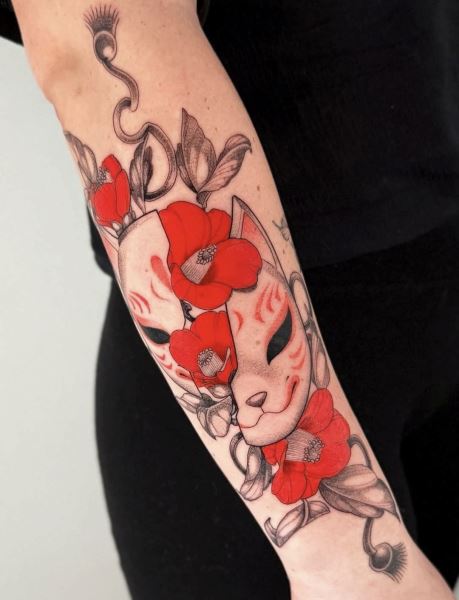
A: In recent years, and even more intensively in the last few
months, I have been studying Japanese tattooing. I find it elegant
and deeply fascinating. What draws me to it is the idea of the
tattoo as a flowing composition that dresses and transforms the
body. My goal is to let this art form influence my vision and
reinterpret its beauty through my own aesthetic.
Q: Regardless of their appearance, which tattoos in your
portfolio typically require the most time, patience, and intricate
detail work to execute perfectly?
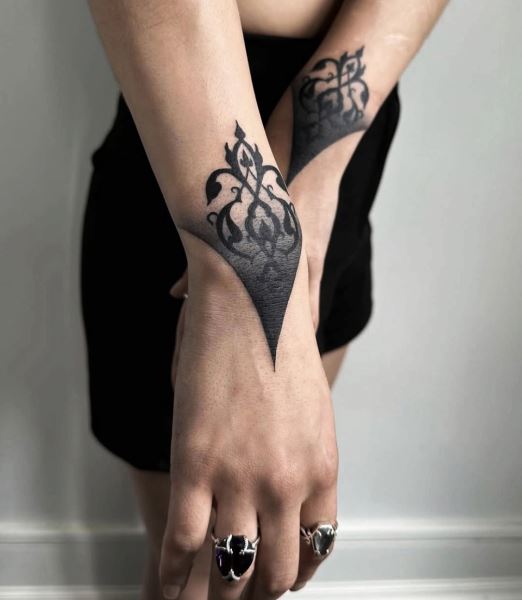
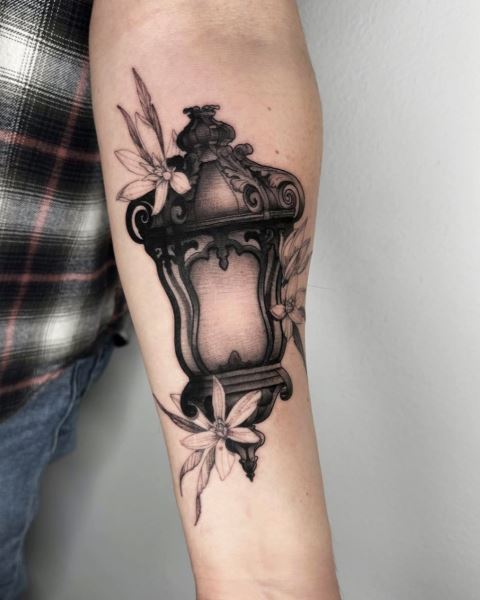
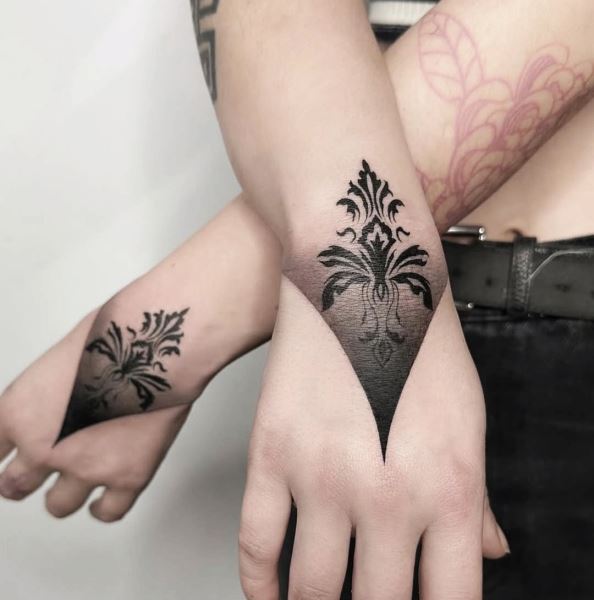
A: Among the tattoos in my portfolio, the ornamental wrist cuffs are
a good example of technically demanding work. They combine sharp
ornamental structures with smooth, delicate shading that overlays
areas of solid black. These tattoos require precise geometric
placement on the body, especially around the wrists where the skin
and anatomy can vary. Even though they are not large pieces, they
demand great concentration and control.
Q: Could you walk us through your design process? How
critical is it to finalize the concept before the session, and what
are the non-negotiable principles you establish with a client before
scheduling their appointment?
A: Before every project, whether in person or online, I always hold
a detailed consultation. I Iisten carefully to each client’s needs
and define exactly what we will be creating, so they know what to
expect and can approach the session with calm and confidence.
Harmony with the body is essential to me. I want every tattoo to
enhance the person wearing it, never to treat the body as a mere
canvas. My goal is for each client to leave not only with a
beautiful piece, but also with a stronger sense of confidence and
connection to themselves. While I always stay true to my artistic
integrity, I am flexible and open to adapting my designs so they
reflect both my vision and the client’s individuality. However, I do
not accept project that are politicized or offensive in nature.
Q: In a seemingly saturated industry, how do you prioritize
and maintain your reputation for quality and trust? What are the key
professional practices you rely on to consistently stand out as a
reliable artist?
A: In tattooing, technical skill alone is never enough. What truly
builds trust is empathy, honesty, and respect for the people who
choose to wear your art forever. Over time, I have learned that
consistency, in both attitude and quality, matters most. I listen, I
try to understand what people need, and I treat every project with
the same care and gratitude, no matter how small or big it is. When
clients feel safe, respected, and proud of what they carry on their
skin, that is when real trust is earned.
Q: In your career, has there been a particular client or a
tattoo story that stands out, perhaps one that was especially
meaningful, transformative, or memorable for you?
A: Out of respect for my clients’ privacy, I cannot share one
specific story. But I know I have accompanied many women through the
journey of feeling more comfortable with their bodies. Seeing them
go from hiding certain parts of themselves to showing them with
pride and happiness is incredibly meaningful to me.
Q: Every artist encounters projects that push their
boundaries. Can you recall a specific tattoo that tested your
creative and technical skills in a significant way, and what made
the final outcome so rewarding?
A: One project that truly challenged me was a large back piece
including the glutes for a woman who practices aerial disciplines.
Her body is her instrument, and I wanted the tattoo to honor that. I
designed an extensive ornamental composition that highlighted her
strength and movement while helping her feel even more confident in
her own shape. Seeing her love her body more, and watching it move
gracefully while she performs her own art with this new aesthetic,
was the most rewarding part.
Q: In addition to custom commissions, do you offer a
selection of flash or pre-drawn designs that clients can choose from
as a basis for their tattoo?
A: Yes, I keep a personal flashbook, although I generally prefer to
create custom pieces for each individual. Every person is unique and
deserves something made exclusively for them.
Q: If a client walked in and granted you total creative
freedom with no limitations on time, size, or budget, what is the
ultimate dream concept you would execute, and where would you place
it on the body?
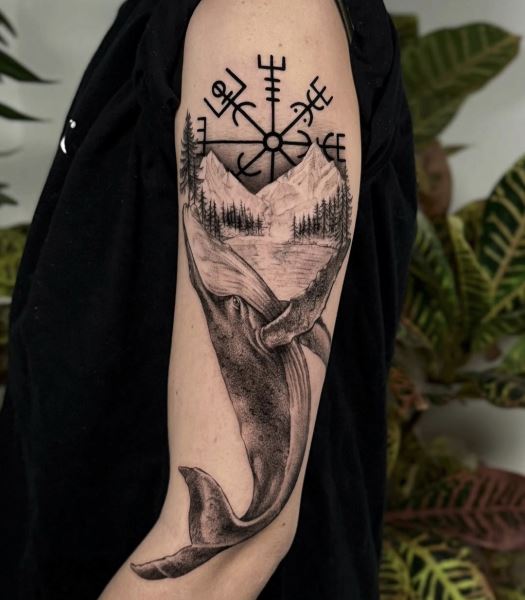
A: At this point in my career, my dream project would be a full
bodysuit, clean, elegant, and harmonious rather than overly complex.
I love the idea of highlighting the body’s strength, while gently
softening areas a person may feel less confident about. An
ornamental composition with a touch of Eastern influence would
capture the kind of beauty I would like to bring to life.
Q: Looking at the industry in general, how have the
demographics and societal view of the tattooed person changed over
the last decade? What kinds of people are getting tattoos now that
were not ten years ago?
A: Today there is really no single type of person who gets tattooed.
My clients come from every possible background, from very young
people getting their first tattoo to clients in their seventies or
eighties. I have worked on professionals from many fields, including
healthcare and law enforcement, as well as entire families,
parents.. even grandparents who come to get tattooed together.
Q: The global tattoo market seems to be characterized by an
increasing demand for unique, highly personalized work. Do you view
this intense focus on custom designs as the defining result of the
industry's progress over the last decade, and what is your broader
take on the direction of the global tattoo scene?
A: As tattooing became more popular and accessible, it was natural
for part of the public to seek something truly personal and unique.
This growing demand for custom work has raised the overall quality
level of the industry. People expect more, and many artists are
responding with greater dedication and skill. It is easier than ever
to fall behind, but I prefer to concentrate on my own growth and on
making my clients happy. When I look at other artists, it is for
inspiration and exchange, to learn and evolve.
Q: Shifting the focus to your immediate area, what is your
take on the local tattoo scene? Are you seeing new talent emerge
with fresh perspectives and innovative styles?
A: I see many young artists bringing fresh energy into the tattoo
scene. Compared to when I started, the general technical level has
risen significantly. New talents have access to endless sources of
inspiration and education through digital media, which gives them
great opportunities for growth and creative experimentation.
Q: Please write down your studio location and website or
social media links. Also, let us know if you are available for
bookings.
A: My studio is Nero Tattoo Atelier, located at Duino 26, Duino
Aurisina, Trieste, Italy. Website: www.nerotattooatelier.com.
Instagram: @_giuliacovelli_ I am currently available for bookings in
Italy and abroad.
Q: As a tattoo artist yourself, your own collection must be
a curated reflection of your artistic values. Could you share some
insights into the pieces you have chosen for your own body and the
artists behind them? Additionally, what key considerations would you
advise someone to keep in mind when selecting a tattoo artist?
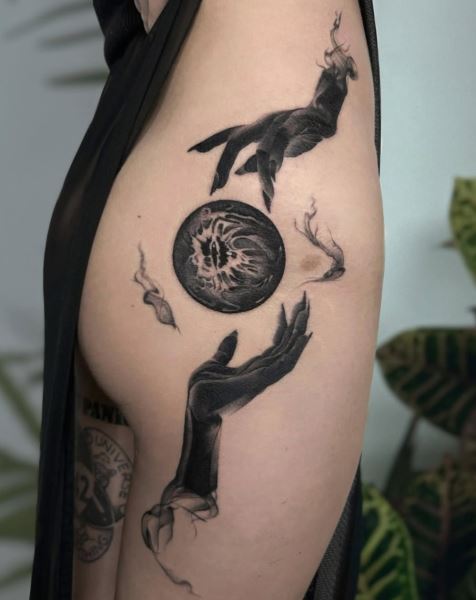
A: Some of the pieces I wear were created by artists such as Mitch
Allenden, Gaia Leone, Rodrigo Kalaka, and Damien Rodriguez, among
others whose work I deeply respect. When choosing a tattoo artist,
look for healed work, not just photos. Make sure the style speaks to
you and, above all, that you feel comfortable and confident in their
hands. Trust and connection make all the difference.
Q: Given the demands of consistently delivering high
quality, custom work, are there occasions when you experience
creative blocks or encounterchallenges in meeting client
expectations?
A: Of course, I am human. There are moments when I feel creatively
tired, especially when I am exhausted or going through personal
challenges. It is part of being human, and it is important to
acknowledge that.
Q: What do you do in your free time? Any interesting
hobbies?
A: I am a very active person. I still love to dance, and I also
practice pole dance. Skiing is another big passion of mine. As soon
as the first snow falls, I am on the slopes. Staying active helps me
clear my mind and recharge creatively.
Q: How often do you attend tattoo conventions? In your
experience, how valuable are tattoo conventions for artistic growth
and building client relationships?
A: Over the years, I have attended many tattoo conventions across
Europe, and they have played a big role in my artistic and
professional growth. Conventions push you beyond your comfort zone,
connect you with other artists, and allow you to work with clients
from different places. I have been fortunate to receive recognition
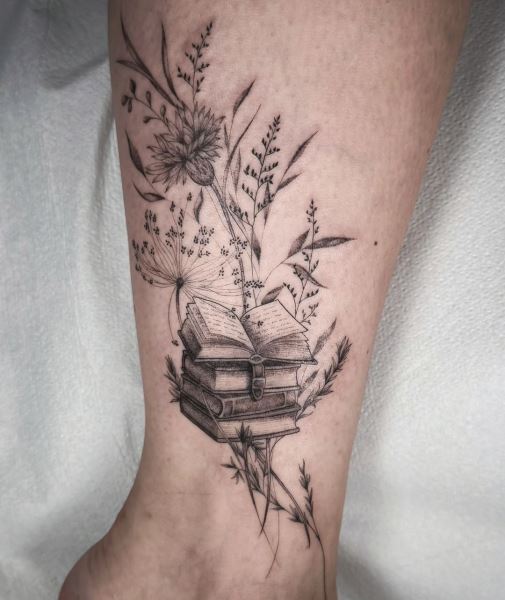
at some of them, such as Best Black and Grey at the Inkspire
Convention in Brussels and Best Ornamental at the Trieste Tattoo
Convention. I have also participated in wonderful events in
Deauville and Épinal in France, where I have had the honor of
serving as a judge.
Q: What about guest spots? Have you ever worked as a guest
artist in another studio either locally or in a foreign country? If
so, what was the experience?
A: Guest spots are the part of my work I love the most. They let me
step into other artists’ creative spaces, connect on a deeper level,
and experience different dynamics. I have worked in many studios
over the years, and these are just some I want to mention among a
longer list. In Italy, White Whale Tattoo Society by Matteo
Nangeroni and Hard Times Torinoby Gaia Leone. Abroad, My work has
drawn significant interest from the Japanese art community, leading
to highly inspiring creative exchanges and professional invitations
from renowned spaces like Three Tides Tattoo in Tokyo. This strong
demand and respect for my contemporary ornamental style in Asia
represent an exciting next chapter for my artistic journey.
Q: Given the significant presence and variety within the
American tattoo world, is that a landscape you might be interested
in engaging with professionally at some point in your career?
A: Yes, I am very interested in the American tattoo scene,
especially in the Oregon and Washington area. There is something
about the atmosphere and aesthetics of that region that fascinates
me deeply.
Q: If you were to consider establishing a presence in the
American tattoo scene, what kind of environment do you envision
would be most conducive to showcasing your work and supporting your
continued artistic evolution?
A: Just like in Europe, I expect to gravitate toward environments
that reflect my values, places where artistic freedom, attention to
detail, and a calm, respectful atmosphere come together. What works
for me is a studio that is organized, clean, and safe, where
creativity can flow naturally. The same kind of environment would
suit me in the United States as well.
Q: What impact do you aspire to have on the tattoo
community?
A: I hope to inspire positivity, in behavior, in values, and in the
way we approach tattooing. A tattoo is not just a sticker on the
skin or a rebellious gesture. It is a meaningful, cultural act that
deserves care and respect. I want to be a light, positive presence,
and also someone who reminds others that this craft carries real
depth and soul.
Q: If you could go back and give your younger self advice
about pursuing tattooing, what would it be?
A: I would tell my younger self to believe in herself a little more
and not to get lost in comparison with others, to focus instead on
surpassing her own limits. I would remind her to take her time, to
celebrate every small achievement, and to enjoy the journey without
too much pressure or expectation. In the end, it is not the
destination that matters most, but the path itself!


