
Interview with Hanzo
Hello Johann Salzinger aka Hanzo, we
appreciate you taking the time for this interview. Can you tell us
about your background and how you honed your craft? For instance,
did your artistic development come from independent study or formal
education? I have always been fascinated by tattoos,
especially through films with yakuza. Drawing and painting was a big
hobby when I was a child, as a teenager and young adult, I lost the
passion for it, but latter on, I rediscover it and at 30 the next
step was tattooing as a self-taught.
Q: Can you recall the moment or period when you understood
that art was more than just a pursuit, but a true calling? What was
the spark that set you on this path?
A: Yes , that was the time when social media came. Before that, I
was primarily doing flash designs, sometimes I think "yeah my work
is really good now". Than facebook and Instagram become very popular
and I saw many great tattoo artists there, so I knew that I have to
get much better. I tried to get better in drawing and tattooing and
I found the right way, my own style step by step.
Q: At what point did you recognize tattooing as a
significant avenue for your artistic expression? What motivated that
shift, and how did you navigate that transition?
A: When I started drawing and painting again as a hobby at the age
of thirty. At that time I was getting tattoed by myself and I
thought this is it, I wanna do this.
Q: What were the defining characteristics of your beginner
tattoo work, and what specific influences or experiences drove the
development of your current style?
A: In the beginning, I did small stuff like tribals an scripts, then
started working with all others.

Q: What is it about the Japanese tattoo style that
captivates you? Could you elaborate on its cultural and artistic
significance, and what you find most compelling about it?
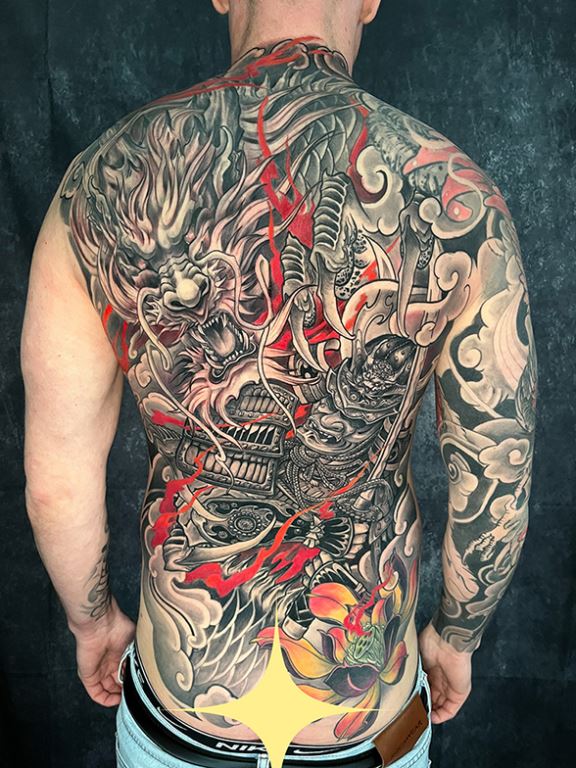
A: The main reason for me was the aesthetic, dynamic and harmony. I
Iove the power and mystic of this style. I love also the harmony
with the black and grey background and bright colors, for me the
perfect tattoo style.
Q: Given the rich symbolism inherent in Japanese tattooing,
with motifs like dragons and masks carrying profound meaning, do you
have any particular symbols or designs that resonate with you
personally, and why?
A: There is so much and also so much that I don't know but I love
the story about koifish that became a dragon. That story talks about
me - with strength, endurance and willpower you can achieve anything
in life!
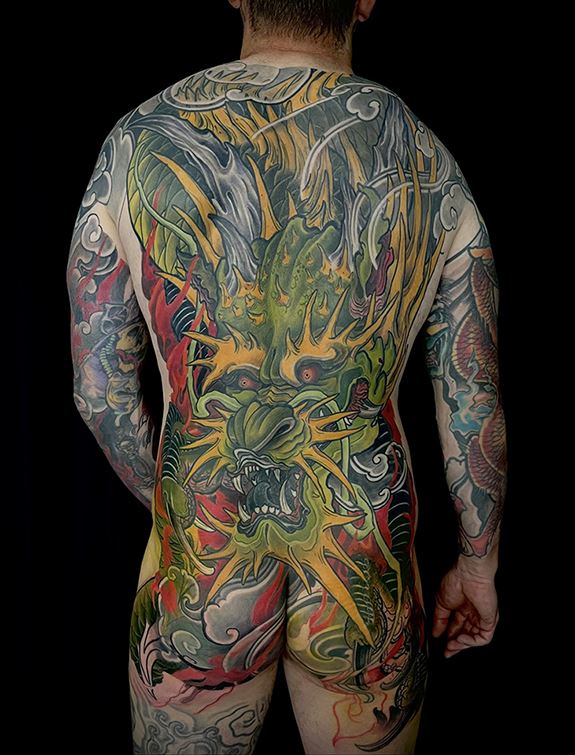
Q: The depth and vibrancy of your color palettes are
remarkable. Can you describe the artistic and technical skills
necessary to achieve such striking color contrasts and highlights?
And how does understanding ink properties play a crucial role?
A: I can't really explain it because I just do it the way I do.
Sometimes I'm amazed at how many different colors I use or need.
Understanding in ink is very important e.g. yellow and violet gives
a nice play of colors and looks not so dirty like yellow with grey
shadows.
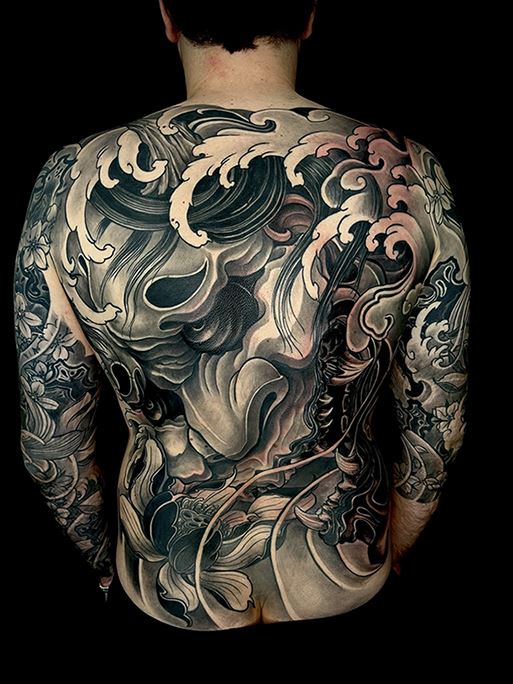
Q: Large-scale pieces like full back tattoos require
significant time and planning. Could you describe the collaborative
process with clients before embarking on such extensive projects?
A: First we discuss everything in person via phone, email or on
Instagram, we talk about placement, size, motif and sometimes the
client's story and if all fits. After that conversation I think
about how I can best implement it. Next step is the drawing via
procreate on my Ipad, after the designing process I send the drawing
to the client and discuss whether everything fits. I transfer the
motif with stencil and create the rest by drawing with my hands.
Q: Can you recall a tattoo that presented significant
creative and technical complexities, but ultimately resulted in a
piece you're particularly proud of?
A: Actually no. Seeing my healed tattoos with excellent contrast and
vibrant colors makes me personally very proud and happy.

Q: The permanence of tattooing and the high expectations of
clients can create significant pressure. How do you manage the
potential for feeling overwhelmed or experiencing creative blocks in
your daily practice?
A: Yes, the pressure to always give the best is really immense and
could be dangerous for me and also other artists. I was close to a
burnout a few years ago, but I was lucky that my wife recognized the
danger and pulled me out. Tattooing is my passion but I have learned
that is not all in life and I need also other hobbies for my inner
balance and health! I love and need my family, riding my Harley, go
mountain biking, go to stadium of Bayern Munich or to go to the
soccer games with my son.
Q: How do you navigate situations where client expectations
differ from your artistic vision? What are your boundaries in
balancing client desires with maintaining your artistic integrity?
A: This can be difficult sometimes but it is very rare because my
customers know what I am doing.
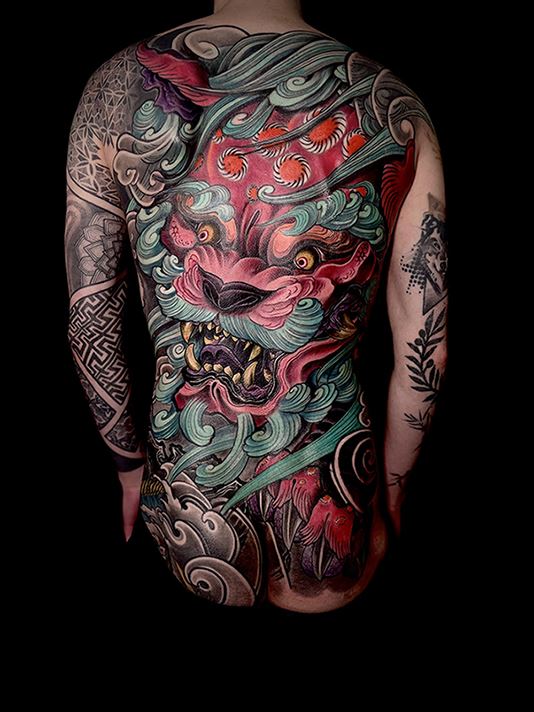
Q: Have you considered developing a clothing line featuring
your artwork?
A: Yes sometimes I have t-shirts printed.
Q: Amidst the constant emergence of new tattoo styles, what
are your thoughts on the long-term relevance and evolution of
traditional styles like Japanese tattooing?
A: I think that the traditional styles will always find fans and
customers, but perhaps not so many, because we had a demographic
change and the young people are all on tiktok and they follow
"tiktok tattoos" and tiktok-trends like minimalistic tattoos and
that is not good for the tattoo artists.
Q: Have you considered exploring other stylistic avenues in
your own work?
A: I'm fully booked for the upcoming year. Although I'm capable in
various tattoo styles and would explore them if there were fewer
opportunities for my Japanese work, tattooing in the Japanese style
is what truly brings me joy.
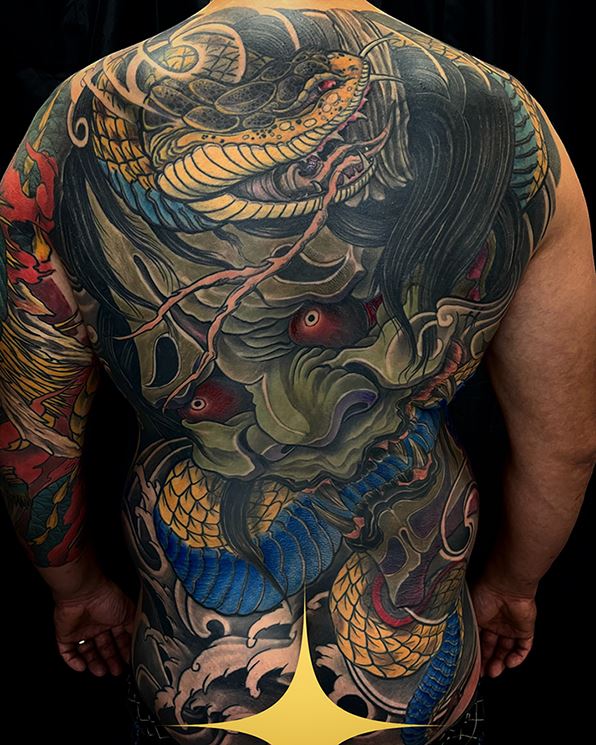
Q: Tattooing appears to facilitate a profound human
connection, where art and personal stories intertwine. How do you
perceive the transformative impact of this intimate exchange on both
the client and yourself?
A: Somehow a connection develops between the tattoo artist and the
customer, sometimes even friendships. You spend a lot of time
together and build trust. It's great when customers are enthusiastic
and keep coming back.
Q: What's your take on the local tattoo scene? Are you
seeing any exciting developments, like new artists, styles, or
events?
A: There are so many great artists working in different styles right
now but I think, tattooing is becoming more mainstream as art among
younger people and many people wanna be tattooers, even if they
can't. I think the future gets harder for tattoo artists.
Q: Please write down your studio location and website/social
media links. Also let us know if you are available for bookings.
Instagram, www.old-salt-tattoo.de
hanzo@outlook.de
Old-Salt-Tattoo
Sägewerkstraße 3
83395 Freilassing/Germany
Bookings are open contact via email or Instagram. We have an airport
20 minutes far from the shop.
Q: How frequently do you participate in tattoo conventions
or seminars? Do you find them valuable for professional development
and maintaining connections within the global tattoo community?
A: Before covid, I attended many tattoo conventions in Europe, my
favorite convention was in Florence, Italy, but nowadays, I only go
on conventions as a visitor. I have not received an award, because I
have never participated in a competition. Conventions are important
for the international top-scene and it is a lot of fun to be around
other artists and friends. I'm not planning any conventions in the
near future. My plan or better wish is getting the green card or the
O-1 visa for legal work in USA.
Q: How do you perceive the current trends shaping the global
tattoo scene, and what are your thoughts on the industry's overall
direction?
A: The global scene is full of great artists with incredible skills
and technical abilities. I think the tattoo scene in the USA is
bigger than in Europe and is more appreciated. I would like to
immerse myself in the American tattoo scene and get to know it.
Q: While tattooing is often idealized for its creative
freedom and client connections, it also entails demanding schedules
and consistent pressure to deliver exceptional work. What essential
considerations should aspiring tattoo artists weigh as they enter
this profession?
A: People who want to become tattoo artists should know that it
requires a lot of work and discipline to become successful and to be
able to make a living from it. They should first calculate how much
they need to earn to be able to pay for everything-that's a lot! The
best way is to find an instructor or teacher in a good tattoo-shop
for apprenticeship. But before all of this, they have to draw, paint
and design every day. The story of the koifish can help, if people
can understand it.


