
Interview with Jema Ferrer
Hello Jema Ferrer! Thank you
so much for taking the time to do this interview. It really means a
lot having you here. Please start by telling us a bit about yourself
and your background. I was born in Caracas, the capital of
Venezuela, and moved in with my paternal grandparents when I was
three. I was fortunate that my grandmother, a very artistic and
creative person, instilled in me a love for painting and music. From
a young age, I was surrounded by an environment full of artistic
expression, including dance and painting. The talent was always
within me. It developed naturally. I was always a creative and
artistic child. My first encounter with realism was through
portraits of people, which have always been my favorite. I am
captivated by symmetry, textures, and especially the eyes that
convey deep emotions. From a young age, I found inspiration in
creating models.
Q: What type of art do you like the most? Favorite
artists?
A: I feel a strong attraction to various art movements, especially
Romanticism, Impressionism, expressionism and surrealism. I find it
fascinating how each style uniquely conveys emotions and concepts.
Among my favorite artists, I deeply admire the works of Claude
Monet, Vincent van Gogh, Frida Kahlo, and Salvador Dalí. Each of
them has left an indelible mark on the art world with their singular
vision.
Q: What sparked your interest in tattooing?
A: I have always been obsessed with the technique of permanently
imprinting the skin with ink, which could be in different styles,
techniques, and gradients. This captivated me from a young age. I
used to draw on my friends' skin with markers at school, and I
always knew. When I was old enough to start tattooing, I knew it was
what I wanted to do. My first three tattoos were on my best friend,
who served as
guinea pig and still proudly wears them to this day.
Q: When did you do your first tattoo? What was it?
A: The first three tattoos I did were on my best friend, who served
as a guinea pig and still proudly wears them to this day. The first
one was a phrase that said, "She was like art," a quote from her
favorite childhood book.
Q: How long have you been tattooing professionally in a
tattoo studio?
A: I have been working in this field for seven years, five of which
have been professionally. The first professional studio I worked at
was AngryMom, located in Colombia.
Q: Was it difficult to get into this business? Did you face
any challenges? What kept you motivated?
A: Yes, definitely. Entering this industry was a challenge,
especially since it was primarily dominated by men. The talent,
discipline, and skills of women were underestimated. Additionally,
my youth was an obstacle in gaining clients' respect initially. I
didn't have much experience and was mostly self-taught, so I had to
dedicate several years exclusively to tattoo art, being the first to
arrive and the last to leave the studio. All this effort was
necessary for my rapid career evolution. My motivation is that art,
for me, goes beyond a simple job; it has become a lifestyle, a
necessary routine. I feel deeply connected to society through my
artistic expression and interaction with clients. Knowing their
stories and helping them process and ink them onto their skin is an
invaluable blessing to me.
Q: How long did it take to discover your creative direction?
A: I believe that creative direction is a constantly evolving
journey. While I have always been attracted to realism, techniques
and designs are continually changing. I think defining oneself too
rigidly can limit possibilities, so I remain open to exploring other
styles and techniques. I am always learning, experimenting, and
staying open to new ideas and approaches.

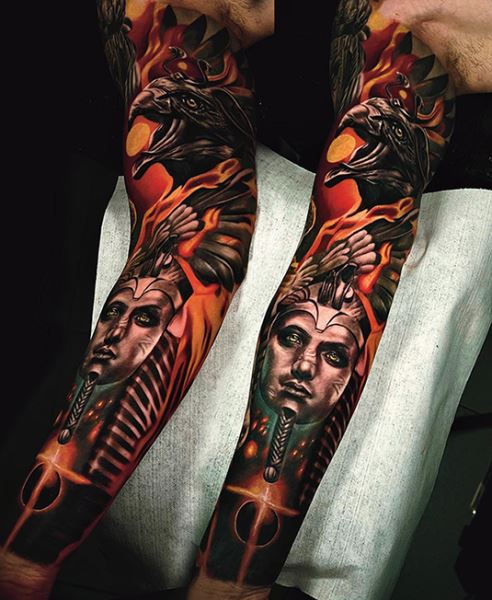
Q: How would you define your style?
A: In art, I prefer to see it as a free expression rather than
categorizing it into specific styles. As an emotional person, I aim
to offer my clients something that suits their personality, skin
tone, and the concept we are exploring together. Therefore, I don't
limit myself to a single style of expression; I always seek the best
option for each individual.
Q: Tell me about your creative process. Do you draw sketches
before the session?
A: In my creative process, I usually start with some sketches before
the session. For specific projects, I can dedicate days or even
weeks in advance. In the case of conceptual projects for
conventions, I might take over a month to create the design.
However, for realism projects with clients, the process is usually
more fluid. If we don't finalize the design during the session, I'm
willing to take another day to ensure that both the client and I are
satisfied with the result. Generally, I appreciate it when clients
come with clear ideas about what they want for their tattoo. I
recommend they seek inspiration before the appointment to have an
idea of the style and result they prefer. Although the final design
will be my creation, I always strive to respect the client's
decisions on how they want their tattoo to look on their body.
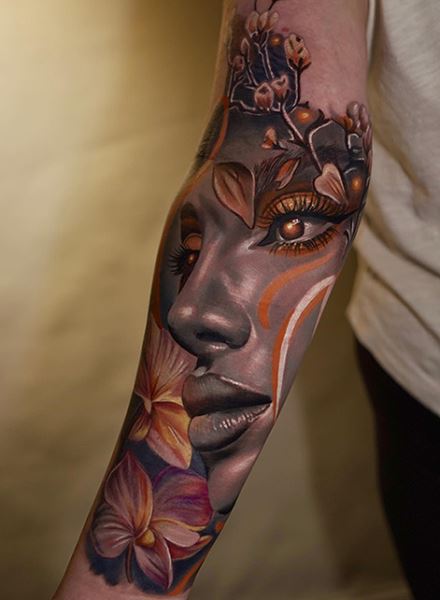
Q: Do you have a favorite tattoo you've done?
A: I genuinely enjoy every tattoo I create, from the experience with
my clients to the design, execution, and final result. However, one
of my
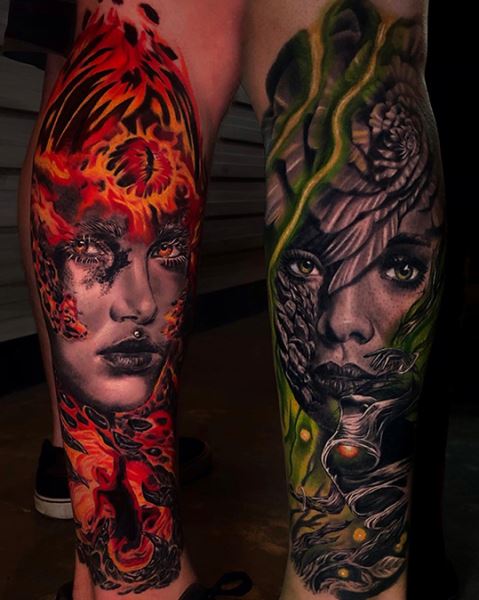
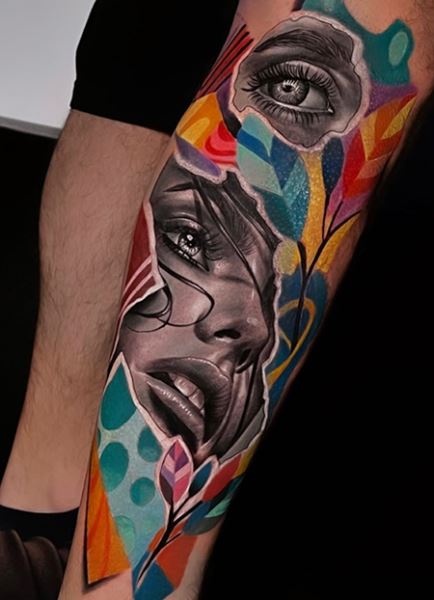
favorites was a biorganic-style tattoo, where the client allowed me
to draw directly on their skin. I had complete freedom to choose the
colors, making it one of my favorites.
Q: Which part of the body is the most difficult to tattoo?
A: I believe each part has its difficulty due to pain, skin
complications, or positioning discomfort. But if I had to pick one
that combines all three, I would say it's the neck area.
Q: How do you cheer up your clients during long sessions?
A: I usually try not to make my sessions too long. My sessions
typically last about 5 or 6 hours. I aim to make the studio space
comfortable for my clients. To stay focused, I maintain a balanced
diet that keeps me comfortable all day and drink plenty of water.
Q: How is the tattoo scene in Sweden? Do you see progress?
Please let us know if you are available for bookings.
A: The tattoo scene in Sweden is quite strong. It is one of the
countries with the highest number of tattooed people per capita. The
most popular styles would be blackwork, ignorant tattoos, and
traditional tattoos. I think we are now expanding more in terms of
styles, including realism and oriental. Over time, I believe there
will be more variety and color. I am available at Studio75 Studio
location: Kammakargatan 47 Email: Jema.citas@gmail.com
Q: As a traveling artist, what is your favorite place and
your ultimate growth point?
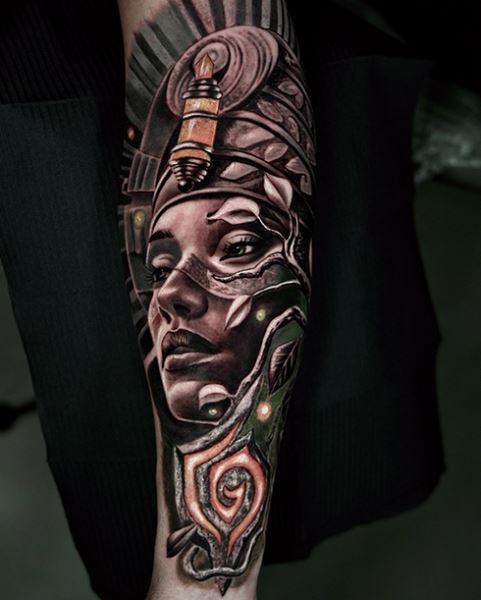
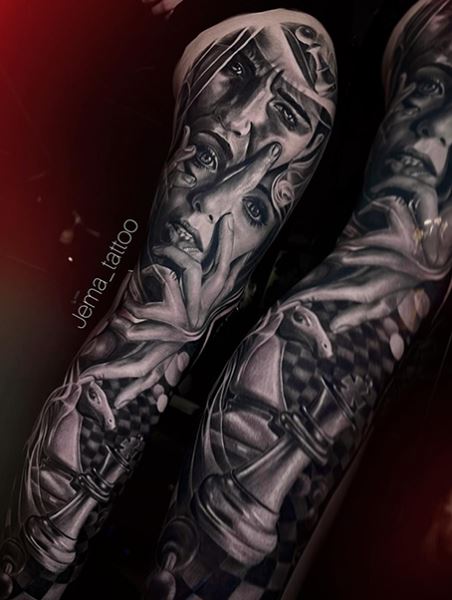
A: Currently, I frequently travel to countries like France, Germany,
and Belgium. My favorite place is in France, at an international
studio called La Machine Infernale Tattoo, which has many diverse
artists. It is a learning environment, a mix of cultures, and that's
very enriching. I do this for a few weeks, but I try to spend the
rest of the time in my home city, Stockholm, to work on large-format
projects and more complex designs that require multiple sessions.
Q: Your talent is undeniable, and I'm glad to see major
brands supporting your career. When did these wonderful
collaborations begin?
A: I feel very excited and fortunate to have the opportunity to work
with major brands in the industry. Many of these collaborations
started two or three years ago when they saw my work, believed in my
process, and offered me products to try. They were also interested
in my feedback and invited me to represent them at conventions and
competitions. My sponsors include brands like Yossi Tattoo, which
makes the best needles I've tried. I've been working with them for
about three years and am very satisfied with their products. I am
also sponsored by Raw Pigments, with whom I've had a very gratifying
experience over the past two years. Their pigments are easy to
apply, and the healing is impressive. I use Dermalize for skin care
during and after the work, and their products are amazing for
healing. Additionally, I use TKTX, an anesthetic I apply when my
clients experience a lot of pain.
Q: The tattoo industry in the United States is undeniably
powerful. Could it be a possible destination for you?
A: The United States leads the global tattoo industry, hosting many
of the world's most important conventions. The open-mindedness of
American consumers towards artistic expression, combined with their
online presence, provides artists with great creative freedom and
makes them true tattoo collectors. Additionally, the abundance of
tattoo studios with renowned artists offers a unique opportunity for
learning and professional growth. Living and working in such a place
is one of my biggest dreams, as I am sure it would enrich both my
career and my personal development.
Q: What do you like most about being a tattoo artist?
A: There are moments when I feel especially inspired, creative, and
connected with art, but I understand that no process or feeling is
linear. There have been ups and downs, but discipline and
determination keep me on the right track. Over time, my perception
of tattooing has become more mature, and I believe my enthusiasm has
evolved rather than stayed the same.
Q: The best moments of your career?
A: When I received the proposal to tattoo for the first time in
Sweden. When I conducted my first seminar in Colombia, alongside my
sponsors and some invited colleagues. The experiences I've had at
international conventions.
Q: What advice would you give to those who want to try
getting into professional tattooing?
A: I believe that each path in art is unique, but if I could give
myself advice when I started, it would be to seek out the muse
rather than wait for her to come. By this, I mean that you need to
actively work for creativity to flow, as the best ideas come while
you are creating.


