
Interview with Jhonatan Pabon Castro
Today, we have the pleasure of sitting down with
Jhonatan Eduardo Pabon Castro, a powerhouse in the realm of
black-and-grey realism and the founder of Atrios Ink. Known for his
breathtakingly detailed portraits and seamless integration of light
and shadow, Jhonatan has spent years traveling the globe, leaving
his mark on the international scene from Colombia to Europe. As he
prepares for a significant new chapter in the United States, we dive
into his journey, his technical philosophy, and his vision for the
future of the global tattoo community.
Q: Every artist has a "Day Zero." What was the very first
moment you realized that skin was the medium you were meant to
master?
A: I think the desire to see an outstanding result on skin was the
trigger for trying again and again to achieve it. My first tattoos
weren't very good, but that led me to dedicate many hours to each
project. With patience and a lot of self-criticism, I was able to
improve my work a lot, thank God!
Q: Looking back at your early work in Bogota, what were the
biggest technical hurdles you had to overcome to achieve the level
of realism you're known for today?
A: Finding good tattoo machines. In my early years, coil machines
were still the only ones I used. When I switched from coils to
rotary machines, the practicality of the rotary machines helped me
achieve better results without damaging the skin so much.
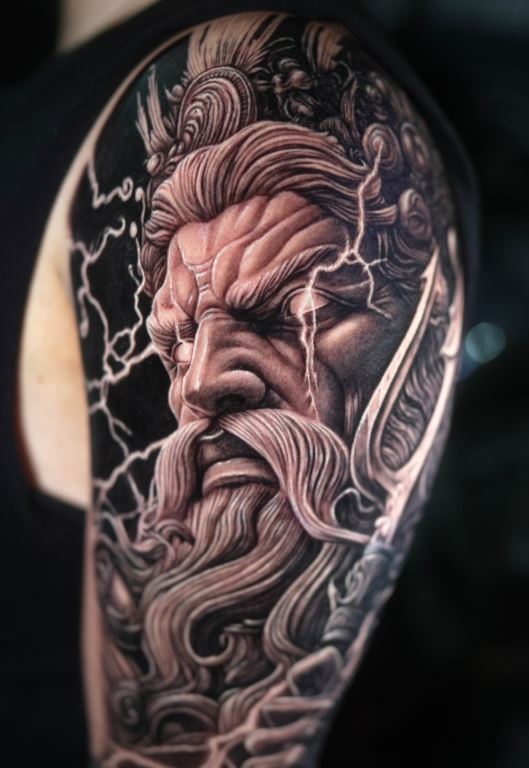
Q: Your work often features a striking
balance between deep blacks and luminous highlights. Who were the
artists, either in tattooing or classical art, that most influenced
your understanding of light and shadow?
A: I have three role models whose work inspires me to try to reach
that level of detail. They are true masters, and I hope to share the
stage with them someday: @Tampatattoo from Brazil,
@robertocarlosart_tattoo from Cuba, and @dmitriysamohin from
Ukraine, true tattoo GOATs.
Q: Realism requires immense discipline. How did you develop
the patience and "eye" necessary to capture such minute textures,
like the fur of an animal or the weathered skin of a portrait?
A: I think the frustration of not being able to achieve it in the
first attempts made me concentrate on how the cartridge needle
penetrates the skin, understanding the correct movements, the hand
must make so as not to lacerate the skin, and in turn, that softness
allows the skin to better withstand the friction of the needles in
order to achieve the correct textures.
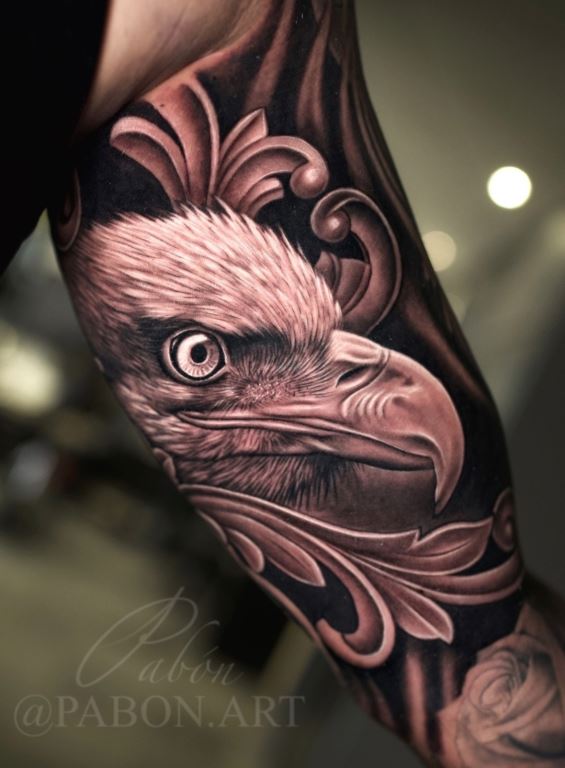
Q: Your work often uses "true blacks" to create a 3D effect.
How do you determine where to place the deepest saturation to ensure
the tattoo has the depth of a sculpture rather than just a flat
photo?
A: A key point is identifying the direction from which the light is
coming, the opposite side is where the darkest tones should go. What
my eye perceives as solid black, I inject pure black without fear,
then the mid-tones, and finally the light ones. But it's subjective
because each artist can have a different order and obtain the same
result with incredible detail. In my case, this method and order is
what works for me and seems most practical.
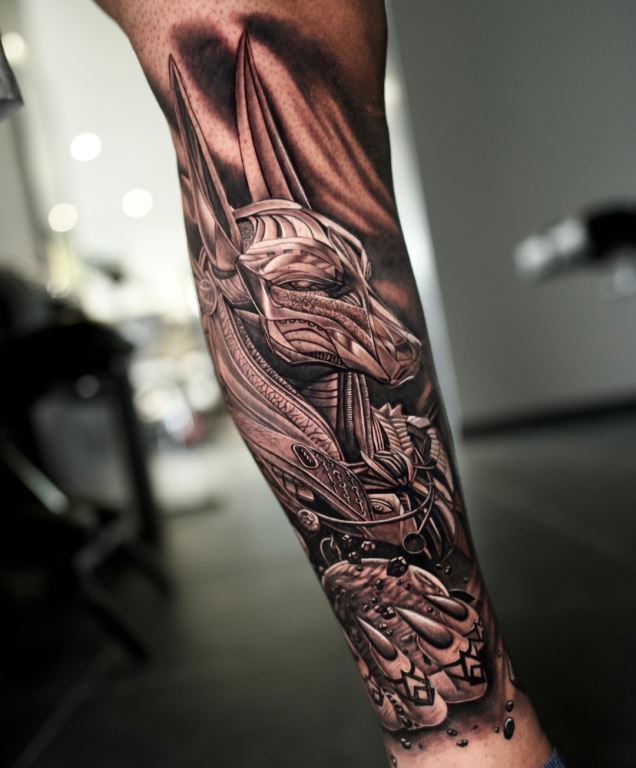
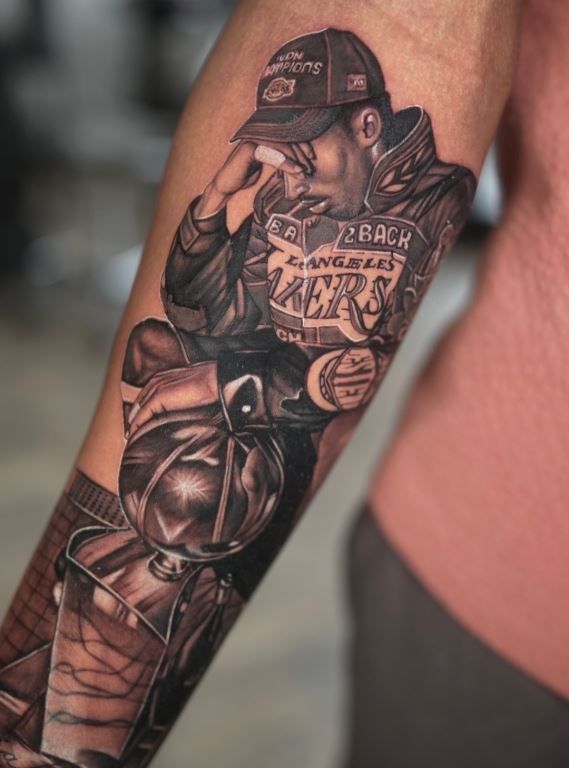
Q: From the weathered skin of a portrait
to the metallic sheen of a Spartan helmet, your textures are
incredibly tactile. What is your technical secret for keeping these
fine details from blurring over time?
A: It's all about practice. Human beings were designed to learn
repetitively, from babies repeating words to learn to speak, to
developing motor skills. Everything becomes better and more precise
when we accumulate hours of practice. There comes a point when
you're so confident that you inject the tones with precision. If
you're new to this art and want to be good, you can achieve it.
Invest many hours in practice and always look for good references
that inspire you. That hunger to learn will lead you to that
solidity. Trust the process.
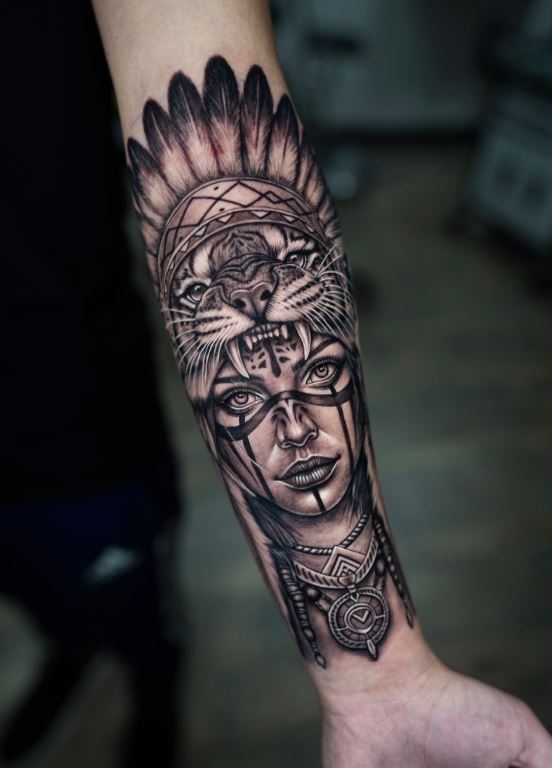
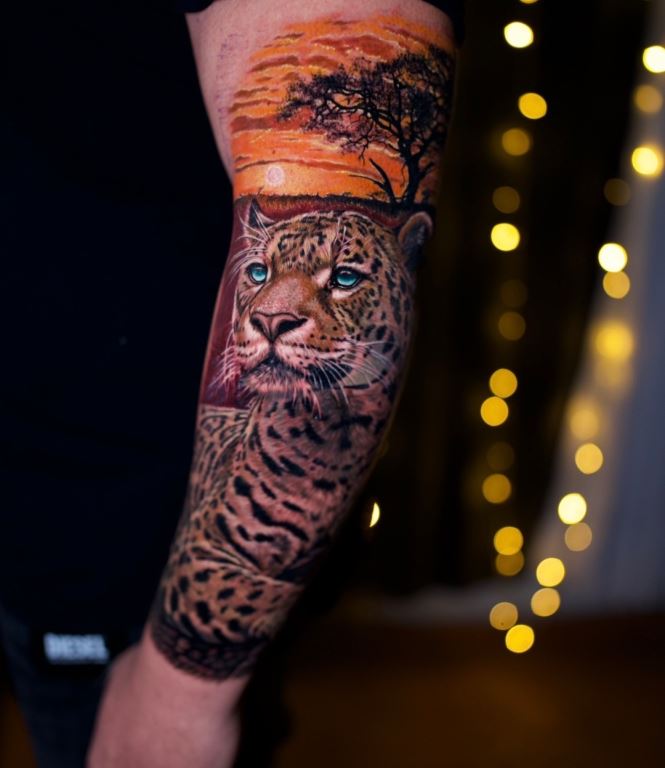
Q: In many of your pieces, like the Greek gods or the tiger
portraits, there is a distinct glow in the eyes. How do you approach
the "negative space" and white ink to create that piercing, lifelike
gaze?
A: I love doing this type of work. I study photographs of sculptures
or animals extensively, and I try to interpret the expression in
their eyes as closely as possible to the reality my eye perceives.
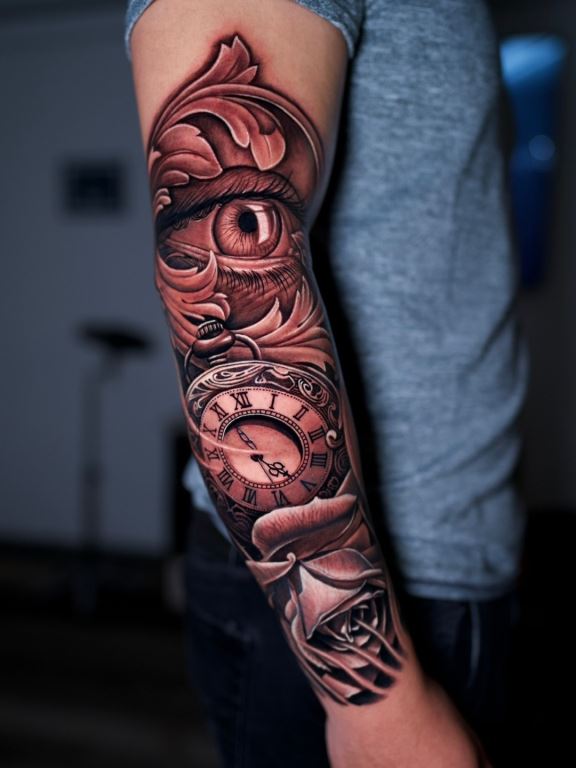
Q: Realism on a moving canvas (the human body) is much
harder than on paper. How do you adapt a flat reference image to
follow the natural muscle groups of a client's anatomy?
A: I look at the stencil from several angles. When I think it adapts
correctly to the area I'm going to work on, that's when I start. If
I see it's misaligned, I clean it up and reposition it until it
harmonizes with the body's muscles, so as not to distort the
important areas of the design.
Q: Looking at your Zeus and Poseidon
pieces, there's a clear nod to classical Renaissance sculpture. How
much does art history play a role when you are designing a custom
sleeve?
A: Before becoming a tattoo artist, I was very passionate about
sculpture. I studied it for two years, to the point of spending all
day in the workshop of Rigoberto Navas, my teacher, who taught me
everything I know about painting, sculpture, and anatomical drawing.
Thank God I had the privilege of learning the foundations from a
great Venezuelan visual artist, which led me to achieve what I can
do now. God has placed wonderful people in my path from whom I have
learned a great deal.
Q: Beyond technical skill, many of your pieces feel like
they are telling a story. How much of the "symbolism" is your own
creative input versus the client's request?
A: I always take the client's ideas as a starting point. Based on
those main ideas, I begin to build the design, and depending on what
they are, I try to create compositions that are pleasing to the eye,
where the beauty and brilliance of the elements stand out, something
that has an impact upon observation and that can be understood over
time. I try not to saturate the design with elements, that creates
order and beauty in the design.
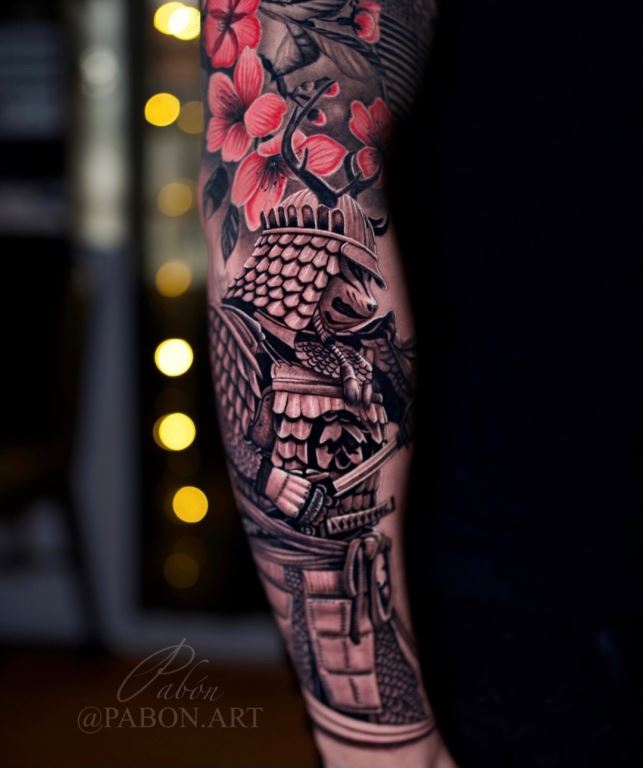
Q: If we compared a portrait you did three
years ago to one you finished today, what is the one technical
advancement in your style that you are most proud of?
A: Bringing eyes to life, whether in portraits of people or pets, is
something I see and I feel very satisfied with the results.
Q: At what point did you notice your reputation shifting
from a local artist to a sought-after name in the international
community?
A: Without realizing it, a point was reached where, thank God, my
schedule began to include clients from different countries, from
Europe, North America, Australia, and Latin America. People travel
from other countries to get tattooed by me, that's something I find
incredible! I still can't understand why, with so many good artists
in the world, people travel to have me work on their projects. It
fills my heart with joy and makes me realize that I'm good at what I
do. God bless all my friends who value my work.
Q: As the CEO and Founder of Atrios Ink, how has leading a
studio changed your personal approach to the art of tattooing?
A: I don't really attach much importance to being CEO; the most
important thing for me is that clients receive excellent work from
me. I am always available to serve anyone who needs it, regardless
of who they are, and that makes the atmosphere in the studio much
more pleasant.
Q: How do you balance the "business" of
being a high-profile artist with the need to remain creative and
experimental?
A: My anchor is God. Jesus came into this world to serve, not to be
served. I always try to be available and not let ego or vanity into
my life. This leads me to respect and give each person and client
the place they deserve. Colossians 3:23 says, “Whatever you do, work
at it with all your heart, as working for the Lord rather than for
human masters.” It’s a principle that inspires me to do everything
with excellence.
Q: You've spent a significant amount of time as a traveling
artist. How does the "tattoo culture" differ between South America
and the European studios where you've guest-spotted?
A: At this point, the tattoo world moves very fast. I think that in
both Latin America and Europe, tastes can become similar. Both
continents are very advanced in this art. I believe Latin America
has the largest number of incredible artists in the world, both in
terms of creativity and composition.
Q: When you are working in a foreign
country, how do you adapt your workflow to a new environment while
maintaining your signature quality?
A: I have become like a chameleon, I adapt easily to any environment
but without losing my essence or personality, I let things flow at
their own pace and I spend my free time with my wife, my son and
seek the presence of God in prayer.
Q: What is the most valuable lesson a foreign studio or
artist has taught you that you still carry with you today?
A: From a great Colombian tattoo artist named Leonardo Castañeda. In
my early days, I had the opportunity to see him tattoo at a
convention. He told me something that has stayed with me forever:
“Skin doesn't deserve to be mistreated, always treat it with care.”
This forever changed my perspective that tattoos are extremely
painful. Now I can work for eight hours straight, and my clients
endure the entire session.
Q: You’ve participated in major events like the Ibiza Tattoo
Convention Tattoo. What do you feel is the most important role these
high-level conventions play in an artist’s career?
A: They are extremely important because they push you to strive for
excellence in every stroke you make, encouraging your brain to
develop a new level of detail in every piece we create. Without a
doubt, it's healthy competition that demands the best from every
artist.
Q: When you are surrounded by the world's
best talent at a convention, what is the one thing you look for to
stay inspired?
A: I try to be myself. I try not to focus on what others are doing
so as not to alter the essence of who I am or my work. I let the
pressure of the event drive me, but I don't get lost trying to fit
in. I'm as much myself as possible in every way, haha.
Q: Realism can be mentally exhausting due to the level of
focus required. What is the "fuel" that keeps you motivated during a
10-hour session?
A: Seeing the progress of each piece blows my mind. Knowing that you
are capturing those details on the skin makes 10 hours feel like 1
hour. I lose track of time and just enjoy what I do. I love my job.
Q: With such a big following and international demand, how
do you manage your booking process to ensure you're taking on
projects that truly challenge you?
A: The filter will always be the level of detail in the design, any
project that demands a high level of detail will always be welcome.
Q: The United States has a legendary tattoo history. What is
it about the American tattoo scene that draws you there for this
next stage of your career?
A: Being able to share the tattoo scene with old friends and
colleagues who are currently making waves in the US scene. Seeing
them again and learning everything I can from them motivates me to
explore this new scene.
Q: Moving to the States is a major
milestone. How do you plan to merge your South American roots and
European experiences with the aesthetic of the US market?
A: It's something I don't know yet, I hope to discover it along the
way, with God guiding every step I take.
Q: What are your primary goals both artistically and
professionally once you are established in the USA?
A: To be able to bring satisfaction and fulfillment through my art
to each client, so they can wear every project I create with pride
and joy. And also to be able to live here with my family.
Q: How do you hope to contribute to the local community in
the States? Are there specific artists or studios you are looking
forward to collaborating with?
A: I would love to work with my friend Dario Rodriguez, a great
Venezuelan artist who has his studio in Seattle, and also with my
friend Ramon Nieves, another great Venezuelan artist who lives in
Charlotte.
Q: If you could go back and give one piece of advice to the
younger Jhonatan just starting out in Bogota, what would it be?
A: Keep dreaming, keep believing in yourself, you're going to
achieve it, every second is worth it, God is with you!
Date: 22 March 2026
Interview: Ivana Kancheska


