
Interview with Julia Penza
To mark the eighteen anniversary of Skin Artists
Tattoo Magazine, we are spotlighting the creative forces who are
actively rewriting the rules of modern surrealism. Julia Penza has
been selected for this milestone celebration as a top-tier artist
whose work masterfully balances the line between the mystical and
the hyper-technical.
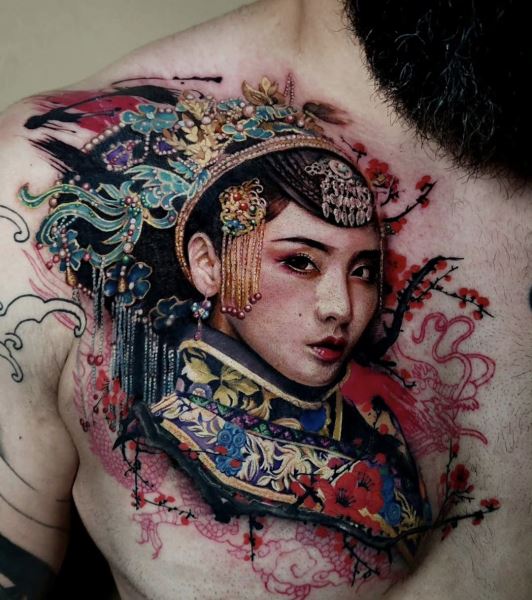
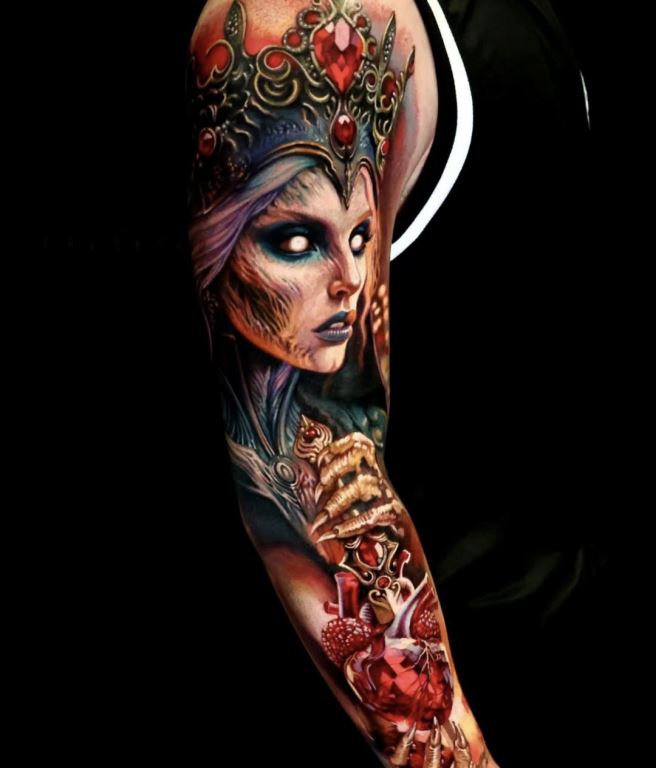
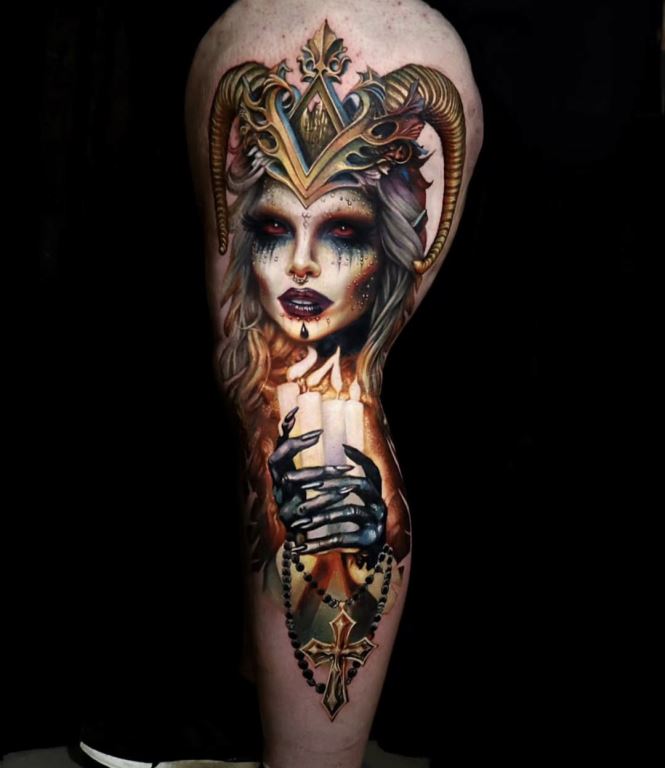
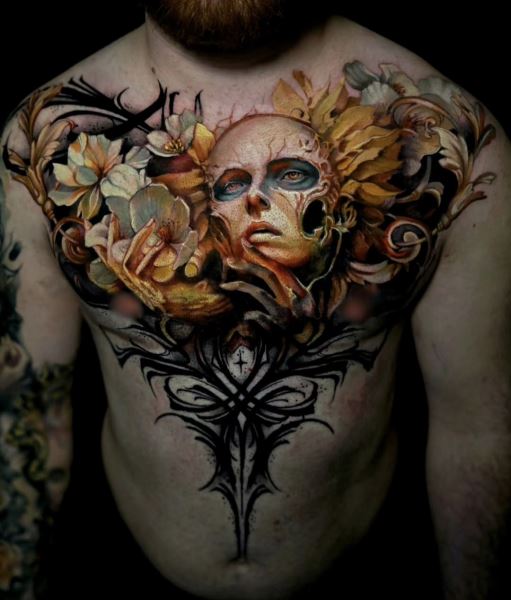
Julia’s signature style often referred to under the "Ink Goddess"
motif is an exploration of power and transformation. Her portfolio
showcases a profound ability to manipulate light, making her
subjects appear as if they are emerging from a deep, velvety
shadows. By weaving together intricate ornamental details with raw,
emotive portraiture, she creates a visual language that feels both
ancient and sharply contemporary.
This interview moves beyond the surface to tackle the central theme
of this series: exploring the future of tattooing. We delve into the
shifting demands of the high-end collector, the psychological
connection required to manifest such complex archetypes, and Julia's
vision for where the craft is headed as the industry enters its next
major era.
Q: Your compositions often feature a central "protagonist"
surrounded by chaotic, beautiful elements. How do you decide which
single element holds the emotional weight of a full-sleeve story?
A: I wouldn’t say that I intentionally choose a “hero” for the
composition. Usually everything starts with a reference that
inspires me visually. From there I build the composition, changing
details and adding elements. It’s easier when the theme is set by a
competition or a client, because the topic already gives direction.
When there are no limits, it’s harder to focus on one thing, because
there are many ideas and I want to try all the different variations.
But when I have to choose myself, I rely on an emotional response.
It’s the moment when a design feels complete and I don’t want to
change anything about it.
Q: Many artists can copy a photo, but you "edit" reality.
How do you determine which parts of a reference to keep sharp and
which parts to let dissolve into surrealism?
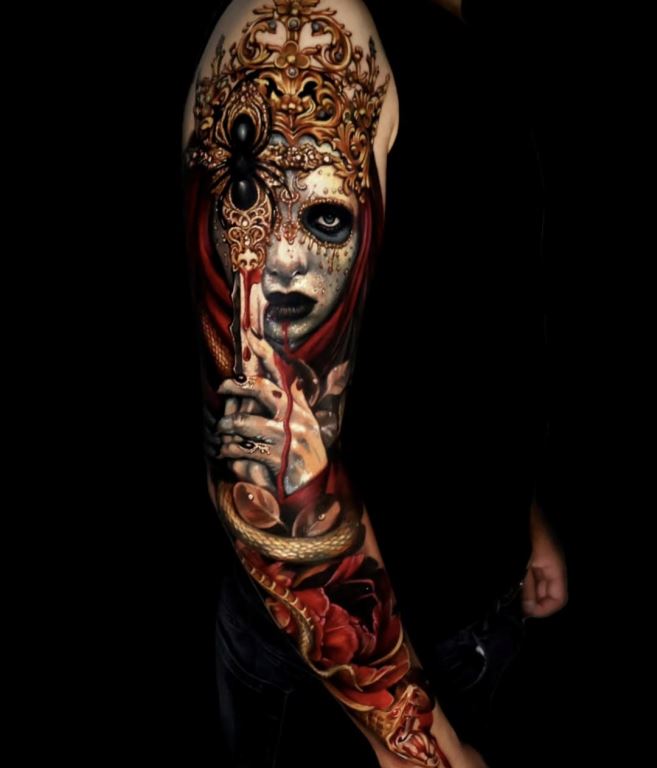
A: It’s difficult to answer this question because there isn’t a
specific rule. I think it largely depends on each artist’s personal
taste and artistic vision. That vision is what I would call talent
the rest is technique, and technique can be learned. If I look at my
own process, I often choose to emphasize unusual textures and deep,
rich colors. I’m especially drawn to materials like velvet, metal,
glass, fur, glowing elements and some kind of patterns. These
effects are what I like to add to otherwise ordinary designs to give
them a unique character.
Q: Your use of light makes your tattoos
look like they are illuminated from within. Do you view color as a
decorative tool, or do you use specific palettes to manipulate the
viewer's mood?
A: I believe working with color is one of my strongest sides. While
many artists see only a few shades of the same color, I tend to see
a whole palette. Even with a wide range of inks available, I often
mix additional tones to achieve the exact shade I want. The glowing
effect and depth of color usually come from strong contrast. Many
artists are afraid to use very dark shades, but in my opinion that’s
where the real secret lies. Not every ink brand actually offers deep
and saturated enough colors to create this effect. As for my
personal preferences, I most often choose warm tones, simply because
they reflect my mood better.
Q: You frequently portray powerful, often ethereal or
dark-goddess-like women. What does this archetype represent to you
in the context of 2026’s evolving social landscape?
A: I’m glad you noticed this tendency in my work and described it as
a “dark goddess.” In fact, I’m currently developing my personal
brand called Ink Goddess. For me, divine power represents something
magical, something I think many people would love to possess. Female
beauty is unique, attractive, and captivating. When I add darker,
mystical elements, it softens the overly “girly” look and gives the
character a sense of strength and power. This balance of beauty and
dark magic is also something that resonates strongly with many of my
male clients.
Q: You have an incredible ability to
render fine details like lace or jewelry. How do you ensure these
small elements don't "clutter" the overall impact of the piece?
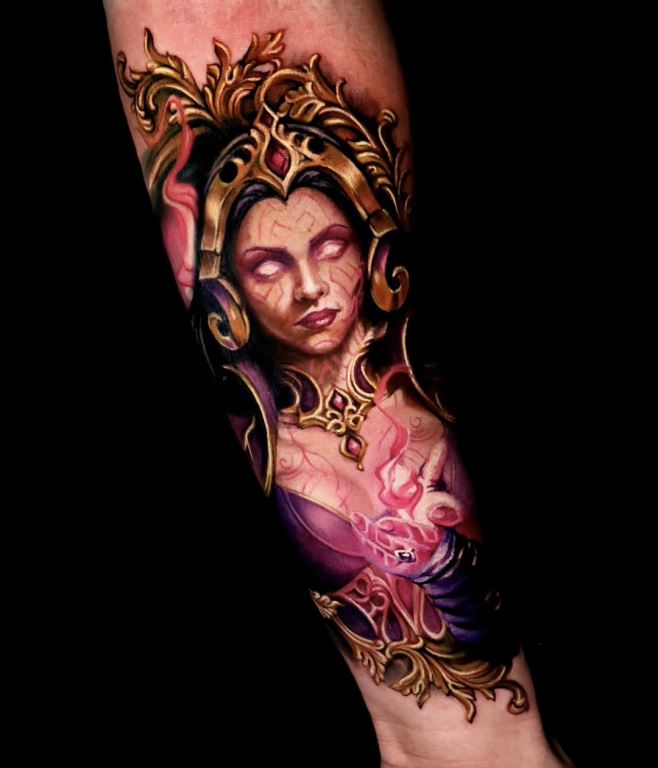
A: The secret is balance. Everything in the design has to be
balanced, and nothing should dominate too much. When the elements
are in harmony, even very fine details won’t feel overwhelming or
cluttered.
Q: Have you ever used AI to generate a texture or a lighting
reference that you otherwise couldn't have imagined, and where do
you draw the line between "AI assistance" and "AI replacement"?
A: In today’s technological world, it’s important not to ignore new
tools. We have to move with the times. Yes, I use AI to replace a
small part of my workflow, mainly when searching for reference
images. Before AI, the process looked like this: I would imagine a
design and then spend a huge amount of time searching the internet
for images that could help me build the composition I needed. Even
then, the references were often only partially suitable and rarely
matched my idea perfectly. With AI, this stage of the process has
become much faster. By describing my vision, I can generate
references that are much closer to what I imagine and use them as a
starting point for my work. However, I don’t believe AI can ever
fully replace human vision. It creates images based on human
prompts. And to write the right prompt, you first have to see the
design in your own mind. In that sense, AI is just a tool that helps
bring an artist’s vision to life, not something that replaces it.
Q: In 2026, "perfect" tattoos are
everywhere. What "human flaw" or artistic "grit" do you
intentionally leave in your work to make it feel alive?
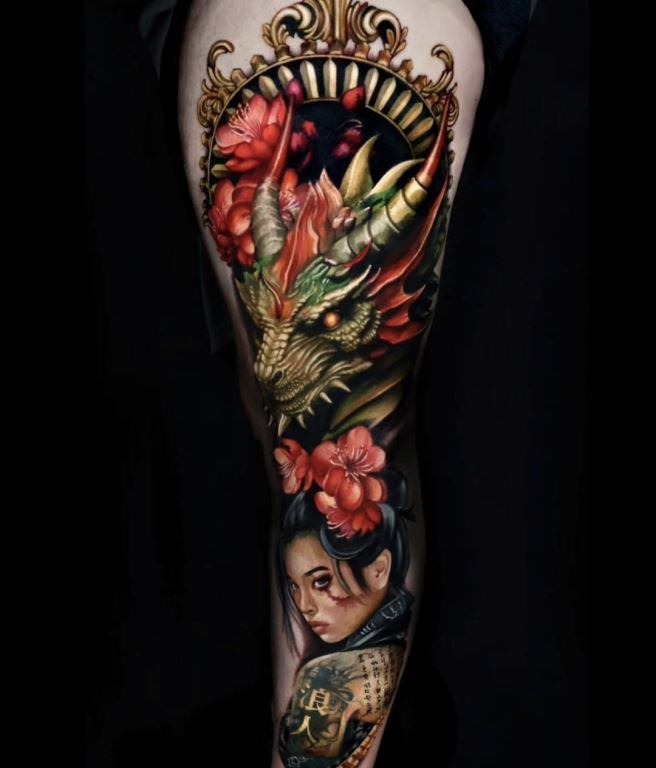
A: It’s great that this impression exists, because it means the
industry has grown a lot in terms of quality and tattooing has truly
become an art form. However, I can assure you that even the most
well-known artists, just like me, will always find imperfections in
their own work. Because of that, I don’t intentionally leave flaws
in my works. Instead, I allow small imperfections to exist if they
are not significant, while continuing to improve my skills with
every new piece.
Q: As digital design becomes the standard, how do we protect
the 'Originality' of a piece? In 2026, is a 'custom' tattoo still
custom if the inspiration came from a shared algorithm?
A: This question can be viewed from different perspectives. The
first is artistic vision, and the second is technical execution.
From the perspective of artistic vision, very few artists copy a
design exactly as it is. Most professionals adapt publicly available
references and transform them into their own interpretation. From
the technical side, even the same design executed by different
artists will always look different. Technique, style, and personal
approach inevitably make each piece unique.
Q: We are hearing more about 'responsive'
pigments that change with temperature or light. As a color
specialist, does the idea of a 'living, shifting palette' excite
you, or is the permanence of traditional ink the whole point of the
art?
A: I’m generally supportive of any kind of progress, and I think
it’s a very interesting idea. Technologies like responsive pigments
sound exciting and open new possibilities for the future of
tattooing. However, as a tattoo artist who mainly works with a wide
palette of colors, this technique currently offers limited
opportunities to express my personal style. My work relies heavily
on complex color combinations and depth, so for now traditional inks
still give me much more freedom creatively.
Q: By 2026, we are seeing the rise of 'smart' skin and
wearable tech. Do you believe tattooing will remain a purely
aesthetic art, or are we moving toward a future where ink becomes a
functional interface?
A: Despite these innovations, I believe there will always be many
supporters of traditional tattooing. A tattoo is not only art, it is
also a way of expressing identity and even status. A beautiful,
high-quality tattoo is like a Bentley: something exclusive that not
everyone can afford, and that’s part of what makes it special.
Q: You are often seen as an ambassador for
the craft. How has the definition of a "Professional Tattoo Artist"
changed since you started, and what is the new standard we should
all be reaching for?
A: An ambassador in our industry usually represents a professional
brand that helps artists perform their work at a higher level. In
return, the tattoo artist helps promote the company’s products. It’s
a mutually beneficial collaboration. Technically, a tattoo can be
made with almost any materials, but only high-quality tools and inks
allow an artist to create work that truly becomes a piece of art.
Professional artists understand the importance of using reliable
equipment and materials. At the same time, I think the definition of
a professional tattoo artist has expanded over the years. Today it’s
not only about technical skill. It’s also about responsibility to
the client, maintaining high hygiene standards, constantly improving
your craft, and developing your own recognizable style. These are
the standards that define professionalism in modern tattooing.
Q: You are part of several Pro-Teams. How
does being surrounded by other "Visionaries" push you to reinvent
your style every single year?
A: Being part of professional teams means being surrounded by very
strong and inspiring artists. When you see the level of work they
create, it naturally pushes you to keep improving and not stay in
the same place. For me, it’s not about competing with others, but
about constant growth. Seeing new ideas, techniques, and approaches
motivates me to experiment, refine my style, and look for new ways
to express it. This environment keeps you evolving every year
instead of repeating the same things.
Q: In the current market, the artist’s face and lifestyle
are often as famous as their work. Is this 'Celebrity Culture'
hurting the art, or is it a necessary tool for survival in a
saturated field?
A: Everyone chooses their own approach. Personally, I don’t like to
share too much of my private life. I prefer to focus more on my
professional work. Sometimes, however, it’s nice to share something
personal and communicate with followers. It helps build trust and
create a stronger connection with the audience. This often leads to
recommendations and word-of-mouth, which is a very effective
strategy that many people underestimate. Interestingly, some of my
followers will never get a tattoo themselves, but they still bring
new clients simply because we stay connected and they support my
work.
Q: Today, we see 'Collabs' where two
artists work on the same skin simultaneously. Do you feel this is
the peak of partnership, or is it just a stepping stone toward a
more integrated way of sharing a canvas?
A: I see collaborations mainly as a way for artists to share their
audiences and gain faster recognition through partnership. When two
artists work together, they introduce their styles to each other’s
followers and clients. At the same time, collaborations can also be
a great opportunity to exchange ideas and experience. Even if the
main benefit is visibility, they can still lead to interesting
artistic experiments and new creative directions.
Q: Tattooing has always been about the 'Individual Master.'
As we move toward more collaborative projects, is the industry ready
to let go of the 'Solo Ego' in favor of a 'Collective Legacy'?
A: That’s an interesting question. I think it really depends on the
individual artist and how willing they are to adapt to another
artist’s style. Personally, I’ve realized that it can be difficult
for me to give creative priority in a design to another artist. When
you have a strong personal vision, it’s not always easy to
compromise on it. Perhaps I just haven’t found the right type of
collaboration yet, where both styles can exist naturally without one
dominating the other.
Q: You’ve reached a level where you can
choose your projects. How does the word 'No' protect the integrity
of the global tattoo scene from becoming a 'commodity service'?
A: Even though I’m in a position where I could say “no” more often,
I almost never do. On the contrary, I try to work with many
different types of tattoos. I think it’s great when a client can get
even a very simple tattoo from a well-known artist. I’m also not shy
about posting simple tattoos on my Instagram. At the same time, the
real value of saying “no” in our industry is about maintaining
artistic integrity. When artists choose their projects carefully,
they protect tattooing from becoming just a fast commercial service.
It reminds people that tattooing is still a craft and an art form,
not only a product. For me, the balance is in staying open to
different clients while still respecting the artistic value of the
work.
Q: In a world of 'online seminars' and 'apprentice mills,'
how do we save the sacred bond of the traditional apprenticeship, or
is that model dead?
A: Demand creates supply. Many people want to enter the profession
quickly and cheaply, hoping to start earning money as soon as
possible. Often they only see the final result of a successful
tattoo artist’s career, not the long path behind it. In reality, the
most important foundation is drawing ability. Tattoo technique
itself can be learned relatively quickly if a person already has
strong artistic skills. At the same time, traditional apprenticeship
still has value because it teaches not only technique, but also
discipline, responsibility, and respect for the craft.
Q: We see many young artists trying to skip the fundamentals
to get to the 'fame.' What is the 'Hard Truth' about the 10,000
hours of silence required to reach your level?
A: Yes, it’s very similar to what I mentioned earlier. Some people
can spend many years without reaching the level they want, while
others can progress much faster. But the hard truth is that there
are no real shortcuts. Behind every strong artist there are
thousands of hours of practice, often spent working quietly,
improving fundamentals, and repeating the same things again and
again. In my opinion, the real difference is the goal. A true artist
shouldn’t focus only on fame or money, but on becoming a
professional and developing strong skills. When the goal is mastery,
those long hours of work become a natural part of the journey.
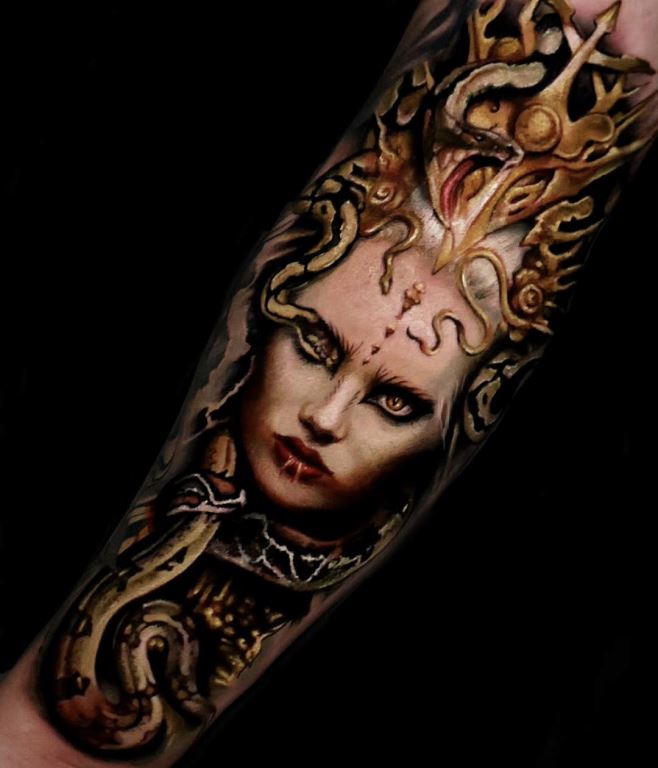
Q: Your 'Ink Goddess' motifs have become
iconic. Do you feel a responsibility to use your platform to
redefine the 'Power Aesthetic' for the next generation of female
artists?
A: I don’t know if I would say that I feel a responsibility, but I
do understand that my work can influence how people see feminine
imagery in tattoo art. Through my Ink Goddess concept, I try to show
a balance between beauty, mystery, and strength. For me, feminine
power is not only about softness or decoration. It’s also about
confidence, depth, and a certain dark elegance. If my work helps the
next generation of female artists feel more free exploring these
qualities in their own style, then I think that’s a very positive
thing.
Q: When the digital noise of today is long forgotten, and
only the healed ink remains, what is the one 'Core Feeling' you hope
your work provides to your clients for the rest of their lives?
A: My style often draws inspiration from ancient cultures that
remain relevant even today. Through my work, I try to create a sense
of luxury and timeless beauty. More than anything, I want my clients
to feel pride in wearing my work. When they look at their tattoo
years later, I hope it still feels powerful, elegant, and worthy of
being carried with them for life.


