
Interview with Konstantinos Moulas
Hello Konstantinos Moulas! Thank you so
much for taking the time to do this interview. Please start by
telling us something about yourself and your background. When did
you discover your talent for arts? As every kid I was also
drawing for fun but since I began my subject of choice was monsters,
dinosaurs, barbarian warriors, carnivore animals etc. It was obvious
that I had a calling and that was why my art teachers in school were
always assigning me to draw heroes of our history in order for them
to print brochures, posters etc for events and festivities. Probably
my biggest influence came from HR Giger because I watched the Alien
film around six or seven years old, Frank Frazetta due to Conan the
barbarian comic book which was one of my favourites, Boris Vallejo,
Predator the movie and horror-sci fi movies in general. But in
Greece being an artist wasn't considered a profitable profession but
more like a hobby so I abandoned it and got back to it when I
started tattooing way later.
Q: What was the initial spark that ignited your interest in
tattooing, and how has your motivation evolved over time?
A: Since elementary school I have admiring heavily tattooed bikers
in movies etc so it stuck as an image in my head. At sixteen years
old I got my first tattoo secretly from my parents and I got hooked
with the smell, the sound due to coil machines back then, the
designs and artworks on the wall etc. Back then I thought tattoo
artists were something like magicians so I couldn't even imagine
that I would be able to do it. Then the recession came in my country
and having nothing to lose I got into it. In the beginning I
tattooed friends, my brother, my girlfriend and close circle as a
hobby but due to my drawing skills people showed trust and interest
in me and started establishing clientele from early on. It took me a
lot of years to figure things out in order to do portraits because I
was self taught. I started with simple linework tattoos, fonts,
simple graphic designs and illustrative things. Extremely stressful
in the beginning because of the permanency factor but eventually
through keeping an archive of fresh and healed works of mine made me
learn and realize a lot through observation and gained confidence.
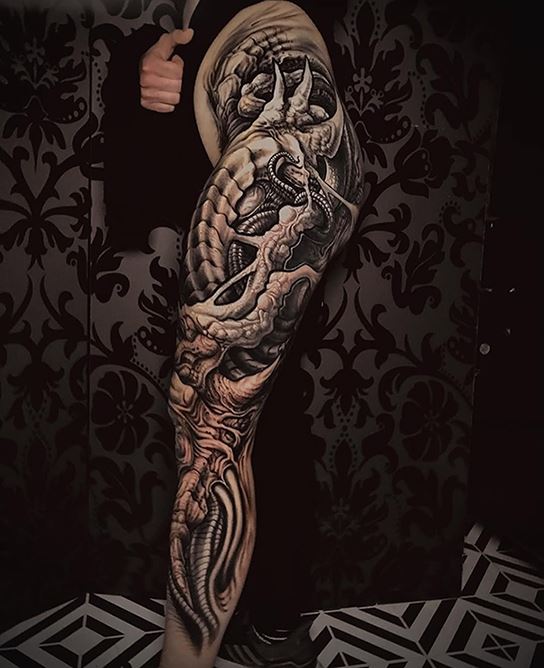
Then I stamped upon Guy's Aitchison work and instantly knew this was
what I wanted to do, bio organic, biomechanical but also realism,
surrealism, horror and combination of them.
Q: What is meaningful to you about
tattooing?
A: Tattooing to me is like a ritualistic exchange between two
people, like catharsis with many confessions and a connection. It's
not a one way thing, it's highly transactional. Through it I got to
travel around the world and one of my favorite rewards is when I see
my client's faces ecstatic from happiness because I got to cover a
really bad tattoo they had that was making them feel ashamed, that
made me become an expert in cover ups. It gave me a sense of super
heroism because many artists were turning them down so I was feeling
like a savior.
Q: Your work displays a compelling fusion of biomechanical
elements and dark imagery, creating a truly unique aesthetic. Could
you speak to the artistic journey that led you to explore this
particular style? What aspects of it resonate most with you?
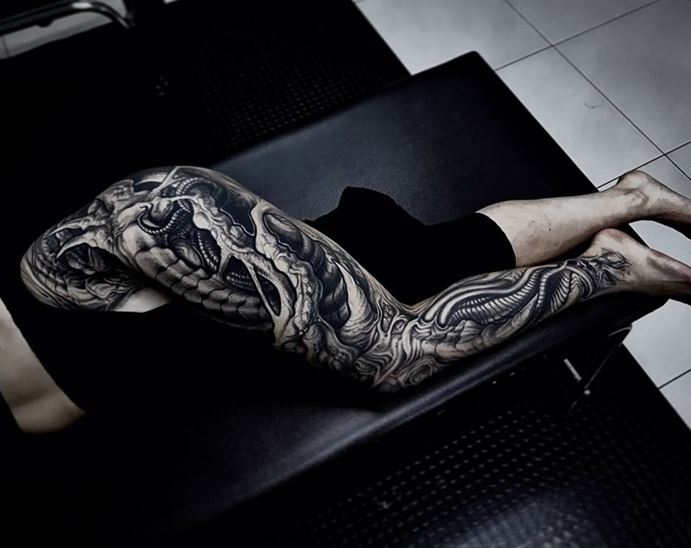
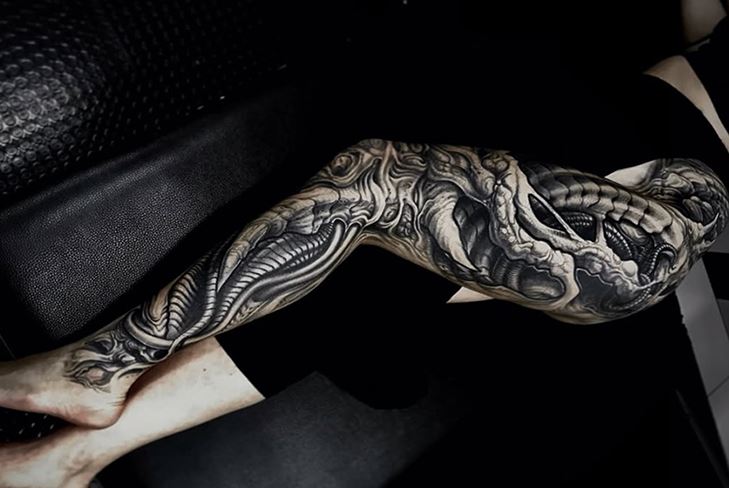
A: Texture was always significant to me. nature, bugs, reptiles,
machinery because I graduated as an engineer and had a big love for
motorcycles. Also I was watching a lot of documentaries about nature
and sci-fi films. This style incorporated all of them and needed a
lot of space in order to transform a part of the body. It's like
you're sculpturing and altering the body making it look really
cooler, creating an illusion to the eye due to the depth we're
using.
Q: Do you ever find yourself drawn to
explore other stylistic avenues, or perhaps the use of color, in
your creative process?
A: Usually I use color as a source of light or on flowers and if I
want to emphasize something but not from choice, people especially
in Europe prefer black and grey tattoos. I want to do more color
portraits for sure in the future but of course with bio elements to
it.
Q: The unique aesthetic of your designs is truly
captivating. I see echoes of certain artistic influences, like H.R.
Giger, which adds to their intrigue. What's the inspiration? How do
you work with your clients to bring their ideas to life?
A: The initial is a discussion with the client, there from certain
questions I start to visualize it roughly in my head considering
their answers. It's really helpful when they have references because
it saves some time, the next step is to do a rehearsal with markers
in order for them to get a visual idea. I take pictures to analyze
them later and improve or add stuff to it until our session.
Q: The white highlights in your work are very effective. How
essential is mastery of ink properties, especially for white ink, in
creating such remarkable tattoos?
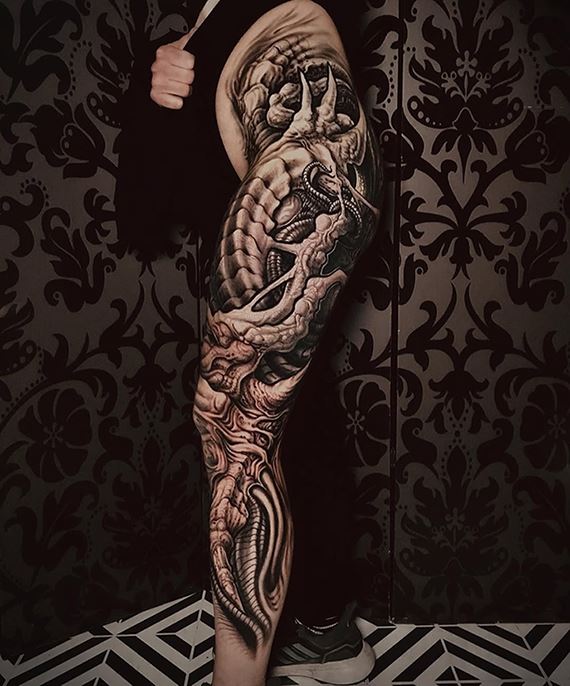
A: White ink in my style is essential, it's not only highlighting or
adding a tone but enhances the texture, it can give a wet slimy look
or shiny metallic one and break down older black ink in cover ups.
Cover ups played a significant role in mastering my technique in
white ink which made me kind of famous for.
Q: As an experienced tattoo artist, what
are your insights on optimal aftercare and maintenance practices to
preserve the 'fresh ink' look for years to come?
A: When it comes to black and grey aftercare things are simpler
because of my grey wash technique I don't stress the skin much so
the guidance is pretty basic and simple, around three times a day
washing and moisturizing with a really thin layer of a good
ointment, cream or butter aftercare. No sun exposure, scratching and
rubbing with a towel, no excessive work out to avoid friction and
sweat and of course not keeping it submerged into any kind of liquid
to avoid getting soaked. Now with color things change drastically,
usually I prefer breathable skin stickers because they prevent
infections due to isolating it from the external environment or
covering it with cling film and multiple times a day removing it,
washing it, letting it breathe and covering it again after the
application of the aftercare product. I always advise my clients to
ask me first before they do anything other than my guidelines and
try to get pictures during and after to make sure they're taking
care of it properly.
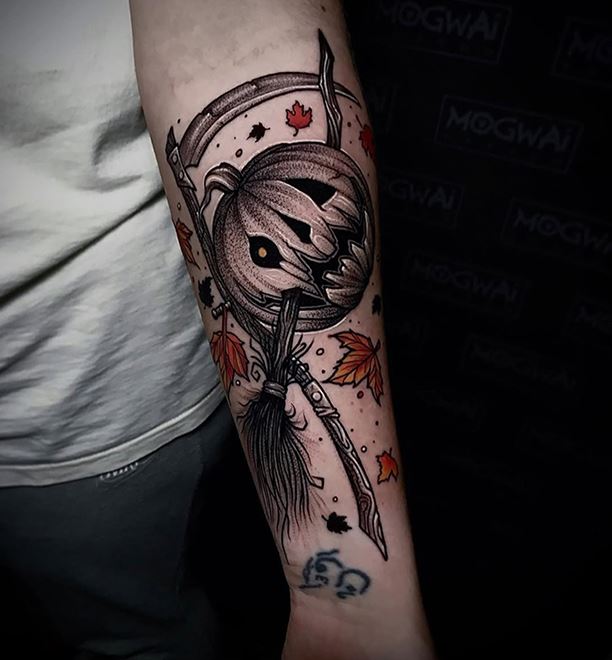
Q: Designing large tattoos is a
significant undertaking. What is your approach to working with
clients on these projects, particularly when their initial ideas
might diverge from your artistic style? How do you navigate that
creative process?
A: When it comes to really large projects usually people that come
to me are already familiar with my work and through a few references
and a bit of discussion we get down to freehand the piece and go
from there. Now if they're not the approach is completely different,
I ask things like music taste, character, preferences in life in
order for me to assess their taste. Also I advise them to gather
references related to the tattoo they want but also in general,
things that draw their attention. Then depending on the subject we
choose real photos that we will combine and create the design.
Q: The most challenging tattoo you ever done?
A: The most challenging tattoo of mine was a cover up of two huge,
black tribal blobs on both forearms and multiple time covered
shoulders on a guy. It looked impossible and everyone referred him
to a laser clinic, so I was his last chance. The outcome was really
impressive but after a lot of sessions and of course tons of white
ink.
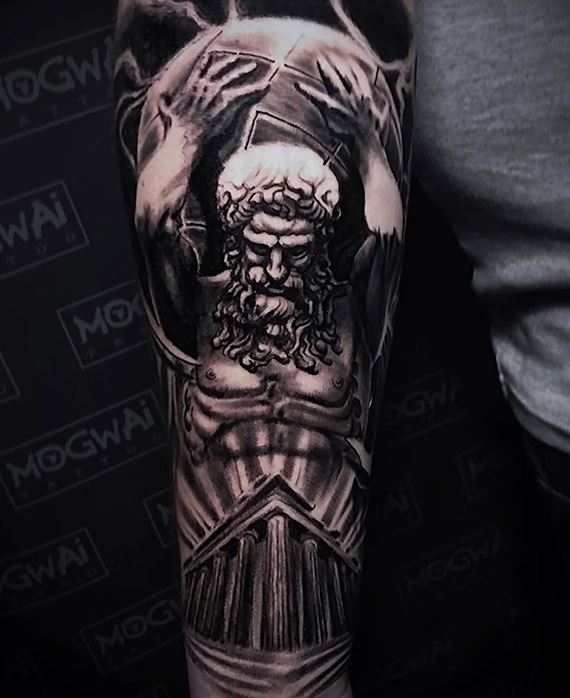
Q: Given the personal narratives you
encounter and the permanent nature of your art, tattooing appears to
be a profoundly shared experience. Could you elaborate on how you
see this dynamic between artist and client?
A: Establishing trust is the first and most important thing, it's
fundamental. Then you need to make the customer feel comfortable and
make it crystal clear that they can ask anything to make their
experience bearable because it's a painful procedure. Brakes for
snacks, some humor to lighten the air and inevitably the birth of a
bond immerges between them.
Q: Do you see more adventurous design choices from male or
female clients, or does it seem to be more of an individual
preference regardless of gender?
A: It's not a rule but in my experience women tend to be a bit more
open and acceptable on extreme ideas than men, I can't detect the
reason and maybe it's just a coincidence but up until now my female
customers are usually beasts!
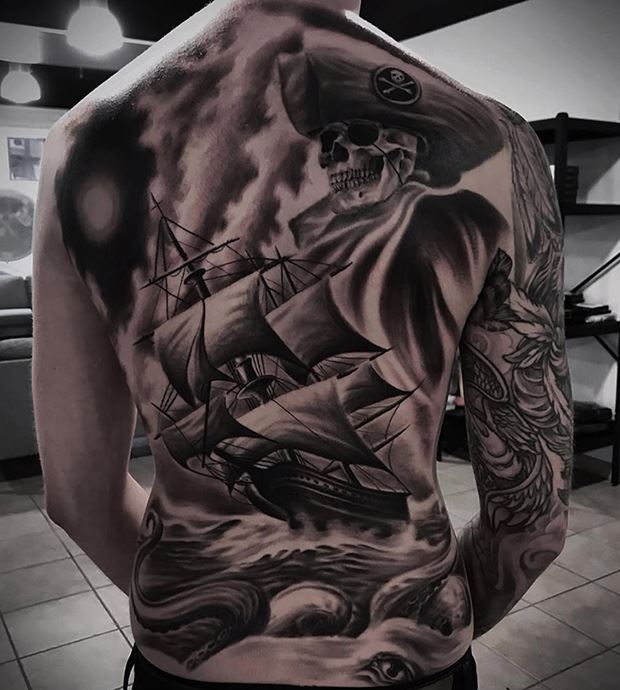
Q: I've noticed your proficiency in
charcoal drawing. How do you believe this artistic foundation
contributes to your ability as a tattoo artist? What role do you
think drawing plays in the development of a successful tattoo
artist?
A: Charcoal is a medium that gives you the ability to produce really
fast and since time is important I regularly use it and mastered it.
Drawing and painting generally gives you all the freedom to express
yourself and through that you create your own personal style. People
that don't draw can copy a photo and tattoo something cool but if
you want to be distinctive and unique you need to know how to create
your own stuff, especially for me and my genre that we freehand most
of them.
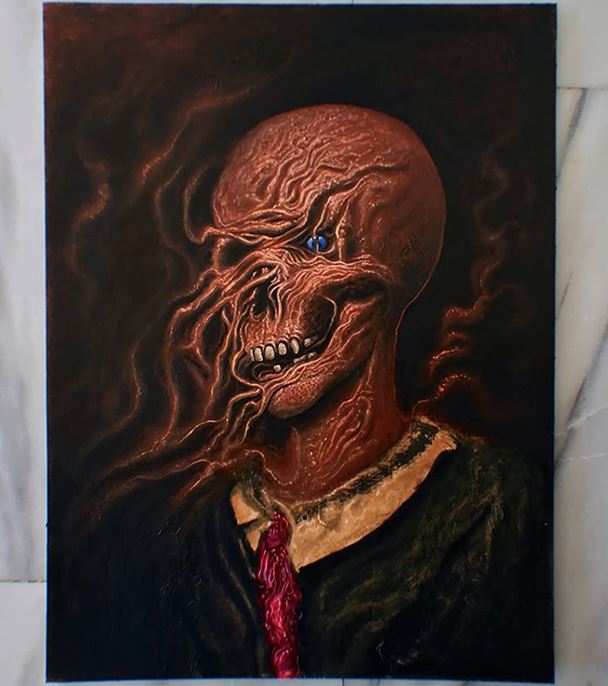
Q: Do you have any aspirations to showcase your drawings in
an exhibition, or do you primarily view them as a personal artistic
pursuit?
A: I have already done a solo art exhibition back in 2019 and
participated in the biggest artistic event in Greece called Art
Athina with artists from all over the world. Unfortunately due to
censorship I was denied to exhibit some of my strong artworks and
that made me distance myself from exposure but I want to do more of
them in the future without the restrictions of course. Art for me is
a necessity, it's therapeutic and some kind of meditation so I will
never stop.
Q: With so many resources available today,
from online tutorials and workshops to conventions and guest spots,
it seems like there are more avenues than ever for aspiring tattoo
artists. Do you feel this increased accessibility has made it easier
to break into the field?
A: All of this made the level of tattooing sky rocket because in the
past artists were keeping their knowledge in closed circles or even
just for themselves but at the same time the profession became more
appealing and the number of artists increased significantly. So I
think locally must be around the same as in the past but globally is
a bit better due to social media.
Q: What's your take on the local tattoo scene? Are you
seeing any exciting developments, like new artists, styles, or
events?
A: Greece is a small country with a really bad economy so that has
forced the artists to obtain serious skills in order to be
competitive, otherwise you're doomed. Therefore the level is really
high for such a small country. The events the last few years have
become great, hosting great artists from all over the world so it's
promising! But still the market is really small.
Q: Please write down your studio location
and website/social media links. Also let us know if you are
available for bookings.
A: Now people can find me on CIRCUS TATTOO BODY AND PIERCING located
at 178 Praxitelous str.. Pasalimani Piraeus (port of Athens))
ph:+302104296159 email: circustattooing@gmail.com, Instagram:
circustattoo_piraeus/
Facebook:https://www.facebook.com/groups/480586121988291
and my personal email: konstantinosmonk@gmail.com feel free to
contact us and ask us anything, Greece is a touristic destination so
we have a lot of people from abroad that combine the trip with
getting some art on their skin.
Q: How often do you attend tattoo conventions? In your
experience, how valuable are tattoo conventions for artistic growth
and building client relationships?
A: I'm kind of new to conventions, I've worked before in the Athens
tattoo convention but now I started to participate in contests, I
almost got an award last year, six artists got chosen among 64
participants in the large black and grey category and I was in. Note
here that in Greece my style doesn't have a category and this was a
fully abstract piece competing against huge portraits from famous
artists etc. So I managed to put my genre on the map for the first
time in my country and It's a matter of time to be awarded since I'm
going to participate more around the globe in the future!
Q: Have you ever done any guest spots at
other studios, either here or abroad?
A: Guest spots are undeniably associated with our profession so of
course I've done many, in Greece but mostly in Denmark and the
United Kingdom where I also lived for a bit, in Liverpool in
particularly great studio. There was a great resident artist from
Italy that made me push myself and vice versa, a really healthy
competitive relationship that grew into a friendship that lasts till
today. In general you meet a lot of great people and learn new
cultures, I consider us really lucky for that cause otherwise I
don't think I would be able to travel that much.
Q: Looking back on your journey, how has your passion for
tattooing transformed since you began? Has it deepened, shifted, or
remained consistent?
A: Inevitably it deepens as you evolve, It's a natural progression I
think because people ask more and more of your art which excites you
but also creates a certain type of responsibility that makes you
want to become better and better to show your gratitude and also
because you enjoy it.
Q: The American tattoo scene offers a wide range of styles
and influences. Do you see any potential benefits or opportunities
for artistic growth in exploring that environment?
A: The country that gave birth to my genre in tattooing at least, is
the USA, so the demand over there is extremely high especially in
comparison with Europe. Most of my fans are in the states and almost
all of my artwork buyers. As I mentioned earlier in the Athens
tattoo convention of 2024 the jury that chose my bio piece were Jack
Rudy may rest in peace and El Whyner both Americans and felt really
honored! Carl Grace was looking for an artist in the past and due to
complications with a Brazilian artist of his and his paperwork
didn't want to go through it again and cost me to lose this
opportunity and many more.
Q: Knowing the diversity of the US tattoo
landscape, are there any areas that particularly resonate with your
artistic style or that you feel would be a good fit for your work?
A: Luckily California has a great scene in my field and weather is
around the same as here which I'd prefer but of course New York and
I have a lot of artist friends in Pennsylvania because my best
friend lives in Philly and I've visited before.
Q: What kind of contribution do you hope to make to the
tattoo community, and what legacy would you like to leave?
A: I want to add more human aspects like feelings and states of mind
into the bio style, other than anger, evilness etc and focus more on
the human condition since I create artworks that already do and
slowly I'll get there because people start to understand my vision
and ask for tattoos. Not many of them can comprehend that they can
be transferred to the skin due to their excessive complexity and
details, but that's why I'm here.
Q: What piece of advice or encouragement would you offer
your younger self, knowing what you know now about the tattoo
industry?
A: This job is a lot more than just to create and be good at what
you do, my mistake is that I focused only on the creating part and
left all the others behind. I wasn't putting any effort on my
promotion and marketing and that held me back, so my advice is to
work and grow all the necessary skills that evolve in order to reach
high goals.


