
Interview with Kyle Warwick
To mark the eighteenth anniversary of Skin Artists
Tattoo Magazine, we feature the work of Kyle Warwick, whose pieces
examine the human face through the perspective of a neon-saturated
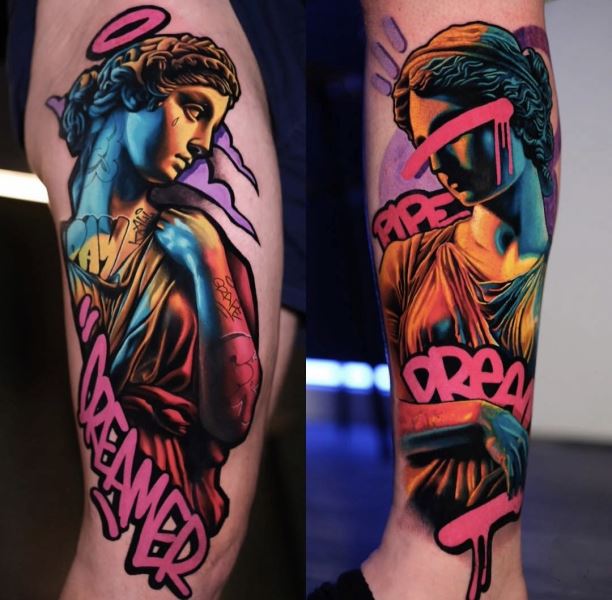
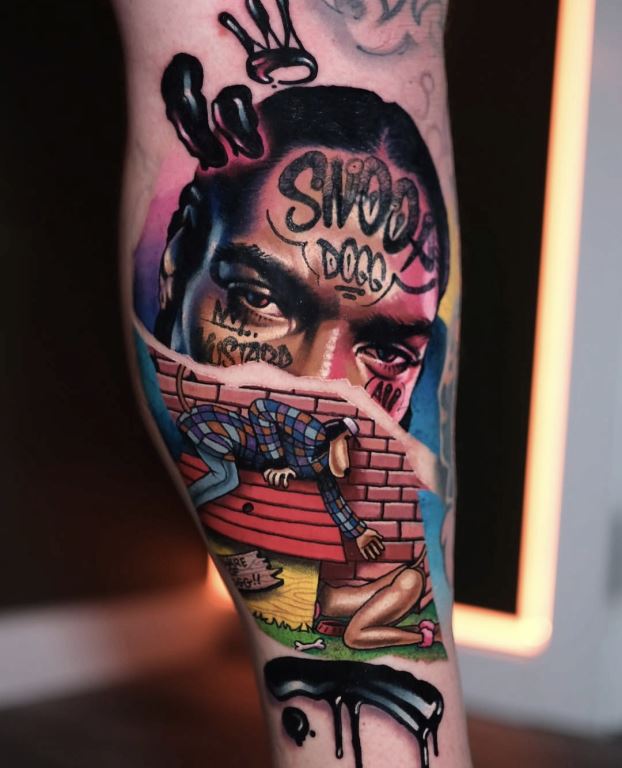
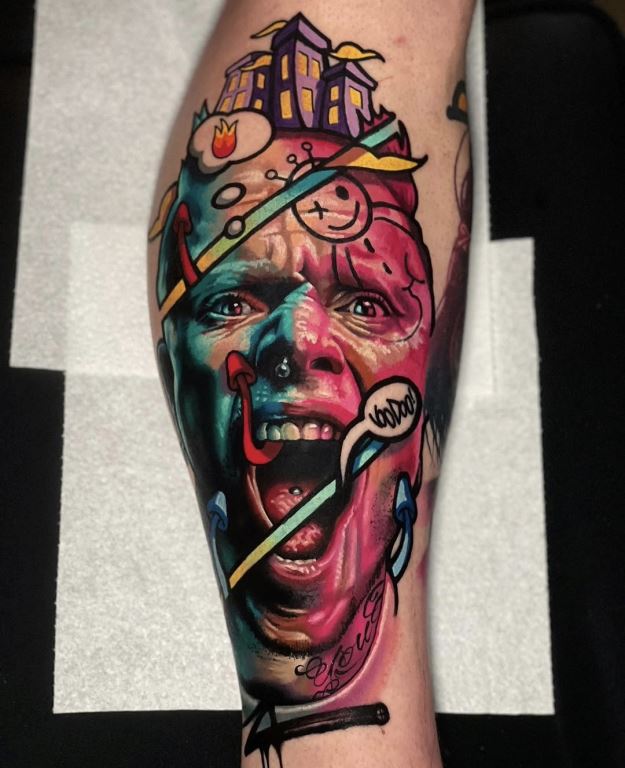
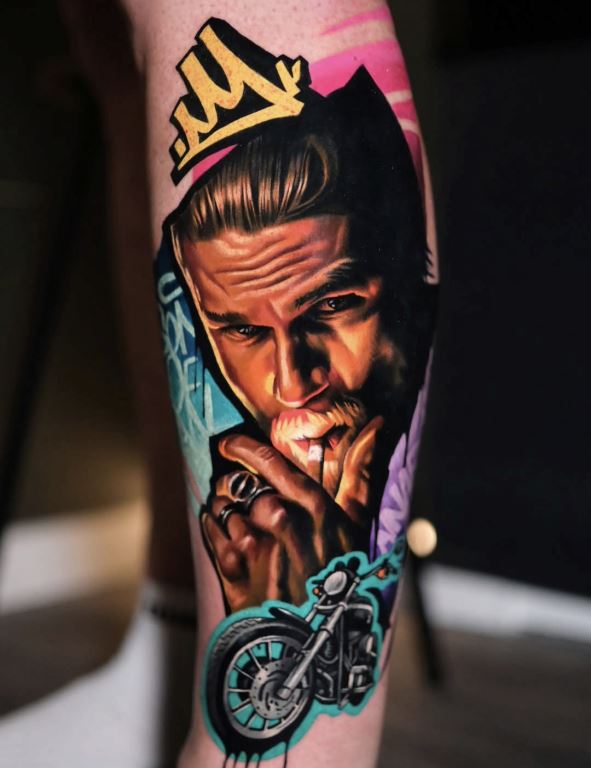
metropolis. His portfolio represents an execution of
"Graffiti-Realism," a style wherein cinematic portraiture is
integrated with the kinetic energy of urban art. By synthesizing
realist precision with contemporary influence, Warwick has
established a visual framework that is simultaneously hyper-modern
and nostalgic.
This interview analyzes the mechanics of his aesthetic and the
methods used to maintain technical accuracy while incorporating raw,
vibrant energy into each design. The discussion addresses the
discipline necessary to connect these distinct artistic styles and
explores why the progression of the "Visionary" artist depends on
identifying beauty within the grit of the modern landscape.
Q: Your work feels like a high-speed collision between
cinematic realism and the raw energy of urban art. Does this fusion
come from a desire to "vandalize" the perfection of a portrait, or
are you trying to prove that the grit of the street is just as
technically demanding as a fine-art masterpiece?
A: Graffiti is very technically demanding, but in a different sense
from a fine art masterpiece. It’s done under pressure, in disguise,
often in the middle of the night under time limit and the aim of not
getting caught. Tattooing shares a problem with time constraints,
also with public perception and socially. They're two worlds that
often collide. Much like my style is a collision, it basically
reflects my life. A collision of coincidences.
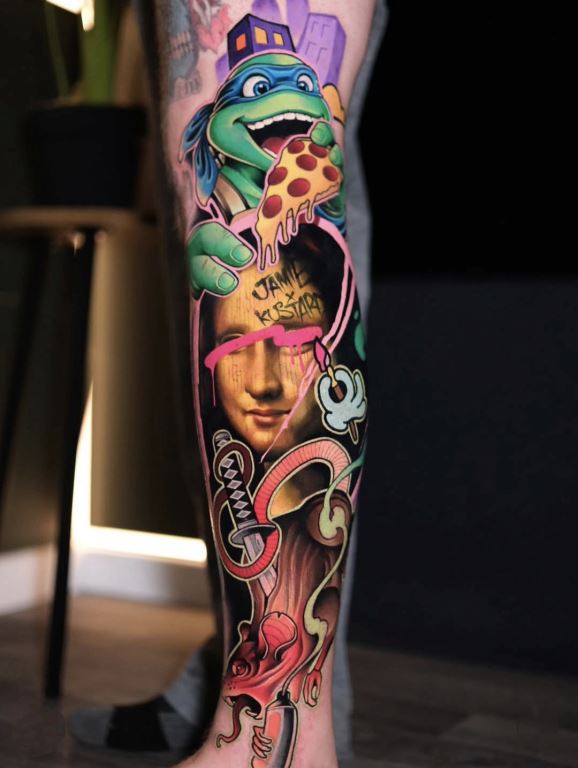
Q: In a market crowded with specialists,
is your fusion of styles a strategic move for longevity, or simply
the organic result of refusing to be limited by a single category?
A: I would say it's an organic accident. My mum was a great pencil
portrait artist, I grew up with hip-hop and fell into graffiti, I
was introduced to manga from my brothers very early on. It all adds
up and becomes abit of you.
Q: As the world moves toward minimalism, your work remains
maximalist. In 20 years, do you think people will crave more "visual
noise" on their skin to compete with a saturated digital world?
A: It's hard to say exactly what will be trendy and what won't be.
One thing I know is, graffiti will still exist in 20 years and
tattooing will still exist in 20 years. Some of that will be wildly
different and more impressive than it is now, the rest may not
differ from what it looks like today. I just hope I still have
something worth offering by then!
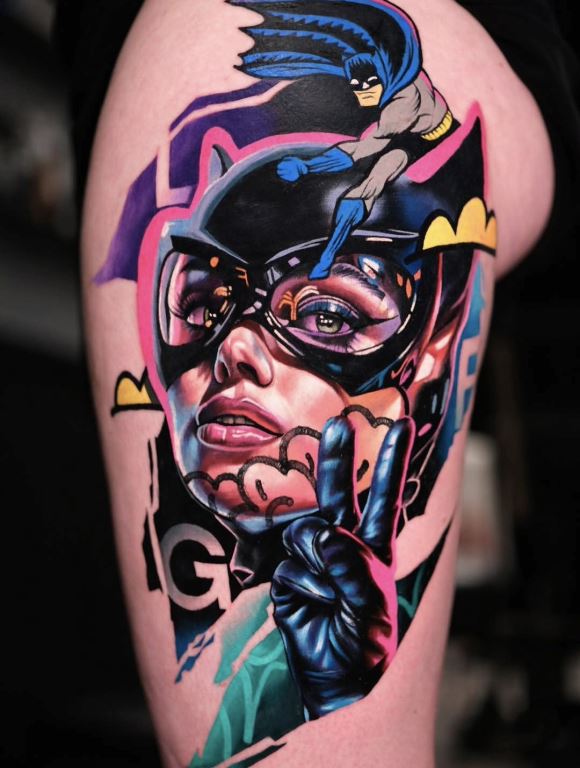
Q: Most artists choose one path. By
choosing both, are you creating a new "Universal Language" for 2026,
or are you just refusing to let the "underground" side of your
identity die in a mainstream industry?
A: I'm certainly not the first or only person to be mixing styles
and blending different paths, so I can't take any credit for that
but I certainly like to think I do it in my own way. I won't ever
let the "underground" side of me fade away. Tattooing has become
more popular but it still has a big sense of it being alternative,
not being the mainstream.
Q: Will tattooing become more diverse or collapse into fewer
dominant aesthetics?
A: Tattooing has peaks and troughs, trends and culture shifts. As it
becomes more popular it may feel that it's overwhelming swaying
towards a dominant culture aesthetics, but all the different pockets
of tattooing will continue to exist in their own ways.
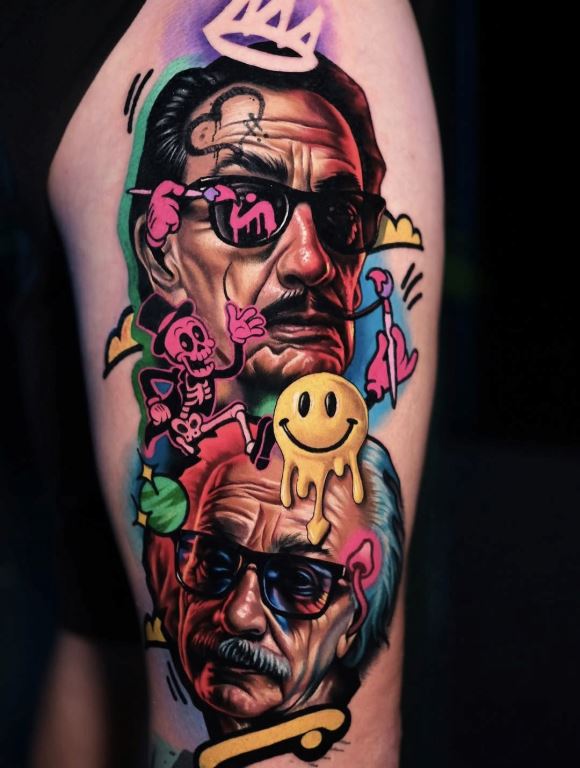
Q: Does the future of the industry belong
to the "specialist" (the artist who does one thing perfectly) or the
"polymath" (the artist who understands design, branding, and street
art)?
A: The future of tattooing doesn't necessarily belong to anything or
anyone - who knows. Currently, both. The specialist gains a lot of
attention. So does the influencer. Equally, so does the walk in,
flash artist. It's all about what you have to offer.
Q: What is the one "unspoken truth" about the industry today
that no one wants to admit in an interview?
A: I'm not aware of any unspoken truths. Tattooing has a ton of
positives and negatives, politics etc. In the end, you get out of it
what you put in.
Q: Has the "Rockstar Tattooer" era peaked? Will the future
favor the quiet craftsman or the loud influencer?
A: Rockstars still exist. As do many other forms of tattooers. I
believe the quiet craftsman and the loud influencer don't share the
same goals, but they may both be favored in their own lanes.
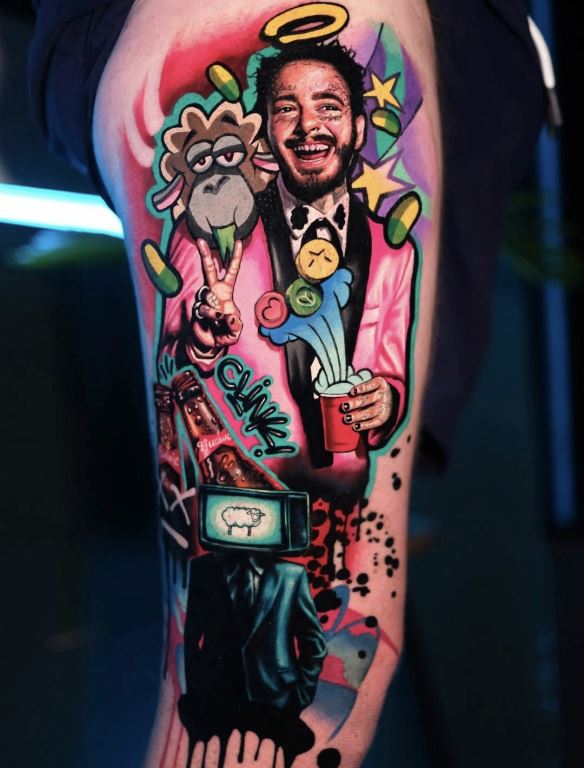
Q: With the rise of "traveling artists"
and guest spots, is the "home shop" becoming a relic of the past?
A: I would say it's the other way around. There is less need to
travel now because of Instagram and travelling clients. There are
far more private and home studios now than ever.
Q: Will the "International Convention" survive, or is the
future of the industry found in niche, curated, invite-only events?
A: International conventions will always survive. Invite only events
don't sound like a lot of potential for growth.
Q: Tattooing used to be a subculture; now it’s pop culture.
What is lost when an art form moves from the shadows into the
spotlight?
A: I believe it's still very much a subculture. It may be borrowed
and pawned in areas of pop culture but that isn't its true nature.
Q: What is the "punk rock" of the future?
If everyone is tattooed and colorful, what will be the new way to
rebel?
A: Everyone won't be tattooed and colourful. Hopefully not anyway.
Balance and differences are good, it would be boring otherwise.
Rebelling is just doing what you're not supposed to do - so,
whatever that may be in that given time.
Q: If you could "reset" the industry to the year 1990 but
keep today's technology, what one cultural aspect would you fight to
bring back?
A: I'm sure people would believe that's a golden age, and probably
for very good reasons, but, I didn't live it. Anyone can get in to
tattooing now if they really want to. I may not like what they do
and how they do, but it's not my choice to decide for others. In the
past, I don't think this was a possibility.
Q: Are we creating impossible standards
with "perfectly healed" photos? Is it time to rebel against the lie
of permanence and accept the beauty of a fading tattoo?
A: Its all subjective, beauty is in the eye of the beholder. I awe
at perfectly executed and healed tattoos, I'm equally fascinated by
aged old school tattoos.
Q: The "Old Guard" protected the secrets, but the "New
School" put them on YouTube. Who are we actually rebelling against
now: the people keeping secrets, or the people making everything
cheap and easy?
A: I'm not rebelling. Maybe that is the new rebellion - not trying?
Everyone wants to be seen as a rebel, everyone wants to appear
different and cause new unnecessary conflict in the attempt, until
they all sound like the same fucking tune - yet no one seeks peace
and contempt. Not caring often brings authenticity, that's a rebel.
Q: If you had to create a piece that
represented the "death" of traditional tattooing, what elements
would you include?
A: Just me simply pretending to be a traditional tattooist would
represent the death of it! In seriousness, I actually enjoy both
having and doing a trad tattoo, it would never die.
Q: With AI's ability to instantly synthesize complex styles,
is the creative process becoming less about "starting from zero" and
more about "curating the output"? Do you feel we are
already crossing that line?
A: AI has its place. Aslong as it's not solely depended on. There
are more "artists" in tattooing than there ever has been. The same
people that are still regurgitating the same flash for the last 100
years, or when we were all using the same google images for a rose
because we had no other sources for imagery are the same people
complaining about AI. It's just a new part of tattooing.
Q: How do we stay human in a digital
feedback loop? Is the only way to remain authentic to stop looking
at what everyone else is doing?
A: I guess so, but also no. Authentic is just doing as you feel,
honestly and with purpose. You don't have to stop viewing and
enjoying others. Staying human requires putting the phone down every
now and then and feeling something natural, like a nighttime walk or
laughter with a friend.
Q: What will matter most in tattooing that doesn’t matter
today?
A: Tomorrow.


