
Interview with Ilayda Kocer Aydinoglu
Q: Every artist has a defining moment when
art transitions from a personal passion into a lifelong commitment.
What was the exact moment you realized tattooing was your true path?
A: Art has been part of my life for as long as I can remember. From
a very young age, I was involved in different forms of creative
expression, including painting, sculpture, and theater. Even though
I studied engineering, my connection to art never disappeared. There
was a period when I was creating my own drawings and receiving
interest from galleries. Around that time, a friend gave me an idea
that completely changed the way I looked at my work: Why should my
art exist only on paper or gallery walls? Why couldn’t the human
body become part of the exhibition itself? That thought was really
the beginning of tattooing for me. Interestingly, the dream behind
it has never completely changed. I would still love to create an
exhibition one day consisting entirely of my own original tattoo
designs, not artwork hanging on walls, but living pieces of art
carried by people.
Q: Starting out as a tattoo artist requires unlearning
certain traditional mediums and adapting to skin as a living, moving
canvas. What was the hardest conceptual shift you had to make early
on?
A: The biggest shift was realizing that skin is not simply another
surface. It is alive, it moves, it ages, and every body has its own
structure. On paper or canvas, you have complete control over the
composition. In tattooing, anatomy becomes part of that composition.
You have to consider movement, muscle structure, negative space,
healing, and how the image will evolve over time. That completely
changed the way I design. I stopped seeing the body as a surface
where I was placing an image and started seeing the body itself as
part of the artwork. Today, I want a tattoo to feel as though it
belongs specifically to that person’s body, not as if an image was
simply placed on top of it, but as if the artwork and the anatomy
were considered together from the beginning.
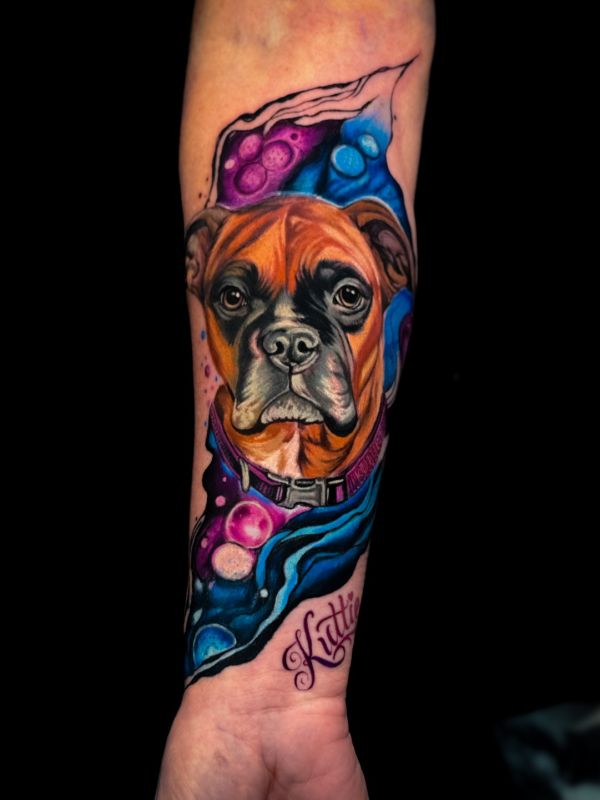
Q: Looking back at your formative years in the industry,
what is one piece of advice or criticism you received that
completely reshaped how you approach your craft today?
A: When I was beginning my career, İso, who is now a very close
friend of mine, said something that I have never forgotten:
“Perfection is in the details, but perfection itself is not a
detail.” I remember hearing that and feeling as though a light
suddenly switched on in my head. In the beginning, I associated
being detail-oriented with adding more. Over time, I understood that
it is really about knowing which details matter, what should remain
quiet, and where the viewer’s attention should go. That idea still
influences the way I build compositions today. Sometimes removing
something requires more confidence than adding something.
Q: How has your personal background or cultural perspective
influenced the stories you choose to tell through skin art?
A: Psychology has always been one of my strongest interests outside
of art. I am fascinated by people, how they think, what they feel,
and how their experiences shape who they become. Because of that,
when someone tells me the story behind a tattoo, I am rarely
listening only for the visual elements. I am trying to understand
the emotion underneath them. Sometimes a story does not need to be
represented literally. It can exist through symbolism, color,
contrast, composition, or even negative space. I don’t only want to
understand what someone wants to show. I want to understand what
they are trying to say.
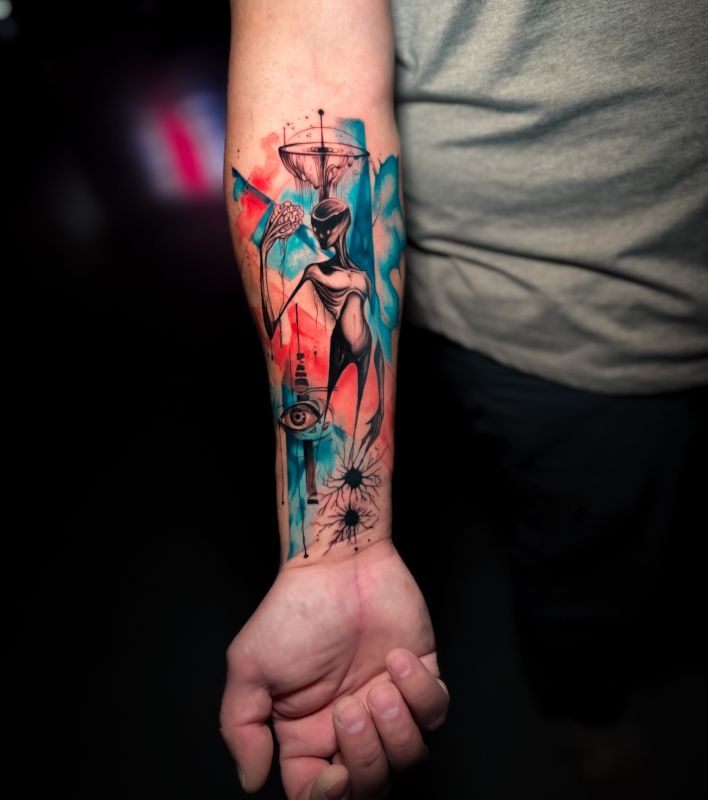
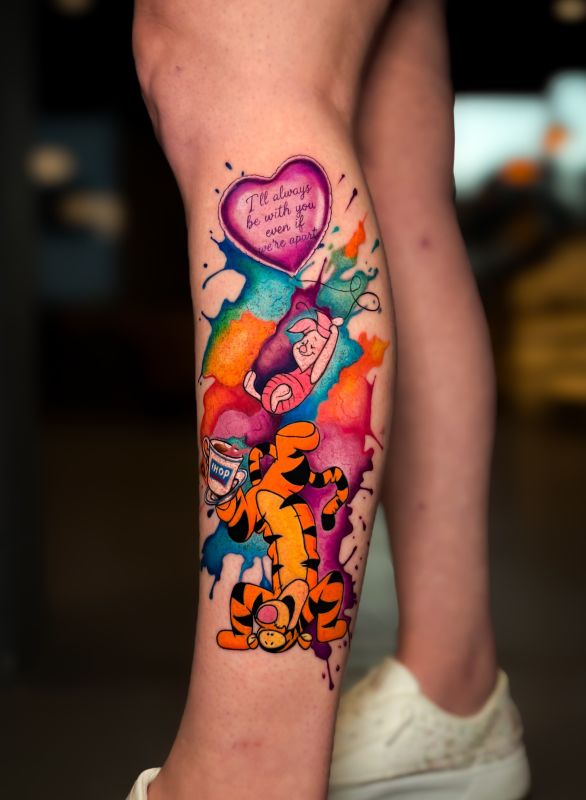
Q: Your portfolio seamlessly transitions between soft
watercolor techniques, vibrant color work, and sharp, high-contrast
realism. How did you cultivate the versatility to balance such
contrasting styles?
A: I think that versatility comes directly from my background in
different traditional art forms. My pencil and charcoal studies
taught me about value, contrast, texture, and light. Watercolor
taught me movement, transparency, spontaneity, and color
relationships. Sculpting with clay gave me a much stronger
understanding of volume, anatomy, and three-dimensional form.
Eventually, all of those disciplines started communicating with one
another in my tattoo work. So I don’t necessarily see watercolor,
color realism, and high-contrast realism as completely separate
languages. To me, they are different expressions built on the same
fundamentals. That background gives me the freedom to choose the
visual language that best serves the idea instead of forcing every
idea into one specific style.
Q: Micro-realism and fine-detail work demand an incredible
amount of precision and patience. How do you prepare yourself
mentally before starting a piece that requires such intense focus?
A: Before I begin something that requires that level of precision, I
remind myself that I am not creating something temporary. Someone
may carry what I create for the rest of their life. That sense of
responsibility keeps me focused. Of course, I care about how a
tattoo looks when it is fresh, but I care just as much about how it
heals, how the details settle into the skin, and what remains years
later. With micro-realism especially, it can be very easy to become
focused only on what looks impressive in the moment. I try to think
beyond that moment. The goal is not simply to create a beautiful
photograph of a fresh tattoo. The goal is to create a tattoo that
continues to work as a tattoo.
Q: Color theory on human skin behaves very differently than
on paper or canvas. What are the key artistic rules you follow to
ensure vibrant color pieces retain their depth as they age?
A: For me, the first rule of color tattooing is never treating skin
as a neutral or white surface. Every skin tone already has its own
undertone, temperature, and natural pigmentation, so I have to think
not only about how the colors interact with one another, but also
about how they interact with the skin itself. Value, saturation,
contrast, and color temperature are especially important to me. If
every area has the same intensity, the image can quickly become
flat. I like to create a clear hierarchy, allowing certain areas to
dominate while intentionally keeping others quieter. I also think
about the healed tattoo from the very beginning. Because color
naturally softens over time, I never want the depth of a composition
to depend only on bright pigment. Strong value structure, sufficient
contrast, and intentional negative space are essential for
longevity. Dark values, highlights, and untouched skin are all part
of the color structure for me. Color is not simply an aesthetic
choice, it is part of the architecture of the composition.
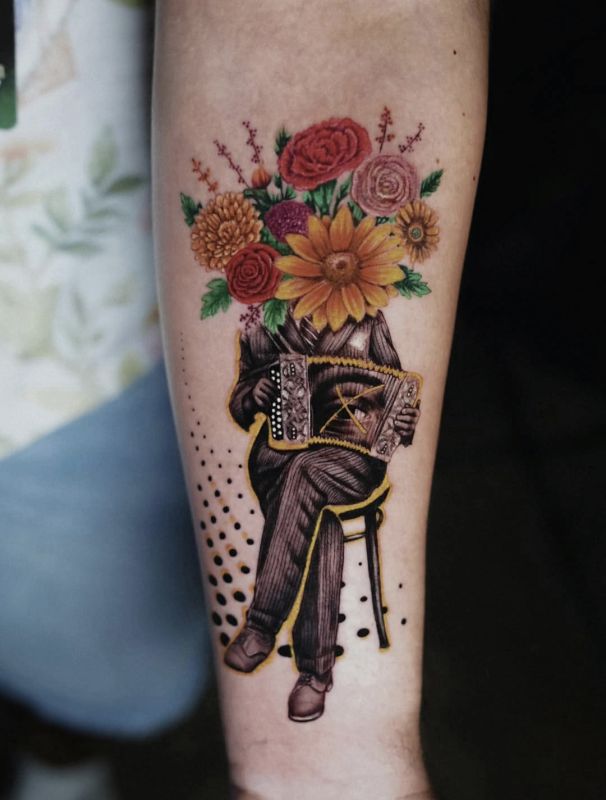
Q: Many artists find that their aesthetic naturally evolves
over time. Where do you feel your personal artistic style is heading
next?
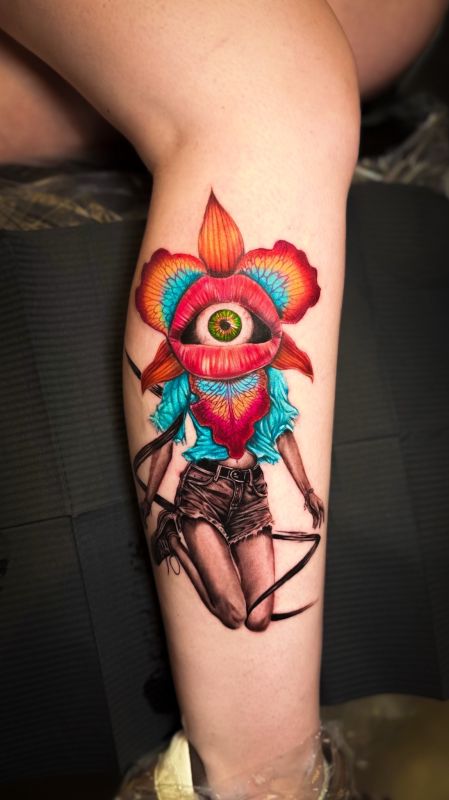
A: For a long time, realism was one of my main objectives. I was
very focused on precision and on seeing how faithfully I could
reproduce reality. Eventually, I realized that technical realism
alone was no longer enough for me creatively. I became much more
interested in disturbing reality, changing proportions, interrupting
realistic forms, manipulating color relationships, and combining
realism with more expressive elements. And I discovered something
interesting: reproducing reality can sometimes be easier than
knowing exactly where and how to break it. That is where I am now.
Realism is still a very strong technical foundation for me, but I am
learning how to deconstruct it and rebuild it through my own
perspective. The next stage for me is less about becoming more
realistic and more about becoming more recognizable as myself.
Q: When a client comes to you with an idea, how do you
balance preserving their personal sentiment with maintaining your
own artistic vision?
A: Communication is probably the most important part of that process
for me. I want to understand not only what someone wants, but why
they want it. Once I understand that emotional foundation, I can
explain how I see the composition, what I believe will work best on
the body, and where my own artistic perspective can contribute. I
don’t see the process as someone giving me instructions and me
simply executing them. I see it as a collaboration. The client
brings the meaning and their personal history. I bring the visual
language, technical understanding, and interpretation. When there is
trust on both sides, those perspectives can meet somewhere in the
middle and become something neither of us would have created alone.
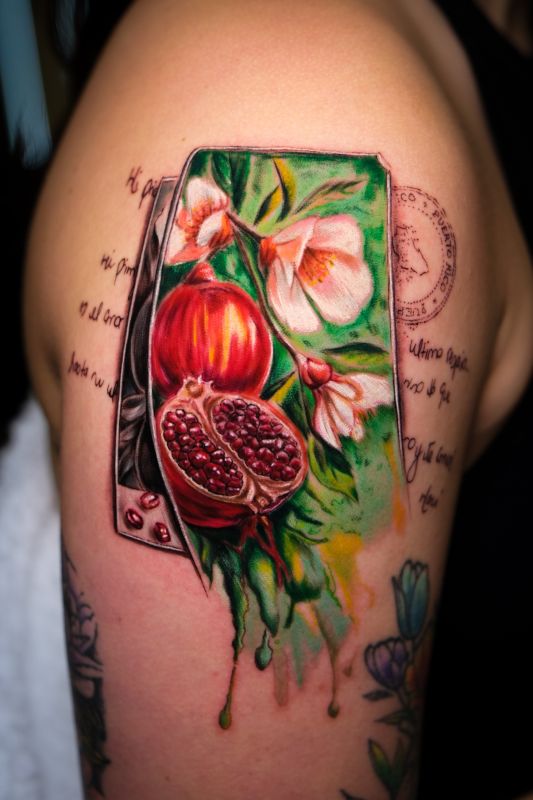
Q: You have earned multiple international awards for your
work. Looking back, which specific achievement felt like a true
turning point in your professional career?
A: Coming from Turkey and then finding myself competing
internationally alongside artists whose work I genuinely respect has
been very meaningful to me. Of course, receiving awards makes me
proud, but what affected me even more was being in that environment,
meeting those artists, seeing their work in person, competing
alongside them, and presenting my own work in the same space. There
was a moment when I realized that I was no longer observing that
world from a distance. I was participating in it. So I don’t think
of one particular trophy as the turning point. The turning point was
realizing that I had a place in that room.
Q: Winning awards at competitive events brings a unique kind
of recognition. How do those high-energy moments impact your
personal motivation when you return to your day-to-day studio space?
A: Winning an award is always emotional. In that moment, I feel
extremely happy and proud, and I allow myself to enjoy it. Then the
next day, everything becomes normal again. I return to the studio,
meet another client, look at another piece of skin, and begin
another design. That tattoo deserves exactly the same amount of
attention regardless of what happened the night before. I think
awards can confirm that you are moving in a meaningful direction,
but I never want them to become the destination. I celebrate the
moment, and then I go back to work.
Q: Working alongside an established studio network like
Cleopatra Ink provides distinct opportunities. How has that
environment shaped your growth and artistic independence?
A: What matters most to me in any studio environment is whether an
artist has the space to feel comfortable, supported, and creatively
independent. I believe artists develop best when there is structure
around them without that structure taking away their individuality.
For me, the healthiest environment is one that gives an artist
enough support to grow while still allowing them to remain
themselves.
Q: Is there a project in your career that posed an immense
technical challenge, but ultimately gave you the most satisfaction
once completed?
A: I find it difficult to identify one tattoo as the most
technically challenging because every skin type, placement, and
project creates its own technical problems. The tattoos that
challenge me the most are often emotional rather than technical.
Memorial pieces involving family members or people someone has lost
carry a different kind of responsibility. You are not simply
reproducing an image; you are being trusted with a memory. Some of
the most meaningful moments in my career have happened after those
tattoos were finished, when the client sees the piece for the first
time, becomes emotional, and we end up hugging or sometimes crying
together. Those experiences remind me that some of the most
important parts of tattooing have very little to do with technique.
Q: Having experienced tattoo culture across different
platforms, how do you view the creative dynamic of local studio
environments compared to the broader global scene?
A: One of the things I love most about local studio culture is the
creative intimacy it can create. In Turkey, I had the opportunity to
spend time in a very special studio environment where creativity
extended far beyond tattooing. We would sometimes stay until very
late painting, sculpting, and talking about psychology, philosophy,
and art. We were feeding each other intellectually as much as
artistically. Larger studio environments have given me something
different. There can be a stronger emphasis on technique,
consistency, performance, and competition, which can push you in
valuable ways. But I still have a very strong connection to smaller
creative environments. There is something special about people not
simply working beside one another, but genuinely contributing to one
another’s imagination.
Q: Tattoo conventions present a fast-paced, high-pressure
environment. What draws you to competing and creating live on a
convention floor?
A: First of all, I see it as a challenge to myself. There is a
completely different energy when you are creating live, surrounded
by other artists, with time pressure, noise, and constant movement
around you. Some people experience that primarily as stress. I think
I actually enjoy a certain amount of that pressure. It forces me to
become extremely present, trust my decisions, and focus entirely on
what is in front of me. I don’t go to conventions only to compete
with other artists. I also go to see what happens when I push myself
outside the comfort of the studio.
Q: What is something the international tattoo community does
exceptionally well, and what is one area where you feel the global
industry still needs growth?
A: Internationally, most of my experience has come from spending
longer periods within a smaller number of studio environments rather
than moving briefly through many different studios, so I try not to
make overly broad generalizations. But from what I have experienced,
one of the greatest strengths of the international tattoo community
is how quickly knowledge and technique can be shared. Artists from
different countries can observe one another, exchange ideas, and
follow developments within the industry almost immediately. One area
I would like to see continue developing is more artist-centered
studio culture. I believe an artist should be supported not simply
as someone who produces work, but as an independent creative person
with their own visual language and development process. When
individuality is protected, both the artist and the quality of the
work become stronger.
Q: With social media bridging the gap between local studios
and global audiences, do you think tattoo art is becoming unified
worldwide, or are distinct regional styles still thriving?
A: Social media has definitely created a shared visual language.
Artists in completely different countries can now see the same
references, techniques, and trends almost instantly. That inevitably
creates similarities. But I don’t think regional identity is
disappearing. The strongest artists still carry something from their
culture, their visual memory, and the environment that shaped them.
To me, the interesting part is what happens when those two things
meet. We may be developing a global language, but the most memorable
artists still speak it with their own accent.
Q: As the industry rapidly evolves with new technologies,
techniques, and pigments, what upcoming trends or tools are you most
excited to explore?
A: What excites me most is not technology simply because it is new.
I am interested in anything that gives the artist greater control or
opens another creative possibility. I am especially interested in
the continued evolution of equipment, machines becoming more
balanced, lightweight, and precise, as well as developments in
pigments, their behavior in skin, stability, and healed results.
Digital design tools are also becoming increasingly useful for
exploring composition and placement more freely. But I have a very
clear boundary when it comes to technology: The tool can evolve, but
it should never replace artistic judgment. Technology can make
experimentation faster and certain processes more precise, but I
want it to strengthen the artist’s hand, eye, and intuition rather
than remove them. For me, the most interesting future is one where
technology expands the artist’s possibilities without erasing
artistic identity.
Q: Beyond winning accolades and mastering techniques, what
kind of footprint or legacy do you hope to leave on the tattoo
community?
A: I actually don’t think very much about leaving a legacy, at least
not deliberately. Right now, I am much more interested in the
process of becoming better, learning, changing my mind, questioning
my own work, and allowing my artistic language to mature through
experience. If that process eventually inspires another artist,
changes the way someone thinks about tattooing, or leaves something
meaningful with the people I work with, then I would already
consider that valuable. I would rather allow any legacy to emerge
naturally from the work and the person I become through the process
than decide in advance what I want it to be.
Q: Looking five to ten years into the future, what is the
ultimate dream project, collaboration, or personal goal you hope to
realize?
A: Looking five to ten years ahead, one of my biggest goals is to
develop my visual language to the point where people can recognize
my work without seeing my name attached to it. I want my style to
become more settled, more personal, and more instinctive, something
that reflects not only the techniques I use, but the way I see
composition, color, emotion, and the human body. I’m not trying to
force that identity or define it too early. I want it to develop
naturally through experience, experimentation, and the work itself.
For me, reaching a point where someone sees a tattoo and immediately
feels, “This looks like her work,” would be one of the most
meaningful forms of artistic achievement.


