
Interview with Mahmoud Khalifeh
Hello Mahmoud Khalifeh! Thank you so much
for taking the time to do this interview. It's a pleasure having
you, and I'm sure our interview will inspire many young artists out
there to try their luck in the tattoo industry. Please start by
telling us something about yourself and your background. When did
you discover your talent for arts? I was born and raised in
Beirut, Lebanon, a city where visual stimuli are endless and
contrasting, shifting dramatically from one neighborhood to another.
Amid the chaos of my city, I learned to find beauty, whether in the
densely packed buildings with their somber, uniform hues on the
verge of collapse, the noise of motorcycles crowding the streets, or
the calm of the sea, the nearby café, and the blues and greens. My
mind adapted by processing these contrasts through an artistic lens.
From a young age, I explored various forms of art, including wood
engraving and charcoal portraiture. Professionally, since the age of
16, I have worked in environments where my visualization skills have
been valued and nurtured, particularly in designing window displays
for major retailers.
Q: What sparked your interest in tattoo art? When did you
start tattooing?
A: In my country, tattoos are everywhere, and I’ve always been
fascinated, both by the technical process and the stories they
reveal about people’s lives. I got my first tattoo at 14, and the
experience was unforgettable. Growing up, I was surrounded by tattoo
artists, including close friends like Hussein Mistrah, an artist I
deeply admire til this day. The turning point came when I saw a
healed tattoo by Sivak, one of the greatest tattoo artists
worldwide. Realizing what could be achieved with ink and a needle, I
knew I had to dive in and be part of this world. My first clients
were friends from school or past jobs. A friend owned a tattoo
studio in the building where I used to live, in the suburbs of
Beirut, where I observed, practiced, and applied what I learned.
Q: How long took you to figure out your creative direction?
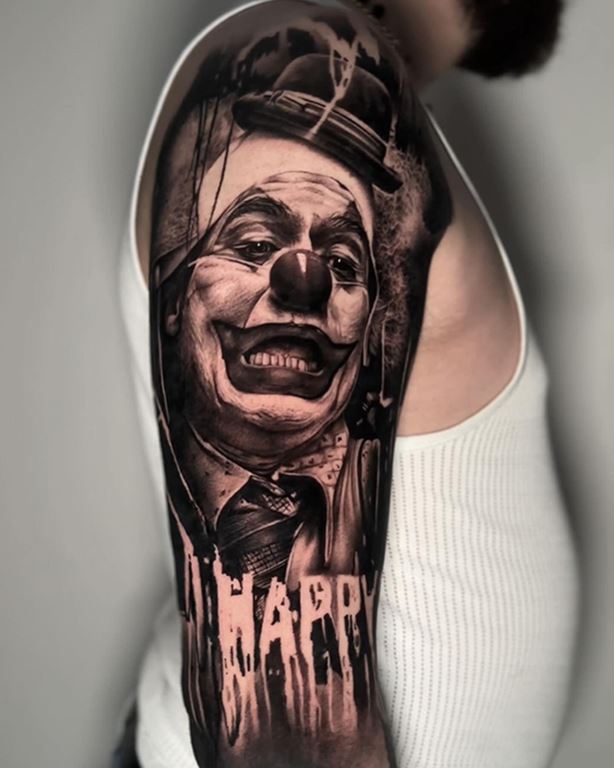
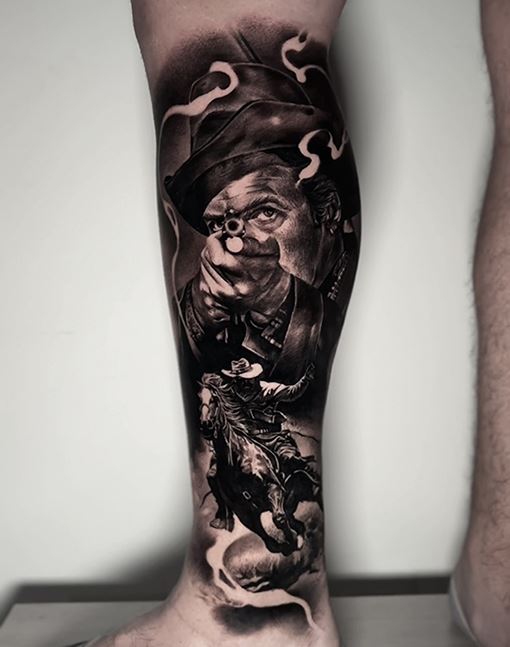
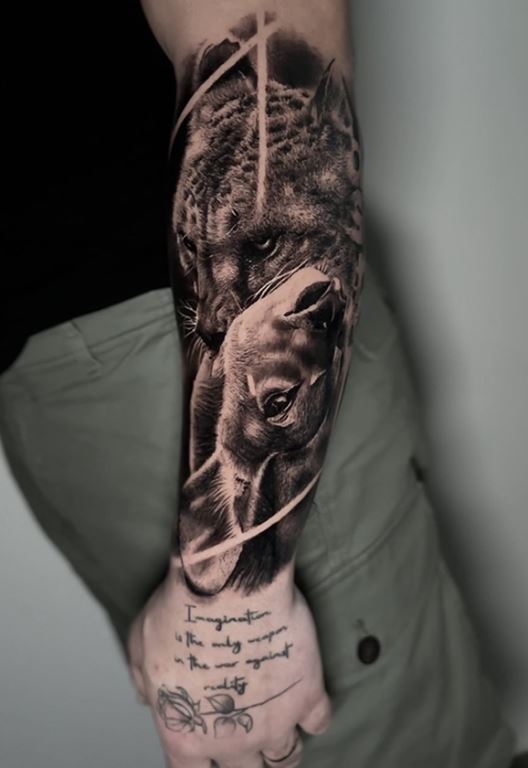
A: From the start, I’ve been drawn to black and white photography.
Photography, cinematic scenes, and personal portraits, especially
those with a vintage vibe, deep gazes, or unique facial features,
have always inspired me. As a child, certain movie scenes left a
lasting impression, with their atmosphere, colors, and even the
imagined scents, and translating that onto skin is what I love most.
While I had to adapt to client requests early on, creating designs
outside my artistic direction, I gradually established my style. To
get there, I often tattooed for free at first, as long as it was a
design I created and loved, allowing me to train and refine my craft
quickly.
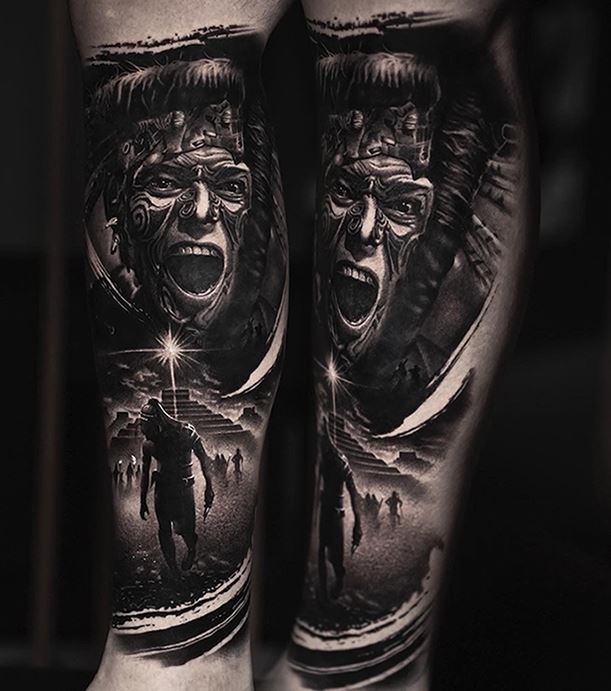
Q: Realistic tattooing is an art form that
demands precision, patience, and years of practice to master. With
clients expecting absolute perfection, even the smallest misstep can
alter the entire piece. In your experience, what are the most
difficult features to capture when creating a portrait tattoo, and
why?
A:cExactly ! The need for precision, patience, and years of practice
is what drives me in my work. Watching what I’ve envisioned slowly
take shape, over hours or even days, is deeply rewarding. Capturing
the essential details to reflect the essence of an image, while
knowing when to stop to maintain balance, is what makes the process
beautiful. Portraits, in particular, require more than technical
skill, they demand the ability to capture a person’s soul. A
portrait holds deep sentimental value for the client, and
overlooking even a single essential detail can make the tattoo feel
off. For example, I find noses particularly challenging; even a tiny
deviation can make the face less recognizable. And, of course, the
eyes, the windows to the soul, are the ultimate test of precision
and artistry.
Q: Only black and gray style? Will you surprise us with some
color tattoos in the future? I think you will be fantastic in color
tattooing.
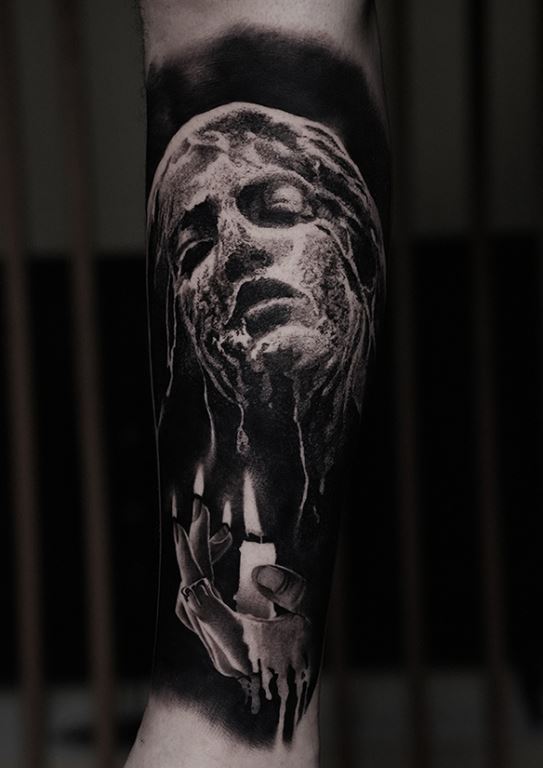
A: I have immense respect for color work, it’s a whole different
level of technical skill ! While I occasionally add color, usually
in a uniform way to highlight text or create contrast, I remain
devoted to black and white. Even in the drawing stage, mastering
black and its shades fascinates me. The depth and dimension that can
be achieved without color is a world that continues to amaze and
inspire me.
Q: I don't have a favorite tattoo from
your portfolio, because I love all of them. However, I gotta say,
the big sleeve tattoos and the back pieces are truly something
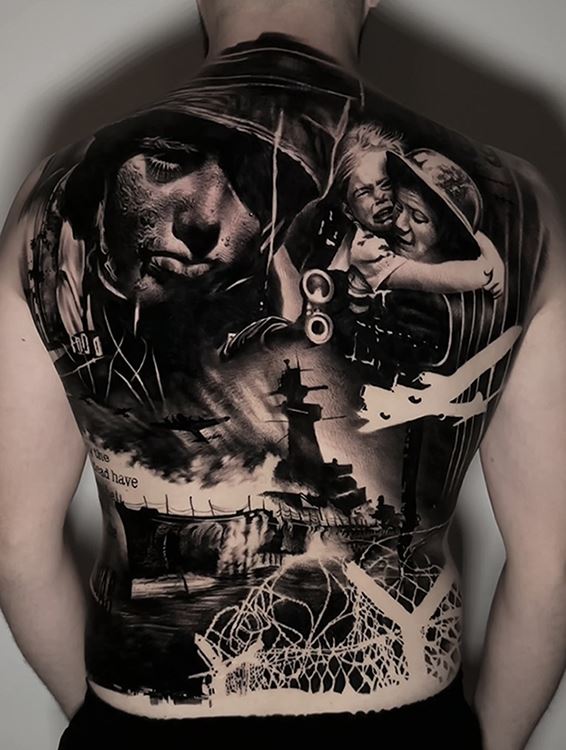
special. I love that "war" back piece. What was the most challenging
tattoo you've ever done? How many sessions it took to finish it?
A: Thank you! I’m incredibly proud of this back piece depicting war,
in collaboration with my friend Ali Husseini, one of the best tattoo
artists I’ve ever worked with. Sharing such deep human and artistic
connection with him has been unparalleled in my experience. One of
the most challenging projects I’ve ever undertaken was a sleeve I
completed in Munich at the PardonParis studio. It featured a
wildlife scene with a massive elephant, zebras, giraffes, and a
nature scene with water and mountains. What I didn’t know at first
was that the client had lost a significant amount of weight, making
the skin difficult to stretch and the ink harder to apply evenly.
This added unexpected time and effort, especially in capturing
details like the elephant’s wrinkles and the splashing water of the
waterfall. Thankfully, the client was pleasant, patient, and handled
the pain remarkably well, which made my job easier and pushed me to
surpass my limits. At the end of the first day, after seeing just
the elephant, he turned pale and said, “It’s just a tattoo man, it’s
not supposed to look that realistic!” It was a funny and rewarding
moment.
Q: Can you walk me through your creative
process? Do you sketch out ideas beforehand, or does it evolve
during the session?
A: When listening to the client, I instinctively create the design
in my mind. I then translate that vision onto my tablet, by finding
good references, ensuring the design is balanced, something I
consider essential beyond technical execution. The stencil stage is
equally crucial, as it helps me capture key details and distinguish
between light and shadow areas. From there, I try to stick to my
design, staying true to what was agreed upon with the client. Since
my work often spans multiple sessions over several days, I sometimes
get new ideas or notice potential adjustments as I see the tattoo
come to life on the skin. I always share these suggestions with the
client before continuing in the next session.
Q: Any favorite piece you did recently?
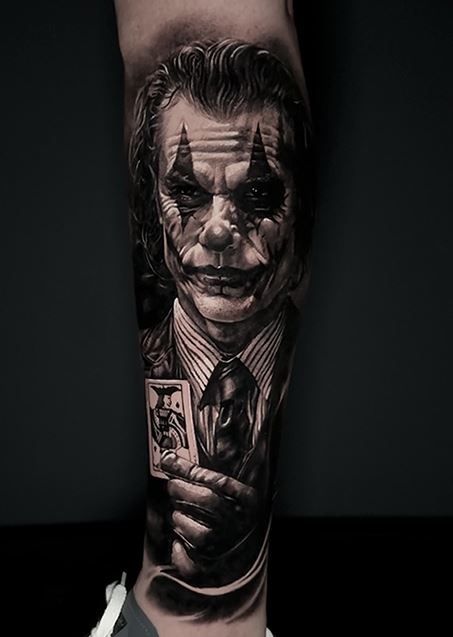
A: My favorite piece is the Joker clown tattoo. The details of the
makeup, the facial expression, and the layers of clothing and
accessories around the face were incredibly fulfilling. I have to
admit, I’m really proud of it.
Q: What would be the "dream" piece?
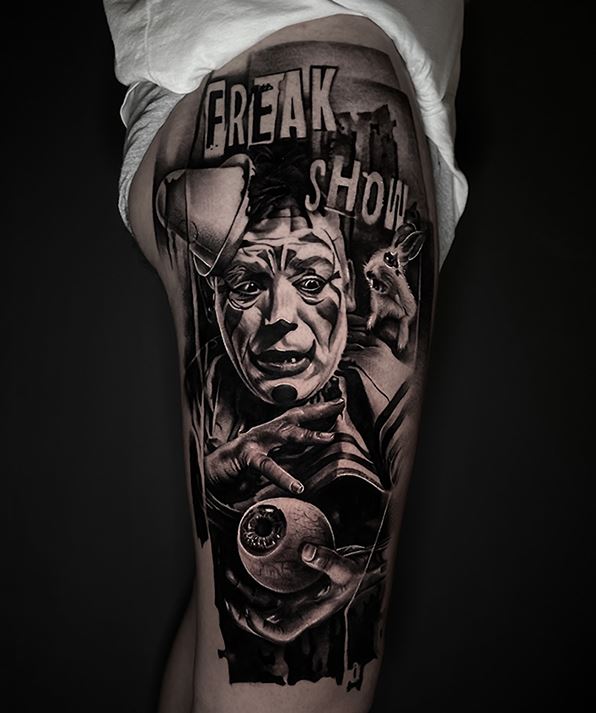
A: I envision a character with layers of texture, like broken glass
in front of the face, fabric, or a bag, combined with powerful
facial expressions. The texture work on cinematic scenes, especially
with this mix, is my ideal. I think of movies like “Requiem for a
Dream” (2000) by Darren Aronofsky, which embodies this raw, intense
visual style.
Q: How important is to negotiate with your clients when it
comes to design corrections or ideas while maintaining your own
style and artistic vision?
A: It’s one of the toughest challenges today. In a world where there
are more and more tattoo artists and clients often come with images
of tattoos already done on someone else, it’s necessary to educate
the client about the importance of respecting other artists' work
and the value of a unique design that aligns with my style. However,
we usually find a compromise where everyone is happy.
Q: Have you ever turned down someone?
A: Oh, absolutely! For several reasons. If a client insists on
dramatically lowering the price, it impacts my motivation because I
see it as a lack of respect for an artist's work. Also, I’ve often
redirected clients to other tattoo artists whose style better aligns
with their expectations.
Q: What’s the most memorable experience you’ve had working
with clients? Are there any standout moments that made a lasting
impression on you?
A: Personally, I need a calm environment, and I like when the studio
presents a nice setting. I don’t talk much during my work because
I’m deeply focused on what I’m doing. I make sure the client is
comfortable and avoid asking questions, as not everyone enjoys
conversation during the session. However, after hours or even days
spent together, knowing my work will stay on their skin for life
creates a strong bond. The time spent together is meaningful. A lot
about a client’s personality and life unfolds during a tattoo
session. I’ve learned more about the complexity of human nature
through my work than in any other social experience. That said, I’ll
always remember the time I tattooed a client on the 80th floor of
the Burj Khalifa in Dubai... a truly unforgettable
experience.
Q: Where are you located now? Please write
down your studio location and website/social media links. Also let
us know if you are available for bookings.
A: I recently spent a few months in Ivory Coast, West Africa, where
I opened a studio. However, I'm returning to my home studio in
Beirut, Lebanon as the tattoo scene in West Africa is still
emerging. You can find me on Instagram @mahmoudkhalifehtattoo.
Q: Nowadays, we have many tattoo conventions and tattoo
seminars. I think, these events are a great opportunity for young
artists, and people who seek a good source of inspiration... What's
your opinion?
A: I completely agree! Tattoo conventions and seminars are fantastic
opportunities for both emerging artists and enthusiasts. They offer
a platform for learning, exchanging techniques, and gaining
inspiration from seasoned professionals. However, it can also be
challenging, especially with my style, which requires a lot of work.
During conventions, there’s often not enough time to fully execute a
piece, and I'm not in my comfort zone, which results in hard work
over several days. It's a huge investment of time, energy, and
money, but the rewards are well worth it for growth and exposure.
Q: How often do you participate at local
or international tattoo conventions?
A: I participated at the Marmaris Tattoo Convention, where I won the
Best Healed Tattoo award. I also took part at the Milano Tattoo
Convention, where I had the chance to meet incredible artists like
Sam Tattoos and Benjamin Lucas. Additionally, in Lebanon, I’ve held
seminars focused on specific topics like texture work and host
one-on-one workshops to help tattoo artists elevate the quality of
their craft, with the goal of pushing the industry forward and
making a positive impact on the community.
Q: Connections are important in this industry. Do you have
any favorite tattoo you would like to work together on a big scale
tattoo? Like a collaboration style tattoo? Ah that would be really
nice!
A: Beyond the style, it’s essential for me to feel comfortable with
the artist so that the working atmosphere becomes an integral part
of the experience, not just the final result. It would be exciting
to blend styles in collaboration with other artists, such as Arabic
calligraphy, which I deeply appreciate, or colored realism. Imagine
a piece that's half black and grey, half colored! And of course,
I’ll continue working with my dear friends Ali Husseini, Ali Saleh,
and Hussein Mistrah. We share the same work ethic and a seamless
connection that makes the collaboration even more rewarding.
Q: Have you ever worked in a foreign
tattoo studio as a guest artist?
A: I’ve had the opportunity to do several guest spots in Europe (Die
Tattoo in Milan, Italy; PardonParis in Munich, Germany), Asia
(Dubai, Jordan), and Africa (Le Studio in Abidjan, Ivory Coast).
These experiences have been incredibly enriching. Being part of a
team is something I’m definitely interested in for the long term.
I’ve been fortunate to guest in respected and respectful studios,
and both professionally and personally, I would continue to guest
anywhere I have the chance, as it helps me grow, expand my
perspective, and build meaningful connections within the tattoo
community. My next big dream is to go to the United States, where
the tattoo scene is truly incredible.
Q: Do you like the local tattoo scene? Do you see progress?
A: Yes, because the Lebanese people are very open to the concept of
tattooing, which has deep roots in our culture, dating back to our
ancestors. This creates an interesting flow of work and facilitates
the opportunity to specialize in a particular style. However, there
has been an increase in the number of tattoo artists offering
low-quality tattoos at very low prices, which is concerning. I’m
receiving more and more requests for cover-ups, which I don’t like
to do, as it feels wrong to work over someone else’s piece. That’s
why I try to educate my clients, as well as new tattoo artists, on
the fundamentals of tattooing to help ensure a rich, professional
community.
Q: What's your opinion about the American
tattoo scene? If given a chance would you consider trying your luck
in the USA working as a tattoo artist?
A: The American tattoo scene is undoubtedly, and obviously, the best
in the world. Every tattoo artist dreams of guesting or having the
opportunity to live in the United States to be part of this vibrant
community, and I am one of them. Americans allow artists to push
their work and grow within the industry thanks to their
open-mindedness and well-established knowledge of the tattoo world.
Clients come for the artist and their craft. Going to the USA would
allow me to break through the ceiling that my country imposes on me.
I hope to make this happen very soon.
Q: What do you like the most about being a tattoo artist?
A: What I cherish the most about being a tattoo artist is the
connection I build with people from all walks of life. Each client
brings their own unique story, culture, and identity, and being part
of that moment when they trust me to mark their skin is truly
rewarding. The flexibility of my time is also a huge perk, allowing
me to manage my work in a way that best suits my creative process.
My hands are my tools, and they translate my ideas, emotions, and
artistry into something permanent on someone's body. There's
something incredibly fulfilling about turning a vision into reality,
especially when that vision means something so personal to the
client. And at the end of each session, the look on their face when
they see the final piece, knowing it will stay with them for life,
is priceless. It’s not just about the tattoo, it’s about the entire
experience and the connection that goes far beyond the skin.
Q: Your advice for those who want to try getting into
professional tattooing?
A: Technique definitely develops with practice, but the hardest part
is finding your own style. It’s a long, personal journey where you
explore different influences before discovering what defines you as
an artist. It’s also crucial to stay open to advice and constructive
feedback. Tattooing is an art that's constantly evolving. As I
always say, "we are always in a learning process." Don’t rush, take
the time to perfect your skills, and remember that every mistake is
an opportunity to learn and grow


