
Interview with Max Demian
Hello Max Demian! Thank you so much
for taking the time to do this interview. It's a pleasure to have
this opportunity. Please start telling us something about yourself
and your background. Are you a self taught artist? Hello
everyone, I'm an artist born in Buenos Aires, Argentina, but I moved
to New York City over two years ago. As a child, I was always
interested in art and went to an art school because I loved drawing.
Honestly, I wasn't influenced by anyone. I just liked drawing
because it was the only way I didn't feel alone. Art is a great
companion for me.
Q: Did you believe that one day you can make a career being
an artist? What kept you motivated?
A: In addition to being a tattoo artist, I'm a musician. I used to
do both professions at the same time, but when I was younger, I was
more into music. However, you can't make a living from metal music
in Argentina, and I wanted to make a living from what I love, and
with tattooing, I was able to do that. Art itself keeps me
motivated; it's a language you never finish learning. You'll never
graduate as a tattoo artist; I'll always have something to learn.
Q: When tattooing came into the picture?
A: In the 90s I had a friend who started tattooing, he was one of
the first and that caught my attention, but I had a lot of respect
for the profession and I didn't dare, until one day I woke up and
said I wanted to be a tattoo artist, the desire led me to be a
tattoo artist, consistency, patience and perseverance.
Q: How long took you to figure out your creative direction?
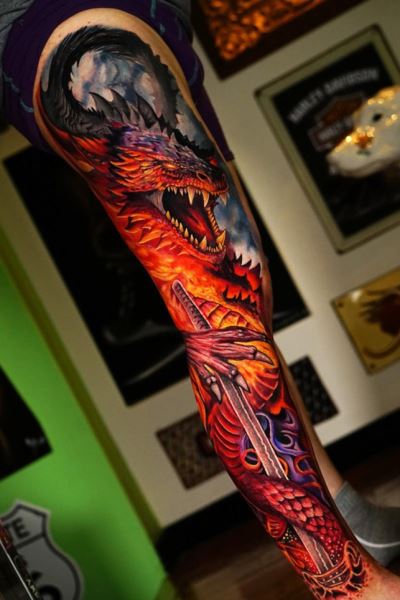
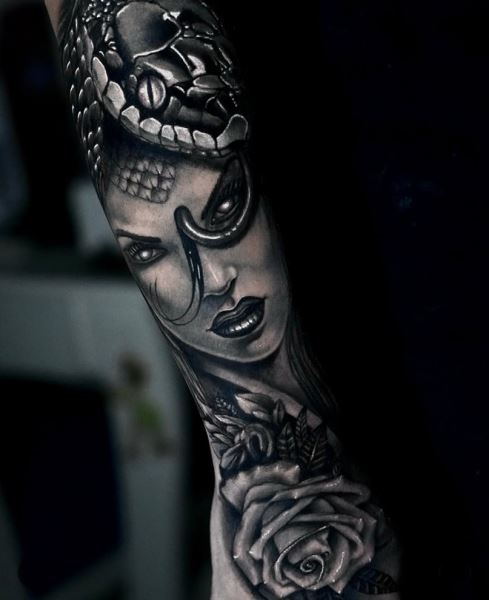
A: I started doing a lot of black and grey (greywash) but over time
I realized that I was starting to get bored with the style and when
it healed the piece didn't look strong, so I started with opaque
greys and then with color, it took me time to do the technique
because it's very different from greywash, and my style is color
realism and black and grey, but now I'm at a stage of finding that
realism doesn't fall apart over the years. Because honestly the only
tattoos I see that don't weaken are Japanese, neotraditional and
traditional.
Q: How do you envision your style continuing to develop or
diversify going forward?
A: Tattoos and their styles keep changing and improving. I try not
to get into AI because I think it's too noticeable, and I prefer to
take images and superimpose them because I think it's more artistic
than AI. But as I told you in the previous question, I'm looking for
ways to ensure that realism doesn't weaken.
Q: Given your mastery of both color and black and gray
tattooing, do you have a personal preference when approaching
large-scale, highly detailed pieces, or do you find both techniques
offer comparable artistic value and expressive impact?
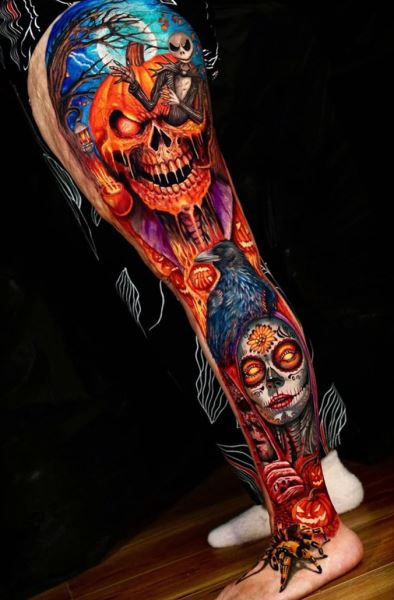
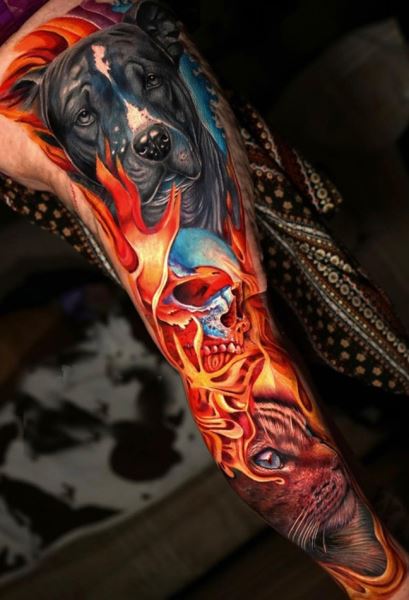
A: It's a good question. I find that with black and grey I have to
think less. Since I did a lot of B to G, it's easier for me and I do
it more relaxed. With color, I have to be careful that the colors
don't stain and I also have to think more. The technique is almost
the same, but I use different needles for color than for black and
grey. For color I use gauge 12 and for black and grey I use gauge
10, because I think the shadows and transitions look better with a
more closed needle. I think the impact depends on the person's
vision. I can be impacted by both the BG and the color, but the
design and what the work wants to say are fundamental.
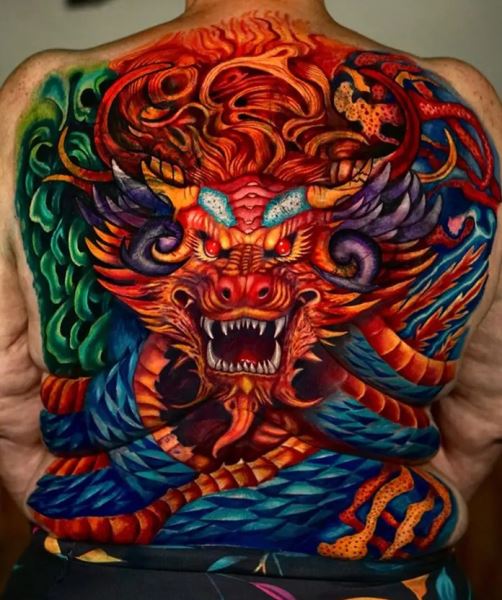
Q: For large-scale pieces like back tattoos, how do you
typically approach the creative process? Do you develop a series of
sketches beforehand, or is the design a more collaborative effort
with your client?
A: To make the design I listen to what the clients have in mind and
I give them some ideas so that the design has flow in their body.
When I finish the design I send it to them and then they decide, but
if their decision is not good for the development I let them know,
sometimes it is difficult for the client to understand but I do
everything possible because I know that in the future they will
agree with me.
Q: Have you ever completed a tattoo that, despite being
exceptionally challenging, ultimately became a personal favorite due
to its successful outcome?
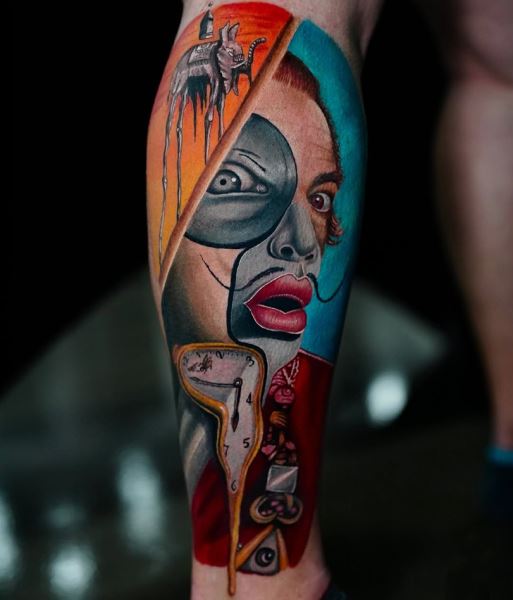
A: Yes, I've done some designs that I didn't know how the final
result would turn out because it was very complicated to do. But for
those types of designs, I study them a week beforehand, analyze how
to do them, and arrive at the session already decided and without
doubts. Because in the past, I've had to arrive at the session and
not know how to solve a design, and I had to solve it on the spot.
So that's one of the things that I have to know before doing a job:
how to start and how to finish before doing it. That gives me
confidence.
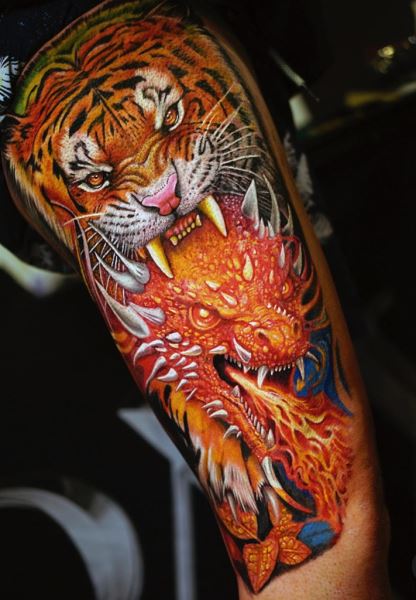
Q: Your tattoos are incredibly vibrant and detailed.
Considering that colors can soften slightly over time as the skin
heals, what design principles do you prioritize to ensure a full
back piece remains 'readable' and visually stunning for years to
come?
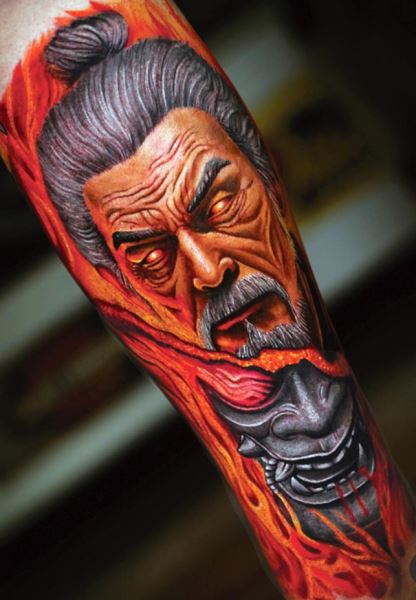
A: Thank you so much!!! I've been experimenting over the years and I
think that the application is fundamental, the stroke of the machine
too, and letting the color take its time when it's applied.
Sometimes I do a part and leave it for about 20 minutes to see its
real color, and then I go back to that same part if I'm missing. But
it doesn't always depend on the artist how long the back tattoo
lasts; it's also the client's responsibility to take care of them.
The type of skin also has a lot to do with it. The skins are
different and there are skins that you use the same technique and
they heal differently. That's why I also try to do a small touch-up
on some tattoos that didn't heal well.
Q: Given your reputation and success, I imagine clients
often grant you considerable artistic freedom. However, have there
been instances where you've had to negotiate a design idea or
placement with a client? How do you typically navigate that
collaborative process?
A: Yes, sometimes it's difficult for the client to change their
mind. In the past, if they didn't change their mind, I wouldn't do
the work. Now, I give them advice, and if they don't accept it, I'll
do it anyway. But I warn them that over the years, they might
realize what I advise them. What I don't do are designs that I don't
like to do. I always try to change them so that it motivates me to
do them. And I try to convince the client that it will turn out
better based on my years of experience.
Q: Best memory with a client?
A: Many of my clients tell me very profound things and experiences
from their lives. That's something that fills my soul because I may
not see them anymore, but they told me something they didn't even
tell their mother or their brother. Something magical happens with
some of my clients, with the tattoo itself. I recently tattooed a
design that the client asked me for, which was a motorcycle and some
cards on the road. It was to remember her grandparents. When the
time came to see it in the mirror, she remained silent, looking at
the mirror with tears in her eyes. The studio fell silent, and the
atmosphere of emotion was felt greatly. She gave me a big hug and
said, "Thank you very much. I'll have it forever." That's all for
me.
Q: In an era where the tattoo industry is seeing
unprecedented talent and evolving professional standards, how
instrumental have your awards and sponsorships been in furthering
your career?
A: Tattooing is always advancing, and in the US, sponsorship became
easier for me. Sponsors are truly sponsors and help my career and
work improve. Prizes also help, but I'm not used to competing. I
only do it for other reasons, but they help my career grow.
Q: Do you have any favorite career highlight? What's next?
A: When I went to the Paris convention (Planetarium), the quality of
the artists was impressive, as well as the organization and the
legendary juries. At that convention, I felt 100% pure art. Now, I'm
doing a lot of conventions in the United States. I really like
getting to know different states and meeting new colleagues and
clients.
Q: You're quite the globetrotter with all your guest spots
and conventions. Beyond the tattooing itself, how crucial are these
experiences for expanding your network, connecting with other
artists, and getting your name out there?
A: Luckily, this profession has allowed me to travel to many
countries around the world, and I've also won awards in Europe,
South America, and the United States. However, I won the most awards
in the US. I was a guest artist at a large studio in Germany called
Art Factors. They have a hotel for guest artists, and it's fabulous.
When I've tattooed in Europe, I've slept on train platforms because
sometimes I didn't make it, and the trains don't run 24 hours a day.
At the Amsterdam convention, I got to tattoo in a very old place,
but it was great. It was like a warehouse from the 1800s and very
rustic. It was a great experience. At Argentina convention a person
who was doing body suspension started to swing and blood started to
drip from the person's forehead. It was a very bizarre moment.
Q: Many might assume that a country like the United States
offers unparalleled opportunities for career development and
widespread recognition in the tattoo industry. Based on your
experience traveling and working internationally, which location or
region do you believe truly stands out as the most advantageous for
tattoo artists aiming to achieve significant career growth?
A: In the past, the USA the industry was a little better, now the
work has dropped a lot but it is still the country I choose for my
growth. I went to many countries in Europe and I will stay in the
USA, there are conventions every weekend and they are accessible,
all the big artists always come to the USA, in NY the work is lower,
in other states it is a little better, but the conventions prevent
one from stagnating and it is good for making connections, meeting
other types of artists which helps with growth.
Q: Do you have any favorite American tattoo artists you
would like to work with in the future?
A: At some point I would like to get a tattoo with Paul Booth
because he was a great reference in my career and still is.
Guy Aitchison, I learned a lot from him, and for me he remains one
of the best exponents.
Q: From your perspective, does the 'American Dream'
represent a realistic path to success for tattoo artists in the
U.S., or is it often more of an elusive concept?
A: In my opinion, I'm not looking for the American Dream; I'm
looking for my own personal dream and fulfilling it, whether in the
United States or another country. But my goals are to fulfill them.
This country is the one I choose because I see my dreams come true
more quickly. And if you fight for what you want, it will come true.
Q: What impact do you aspire to have on the tattoo
community?
A: First, impress myself. Then, if someone likes it, even better.
But mine might be impressive to one person, but not to another. Art
is very subjective, and that's the fabulous thing about art. One
person loves it and the other doesn't.
Q: Where are you located now? Please write down your studio
location and links of your social media/website.
A: I'm in Manhattan, NYC, working in the Hustle Butter Gallery
studio, one of my sponsors, which is located in Soho, Manhattan. My
official website is www.maxdemiantattoo.com and my Instagram is
@maxdemiantattoo.
Q: If you could go back and give your younger self advice
about pursuing tattooing, what would it be?
A: Have more patience in every sense, if you dedicate yourself
everything comes, you should never stay in your comfort zone, when
you fulfill a dream look for another, life is nourished by dreams
and they are there to be fulfilled.


