
Interview with Radion Zinyatov
Hello Radion Zinyatov! Thank
you so much for taking the time to do this interview. Please start
by telling us something about yourself and your background. Do you
have any formal art education? Hello, dear editorial team!
I was born and raised in the small town of Temirtau, located in
Kazakhstan, Central Asia. My journey into tattooing began in 2011
when I was a 16-year-old just finishing school and preparing to
enter a design college. At that time, I already had an education
from a children's art school, where I studied in the art department.
I combined my studies in college with tattooing. I successfully
graduated from college and continued tattooing.
Q: Since when did you discover your affinity for arts?
A: Looking back, I realize that I have always been closely connected
with drawing and visual arts in general. I have been drawing since
childhood, creating various comics about Spiderman and other
superheroes. My parents noticed my interest at an early age and sent
me to a children's art school, for which I am very grateful. I love
my parents.
Q: What type of art do you like the most and do you have any
favorite artists?
A: I am very interested in contemporary art, oil painting, and
artists who can combine abstraction and realism. Among past artists,
I can highlight Hans Rudolf Giger and the Polish artist Zdzisław
Beksiński. I adore their eerie worlds with characters that, in my
opinion, have very interesting and well-thought-out visualizations.
Overall, I am open to any manifestation of visual art from different
times and many things can inspire me. So, when asked, I have many
names and specific paintings that I can remember and describe for a
long time :)
Q: What got you interested in tattooing? How it all started?
A: At 16, when I thought about trying tattooing, it was just a new
way of drawing for me, a tool and material in the form of human
skin. At that time, I had already tried oil painting, graffiti, and
tattooing was another form of visual art. I couldn't imagine that I
would be doing it for the next 13 years, and it would become my
profession.
Q: You are very talented, I bet it was easier for you to
learn the basics, however probably you spent some time "finding
yourself" creatively?
A: Considering my artistic education before I started tattooing, I
didn't make many mistakes or create truly bad tattoos at the very
beginning. At that time, I already had developed precision, which
allowed me to make bad tattoos relatively clean (LOL). I tried
myself in different styles and directions, looking for myself, and I
think that only now I understand what interests me the most in
tattooing. But my search for a style continues.
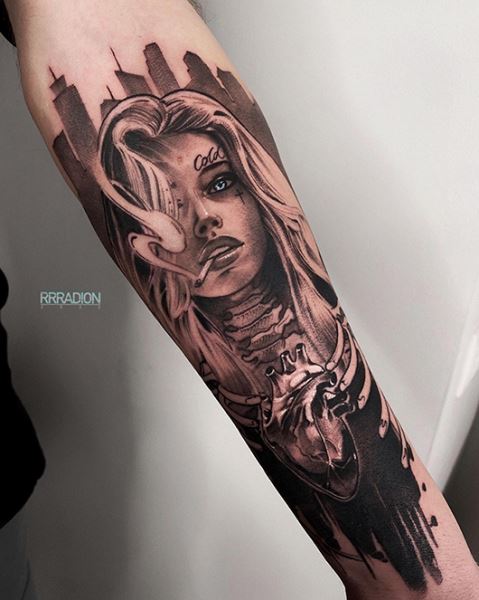
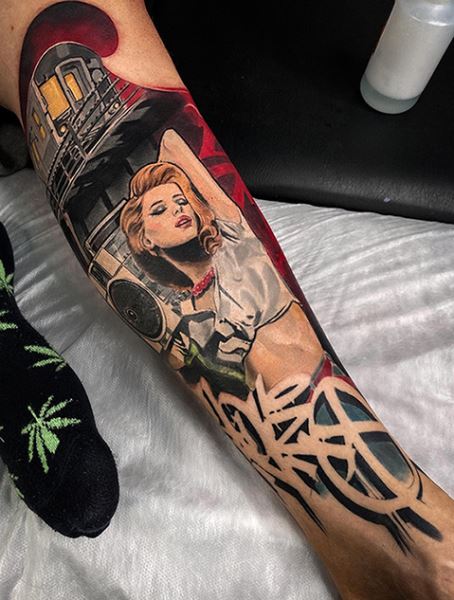
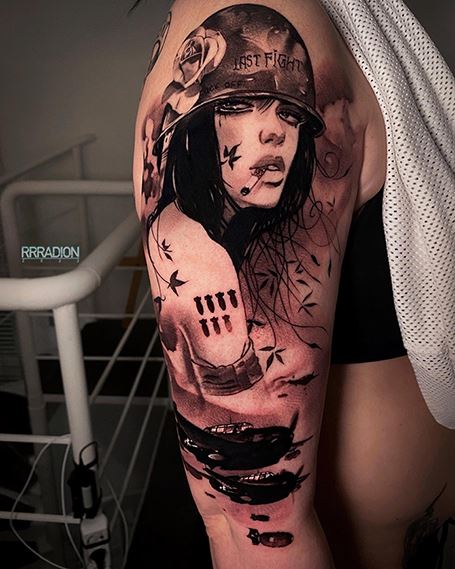
Q: In your portfolio, I see a lot of beautiful portraits, mainly
tattoo realism style. Is this your creative direction or you are
planning to experiment with other styles?
A: I love portraits and think this is something I will always want
to do. I believe this is the direction I want to move in, but I also
want to mix the realistic portraits with other styles.
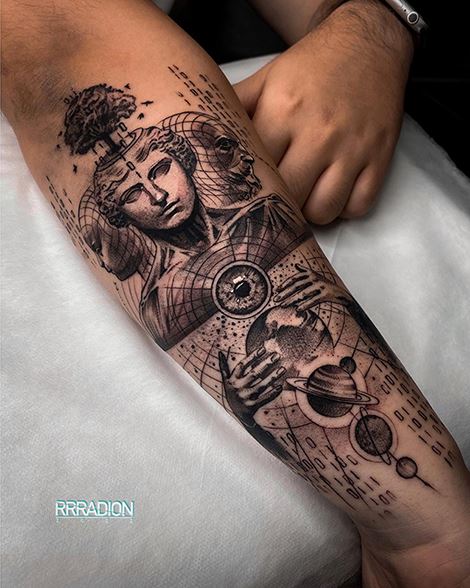
Q: I love the fact that you do color and black and gray
tattooing. Any preference or you enjoy doing both?
A: I can't say I prefer doing either color or black and white
tattoos more. I think the style I am developing can be executed in
both black and white and color. I believe my style should be
distinguished by the line shapes I use in the background, themes
(portraits), composition, and overall mood, but not by the presence
or absence of color.
Q: Some say that realism as a style can be creatively
limiting since we all require that perfect precision and accuracy of
the original portrait photo. However, nowadays clients want
something more unique, so we got more stylized portraits... Many
decorative elements like fonts, interesting flowers or even
cartoonish stuff can look really cool, almost like graffiti style
design. I love this mix. Tell me about the creative process. Do you
draw some sketches before the session or?
A: Yes, I also enjoy combining various styles and elements in
tattooing! Usually, I create a design on an iPad in the form of a
photo collage and draw separate elements by hand for the background.
With the advent of artificial intelligence, I almost always generate
references for collages using AI. This makes my tattoos unique. I
often create designs a few days before the session, considering the
client's wishes and ideas, but I do this in my style, also
considering my artistic experience and perspective.
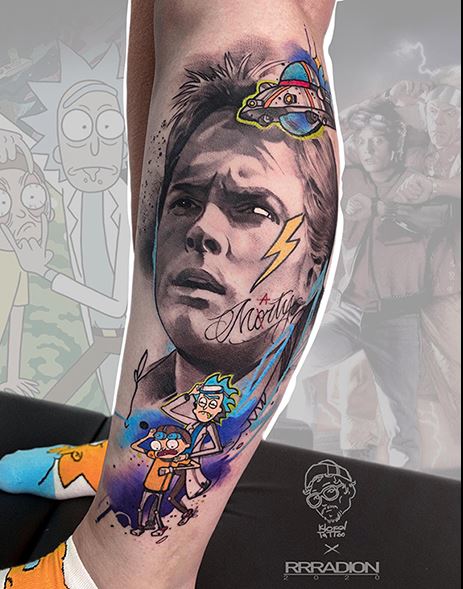
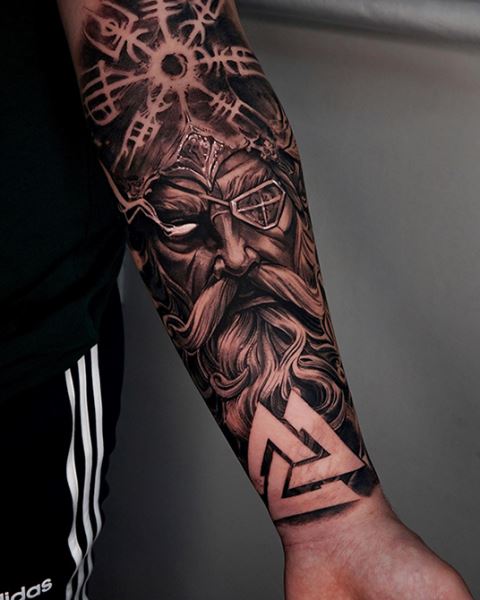
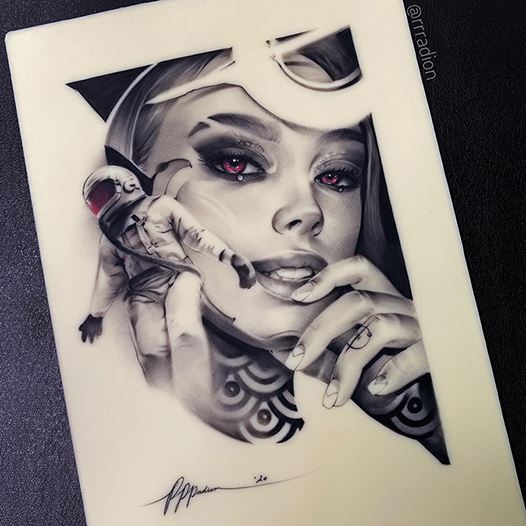
Q: I saw some really cool drawings in your portfolio, but I
was like wow... When I saw the one on fake skin... Radion, that
looks awesome! Seriously, is it more difficult to draw on fake skin
or on paper? I want to encourage our readers to try this technique.
So Guide me!
A: Thank you for your attention to my work on artificial skin! I
love practicing on artificial skin because it is exactly the same
process as tattooing on real skin. Given my extensive experience in
tattooing, tattooing on artificial skin is no more difficult than
drawing on paper, but it takes significantly more time. But I always
rejoice at the result, especially when framing the finished work.
Q: I think you should have your own catalogue with your own
drawings so clients can choose a ready-made design. About the fake
skin... Plan an expo!
A: I have considered a personal exhibition with tattoos on
artificial skin and I am working on it. So far, I don't have many
works, but I continue to pursue this goal. So I hope to announce an
exhibition soon!
Q: We are talking realism style... Technically this style is
very demanding but also very rewarding when you finally master it
and you see your client's happy face at the end of the session,
right?
A: The happy face of my client at the end the session is my highest
reward. The moment when the client first sees the finished tattoo in
the mirror is very important to me. Their emotions always make me
happy and inspired. I am very demanding of myself in the quality of
the tattoo execution, so when clients notice this, I am sincerely
happy.
Q: Do you also do cover up tattoos? If so, please tell us
what type of tattoos (color or black and gray) are easier to cover?
A: I do quite a lot of cover-ups of old and bad tattoos. For me,
this is an opportunity to help people in this way, making their
lives better, more pleasant, and more comfortable. Because old and
bad tattoos often cause embarrassment and shame for some people.
Sometimes they have to hide them with clothing, feeling insecure. So
yes, I feel it is my mission.
Q: Are all "bad" tattoos solvable?
A: I work with almost any cover-up, no matter how difficult
it is. Because I believe that it is always possible to do better
than what it's already there. Of course, it is easier and simpler to
cover light tattoos without a lot of black ink. This provides more
options in design themes and specific elements. Usually, darker old
tattoos are limited in choice. But it is always possible to find
something that the client will really like and that will be suitable
for covering.
Q: Do you negotiate with your clients when it comes to
choosing a proper design and colors? I assume, cover up tattoos are
way more challenging to work on than tattoos on "clean" skin?
A: Yes, of course, we always agree with the client on the choice of
plot and elements for the cover up. Usually, this work is more
complicated, especially in creating the design. It is more complex
and responsible process. The application of the new tattoo usually
does not differ from working on "clean" skin, except that cover up
tattoos often require an additional session to more densely color
the areas of the old tattoo.
Q: Your opinion on lasser removal? What's the timeframe that
a client needs to wait before they decide to cover up the old
tattoo?
A: Sometimes I work with tattoos that have undergone laser removal.
This gives more options in ideas and designs for the new tattoo. I
know that after a laser removal session, some time should pass,
usually more than a month, often 2-3 months. This long period is
because the lightening process of the tattoo occurs during this
time, after the complete healing from the procedure. The body
continues to "wash out" the remnants of the old pigment much longer
than the visible recovery after the removal session.
Q: So many clients, stories and experiences. I guess this
journey is full of lessons and beautiful moments. What do you like
the most about being a tattoo artist?
A: I really like the opportunity to meet new and interesting people.
Every acquaintance is a separate story. With many clients, I often
become friends. I also really enjoy the opportunity to travel, see
new cities and countries. For me, this is happiness.
Q: I can see that you are traveling, guest spots? Where are
you now and are you available for bookings?
A: At the moment, I have been living and working in Canada for a
year. So appointments for sessions with me are open in the beautiful
sunny city of Kelowna at DON’T LOOK DOWN studio. I will be very
happy to see you on my tattoo chair :) You can contact me on
Instagram @rrradion. Previously, I worked in Poland at SKY tattoo
studio, in Moscow (Russia) at PROFF tattoo studio, in Turkey in the
city of Alanya at Cleopatra INK studio, and in Kazakhstan, in my
hometown of Karaganda at AZART tattoo studio. The experience of
working in Turkey was my first one outside my home country. It was
quite an ambiguous but important experience. There, I had the
opportunity to earn my first serious money, which allowed me to move
forward. The experience in Moscow was very positive, as I was an
apprentice of the famous tattoo artist Igor Terentyev
(@tattooproff). There, I was able to significantly improve the
quality of my tattoos and began to form my recognizable style. The
experience in Poland was my first in Europe. There, I had the
opportunity to travel around European countries and visited France,
Paris. The experience of working in Canada opened huge horizons for
me in all areas of my life. I enjoy living and working in Canada.
Q: What about tattoo conventions?
A: So far, I have not attended many tattoo conventions, as I am more
comfortable working in a studio. But a year ago, I attended one of
the major festivals in Canada, in the city of Kelowna. It was very
interesting experience for me. There, I tried myself in
participation, learned how participation works and how to win in
nominations. So at the next convention or festival, I will be
prepared and try to win some nomination.
Q: Since you've had the opportunity to see other countries
and get familiar with the local tattoo scene... What is your
opinion? Do you see progress?
A: I have worked in Central Asia, Europe and North America. These
are completely different countries with different mentalities. But
despite all these differences, I see one similarity. Tattoo artists
in all these countries strive to be better every day, constantly
improving the quality of their work, trying to make them more
interesting and bring something new.
Q: What about the global tattoo scene? Do you feel like we
are heading in a good direction?
A: Tattooing is rapidly changing every year, with new styles and
techniques emerging, artificial intelligence appearing and all this
leading to the overall development of tattooing worldwide. So yes, I
believe we are moving in the right direction.

Q: What would you charge or improve?
A: If we talk about tattooing globally, I would leave everything as
it is, allowing it to develop independently. There is nothing I
would want to fix. And if we talk about myself as a separate tattoo
artist, I would like to dedicate more time to developing my basic
artistic skills, possibly spending more time on oil painting and
education in this field.
Q: Where is the next destination? I bet for a talented and
hard working artist like you, the American tattoo scene will be a
great career highlight.
A: I think there are many countries I would like to visit or even
work officially under a contract. Among these countries are Vietnam,
Japan, Germany, and the United States. I think the next country
could be the United States, as it is close to Canada.
Q: Your advice for those who want to try getting into
professional tattooing?
A: The most important and crucial advice, in my opinion, is to
develop your artistic skills first and foremost. Tattooing is just a
form of visual art, where the same rules apply as in drawing on
paper or painting on canvas.
Thank you for these interesting questions. I was glad to have such a
wonderful conversation with you!


