
Interview with Ruslan Millinhton
Hello Ruslan Millinhton! Thank you
for much for taking the time to do this interview. Please start by
telling us something about yourself and your background. Do you have
any formal art education? Hello to everyone reading this interview,
my name is Ruslan Millington and I am currently 26 years old.
Originally, I am from the city of Sumy, Ukraine. I have been doing
tattoos for over 10 years, and yes, it's been my whole conscious
life. I don't have an art education. I am self-taught, and all my
knowledge comes from the internet, I read forums, watched videos on
YouTube, drew inspiration from other artists' works, analyzed it
all, and drew through the nights. All I remember from the distant
past, before tattooing, is that I was really drawn to any kind of
art.
Q: What inspired you to start tattooing? Was it hard to
learn the basics?
A: It happened so suddenly and was so interesting. I was 15 years
old, yes, just 15 years old. I saw a video on the internet about how
to make a tattoo machine with your own hands, and on the same day,
using improvised means, I made my first tattoo for a friend. Back
then, we used liquid from a gel pen as ink and a lot of alcohol to
make it somewhat sterile. It was awful but pretty cool, lol. From
that day on, the idea of becoming a tattoo artist was born in me. I
found my first job at a construction site, and with the support of
my parents, I saved up for a tattoo kit within a year. I am grateful
to my mother for not scolding me for tattoos but instead supporting
me and believing in me. The basics came easily to me, and at the age
of 17, I was invited to a tattoo studio to take walk-ins. Further
growth made me work hard to become a professional.
Q: I bet even the super talented, need some time before they
feel confident and maintain a regular clientele. How long it took
you? Who were your first clients?
A: To be honest, about some things, I still feel insecure to this
day. It took me a couple of years to build a steady clientele - no
problems there. But when it comes to feeling super talented, I have
questions because there is no limit to perfection. Every time I look
at my work, I think to myself, "it could be better." This feeling
pushes me to develop further and be even better. My first clients
were my friends and their acquaintances. The funny thing is, these
were unusual places for tattoos, like the inner part of the lip, the
stomach, or fingers. These are very challenging places when you are
holding a tattoo machine for the first time.

Q: There are many tattoo styles nowadays. How long took you
to figure out your creative direction?
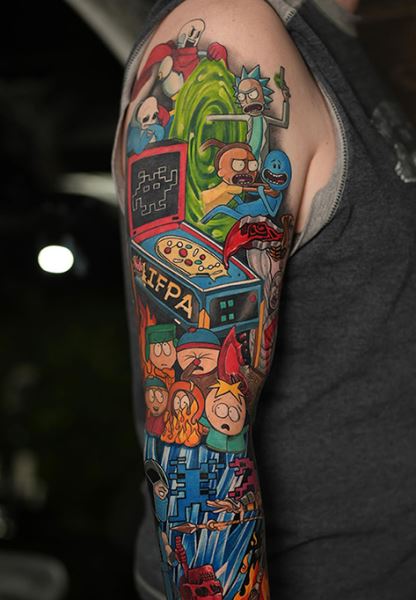
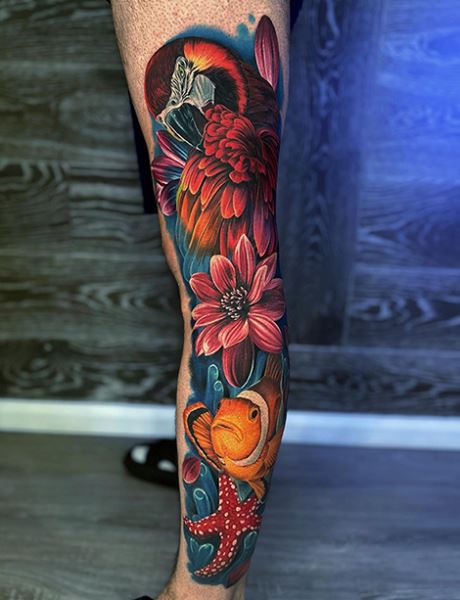
A: I chose color realism because it's challenging and very
interesting. I did non-traditional styles for the first 3 years,
then I saw the works of Evgeny Knysh, and my attention shifted to
this style. I was so interested in this style that I finished my
first color realism piece at 4 am. It was difficult to tear myself
away and let the client go with an unfinished work. It took almost
16 hours of work. Special thanks to my client for their patience.
Q: You have a very interesting style, a beautiful mix of
realism and surrealism. What do you like about this style the most?
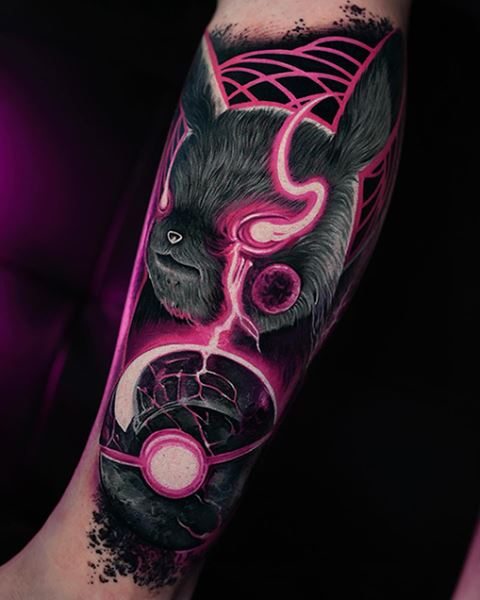
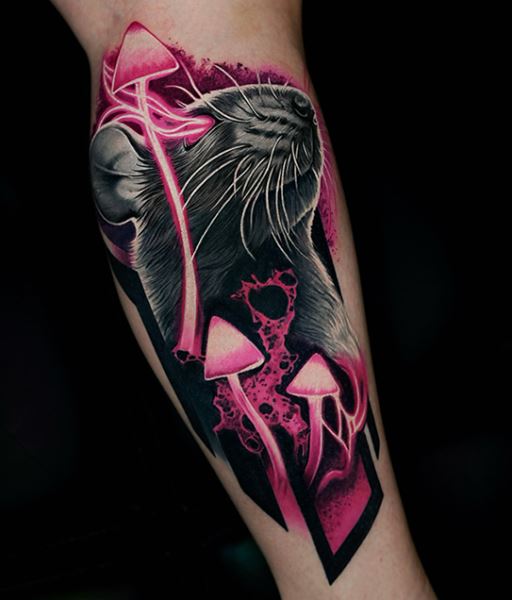
A: Thank you very much. At the moment, I'm trying to make it more
strict and recognizable. Previously, I had a palette of 30-40 shades
from different colors on my desk. Now, I try to use a combination of
gray and pink or gray and fiery orange.
Q: I love the fact that you do both color and black and gray
tattooing. What do you enjoy more?
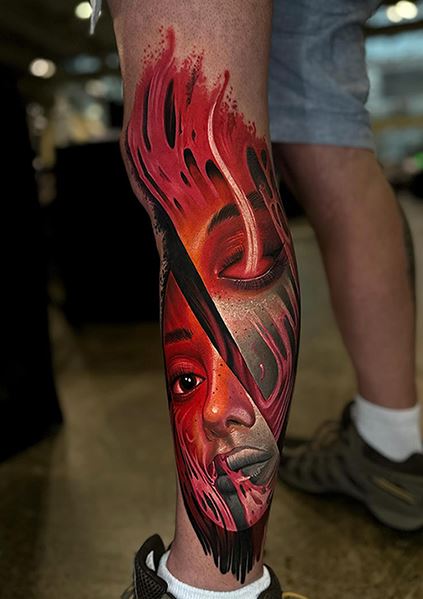
A: I like color style because you can achieve the "wow" effect. In
my opinion, it's one of the most challenging styles. I constantly
test myself and expand my limits with each work done in this style.
But it's easier for me to do black and gray style, sometimes I just
lack variety, as it's a completely different technique.
Q: All of your tattoos are unique. I bet you spend some
extra time to draw each design before the session with the client.
Tell me more about the creative process. Do you draw on paper or
it's digital like pentablet or some software like Photoshop etc?
A: I prepare my projects using a tablet and the Procreate app. I
create collages from various photos and images, apply filters to
achieve a certain effect. Recently, I got acquainted with AI and use
it for certain purposes.
Q: Some designs are quite complex. I like the big tattoos
like sleeves and back pieces. How long does it take to finish one
big tattoo like a color back tattoo?
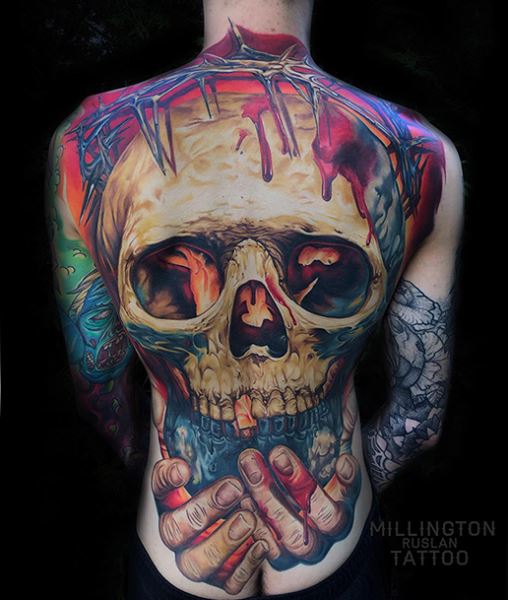
A: The amount of time needed is influenced by many factors, such as
design, body type, etc. For a color back piece, it may take around
11-15 sessions, while in black and gray style, it could be 7-10
sessions.
Q: Talking about long sessions, what's the longest session?
How do you cheer up your clients when they start complaining about
the pain?
A: On average, my sessions last 6-8 hours. Lately, I rarely
encounter clients who have a low pain tolerance, and I don't know
why this is happening. Almost every session is accompanied by
conversations and humor; I'm sure this is a very good distraction.
Sometimes I use a spray or foam that numbs the skin. However, this
only works on damaged skin, which is very helpful at the end of the
session.
Q: I really like the Japanese tattoos but with a new vibe,
more like neo traditional style... You're seriously very talented!
Where are also some anime inspired designs. Do you have any favorite
designs?
A: Thank you for the compliment. I don't think I have favorite
designs, but I can share your interest in the Japanese style. For
me, it's something familiar, mesmerizing, and eternally stylish. The
Japanese and non-traditional styles have allowed me to understand
how to create a dense and smooth gradient in color tattoos.
Q: Since tattooing is a service job, I bet it can be
limiting when it comes to creative freedom. But if the artist, is
truly an artist there will be a way for experimentations with styles
and techniques. Do you agree?
A: It all depends on the artist. There are tattoo artists who do
tattoos for the sake of earning money. Perhaps such artists are
fully immersed in the specific work (earning money) and unknowingly
limit their creative freedom. During this time, I approach tattooing
as art, and I will always have the time and opportunity to
experiment, improve my skills, find new techniques, and express
myself through art. If you really devote yourself to art with soul
and do it responsibly, then the price for it will correspond.
Q: How important is to have a good energy in the studio? Do
you have other artists working in your studio? If so, how many are
they?
A: That's very important to me personally. I can't stand working
alone. I love humor, conversations, sharing my emotions with
someone. Constant discussions about art, analyzing tattoos done,
participating together at festivals, and so on. At the moment, there
are four of us.
Q: You are currently living and working in Toronto Canada.
Do you like the tattoo scene there, do you see progress? How about
the global tattoo scene?
A: The tattoo progress in Canada is weaker and slower than in
Europe. The most popular and in-demand artists here specialize in
black and gray tattoos, with very few artists having a truly high
level in color style.
Q: Nowadays, there are many opportunities for the tattoo
artists and the already established. So many tattoo conventions,
seminars, guest spots... I think it's better than it used to be a
decade ago. I believe even social media has its own positive
aspects, like free marketing and learning new stuff. Your thoughts?
Do you travel for work, like guest spots and conventions? If so, can
you write a few words about the best memory so far?
A: Over the past 2-3 years, everything has really changed, but I
believe that not everything is so straightforward. In terms of
artists, styles, and techniques, yes, there have been significant
changes. Now, on the internet, you can see such a level, such
quality that was impossible to imagine before. It's impressive and
mesmerizing and at the same time motivating. I like almost
everything that comes with tattooing nowadays, except that
everything now seems more like commerce. I travel a lot, visiting
guest spots and tattoo festivals. The brightest days for me have
been at tattoo festivals. These were the moments when you stand by
the stage and wait for them to call your name, to announce you as
the winner among the coolest and world-famous artists. So much
stress, a burning sensation in the chest, and most likely a huge
amount of adrenaline in the blood as I stepped onto that stage
holding my prize. These were not the only awards, but the most
significant for me, as it was my goal, my dream.
2019 Tattoo convention Kyiv Ukraine
1 place color tattoo
2 place big tattoo
2019 Tattoo konwent
1 place big tattoo
2023 Nix tattoo show
1 place color tattoo
Q: What do you like about being a tattoo artist? Would you
change something?
A: Diversity, self-expression, and meeting and communicating with
people. I probably wouldn't change anything, everything is great.
Q: Navigating a busy schedule isn't always easy, what do you
do on days when you feel overwhelmed? Is if difficult to own a
tattoo studio?
A: We work as a team in a private studio, where all processes are
well-established and discussed. I wouldn't say it's very
challenging, as everyone does their job. Good rest, healthy food,
and stable sleep are key to avoiding stress.
Q: What would you say to those who want to try getting into
professional tattooing?
A: Give your all to it and don't be afraid to contribute your ideas
and experiment. "There's always room for improvement," even if
you're told you're doing well. And don't forget to take breaks to
avoid burnout.
Please write down your contacts, social media links and
studio location.
I am currently in Toronto, Canada. But most likely, we will be
moving soon, so stay tuned for updates on my personal page.
My instagram page is @millington_tattoo
https://www.instagram.com/millington_tattoo
Mr.Ruslan Millinhton thank you so much for the interview,
Fredrik Lindstrom,
The Skin Artists Tattoo Magazine Team


