
Interview with Santjakov
In the world of fine-line realism, few artists
manage to capture the weight and "stone-like" texture of classical
art quite like Sant. Currently based in the competitive heart of New
York City, Sant has built a global reputation not just for the
staggering detail of his large-scale black and gray pieces, but for
his philosophical approach to the needle. From his early days at his
home studio, Kannves, to hosting sold-out educational seminars for
the next generation of artists, his journey is defined by what he
calls the "inexhaustible desire to pursue the unattainable". Today,
we sit down with Sant to discuss his beginnings, the mental
discipline required to map out a full-body composition, and why he
believes sharing his "secrets" is the only way to truly move the
industry forward.
Q: You’ve shared that your studio, Kannves, has been by your
side, guiding and teaching you since the very beginning. When you
first started, what was the most difficult part of transitioning
from traditional art to the permanent medium of skin?
A: Honestly, in my early years, it was very difficult for me to
navigate the relationship between classical art and the world of
tattooing. I have always been very romantic and respectful toward
the fine arts academy. I’ve sought to understand my own capacity and
best form of expression in every area of my life; essentially, the
purity of classical art the respect for painting and sculpture, made
me a bit of a purist. For a time, this limited the way I perceived
tattooing and other contemporary creative formats. Because of this,
I kept a great distance between tattooing and the academy. But with
the passing years and the maturity I acquired both personally and
artistically, I realized that the same respect and commitment I felt
toward the academy could also be experienced in tattooing, even if
it was a self-taught, experimental process. I understood that my
spiritual passion for classical art and my interest in new formats
were the bridge where both fields could meet. These two parts are
not separate; they are complementary. Over time, this led me to
commit myself to the exploration of the tattoo industry and give it
an academic direction through seminars and exhibitions. I wanted to
showcase technical and creative processes to show how a true
artistic career can be developed through tattooing allowing me to
maintain the essence of classical art while exploring it through a
new medium.
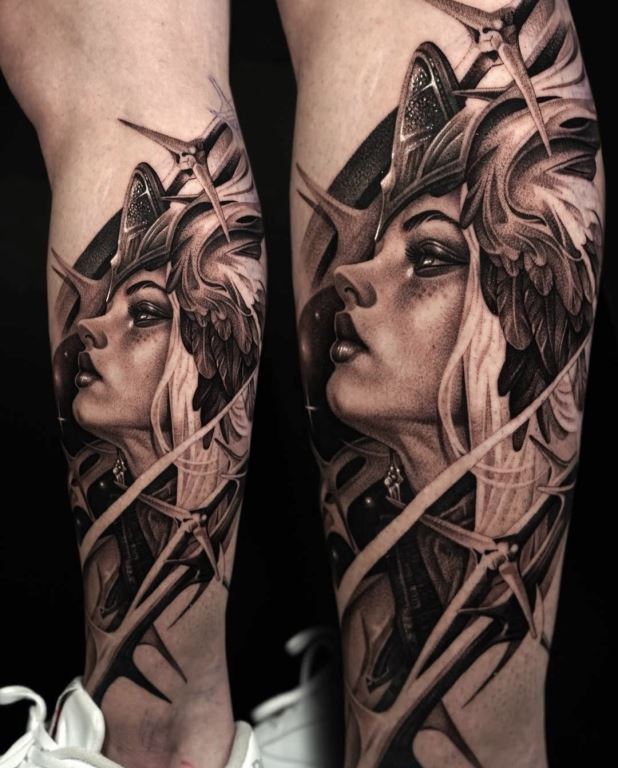
Q: In those early days, how did you handle the pressure of
mistakes, and what kept you motivated to stay in the industry during
the toughest moments?
A: Starting in tattooing truly begins with error. It is impossible
to be fully prepared for the moment you first touch someone’s skin.
You can study and prepare as much as possible, but the experience
remains unique and unrepeatable. That first approach defines your
path because it is rarely what you expect, regardless of your
preparation. In my case, the deep desire to see what I could achieve
with tattooing is what sustained me, specifically, the level of
quality I could bring to the figures. I wanted to reach the point
where my lines were fine and my shadows were properly cared for. I
knew it would be a long road, but I was determined to reach that
goal.
As I saw my evolution, slow as it was I realized it was only a
matter of time and study to achieve what I imagined in my mind. I
didn’t give up. I went deeper every day, confident that I would
eventually see the results on skin exactly as I envisioned them.
Even when no one else believed in me because the early results
weren't there yet, I remained faithful to my conviction. I believed
in myself.
Q: Your portfolio is filled with incredibly detailed
portraits and classical imagery. Why did you choose to specialize in
this specific style?
A: In my home country, I am an art professor, and I had the
opportunity to study at the fine arts academy. During that time, I
was inspired by the classical masters of Antiquity and the
Renaissance; they deeply shaped my interest in the classical style.
Anatomy, proportions, and their ideals of beauty truly captivated
me.
Consequently, my drawings, paintings, and sculptures all moved in
that direction. I wanted to understand how that level of expression
was achieved, so I studied the masters extensively, copying their
work and researching their lives and contexts. I inevitably fell in
love with those times the reflection, the poetry, the music, and the
deep study of the human form. By the time I encountered tattooing, I
already had a rich iconographic language and a narrative I wanted to
explore. Tattooing simply became another format that broadened and
expanded my artistic process.
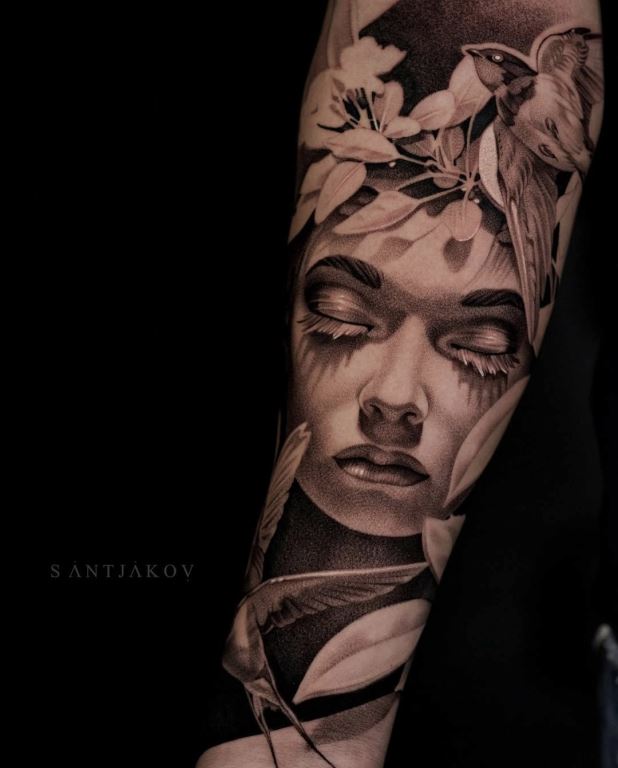
Q: At what point in your career did you feel ready to move
from single pieces to full-back compositions or complex sleeves?
A: I spent many years exploring different techniques, learning from
various styles and references. I experimented to find what worked
for me and which tools best adapted to what I wanted to express.
When I discovered the 'whip shading' technique, I found my place,
that was the method I wanted to use for my entire exploration
process. I began with small pieces and moved into medium formats,
constantly refining my work. After several years, once my results
felt solid and I gained confidence, the process naturally invited me
to work in larger formats: full sleeves, backs, and legs. That is
where I felt truly free. I am now reaching a point where I think of
tattoos as complete 'works' rather than just individual pieces. The
level of study and detail behind each process deserves to be
categorized as a work of art. If you look at the background of each
piece, the dialogue with the collectors, and the symbolic depth
involved, it resembles a research project more than just a quick
image for social media.
Q: When mapping out a massive project how do you approach
the composition so it flows naturally with the client’s muscle
structure?
A: The study of human anatomy has always appealed to me. I quickly
realized that a tattoo is not just an image placed on the skin like
a patch, at least not in my work. Historically, across different
cultures, tattooing carries a narrative; it has paths, stories, and
moments. This made me think of it as something that flows, like a
river. The body has that same nature; it flows. Every muscle and
bone exists in perfect harmony to function properly. I believe
tattooing should become part of the body, incorporated into the skin
forever. Therefore, it should have a harmonious meaning rather than
looking like a print on a sheet of paper. In my work, this harmony
is determined by the nature of the human body. I follow the movement
of the joints and the muscles. These elements guide the structure of
my designs because my tattoos are conceived to be a part of the
person.
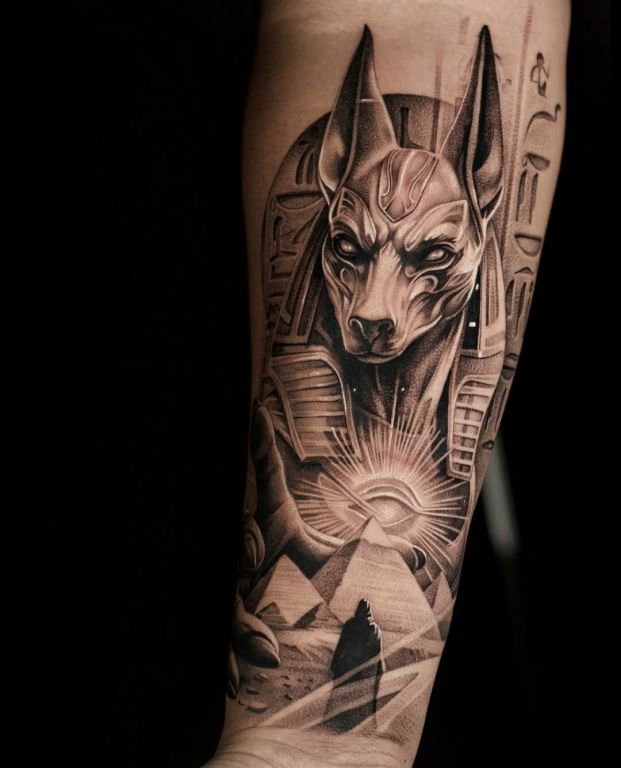
Q: You have a dedicated section on your profile for healed
work. What is your secret to ensuring that fine-line realism stays
sharp and doesn't blur over the years?
A: I have studied different pigment qualities, needle types, and
healing processes extensively. I’ve documented everything in notes
to make informed decisions about what works best. I define my
success through a few key aspects: conscious handling of technique,
meticulous selection of tools, an understanding of different skin
types, and a healing process based on natural drying. I prefer to
let the body regenerate naturally during the first few days without
external agents interfering. Once the tattoo has passed that first
natural stage, I recommend supporting the skin’s reconstruction with
specific, pre-studied creams that prevent dryness. Of course, this
doesn’t mean the result is always perfect; every body and every skin
type is different and has its own particularities.
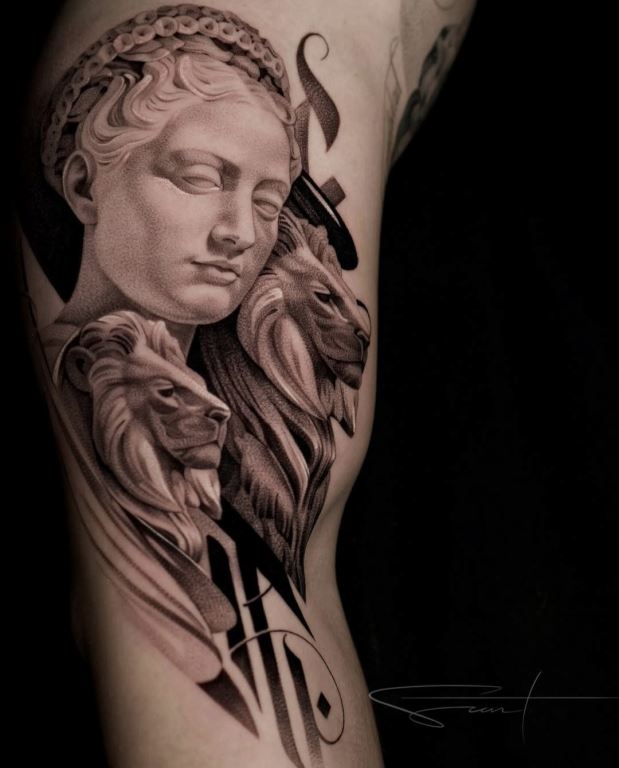
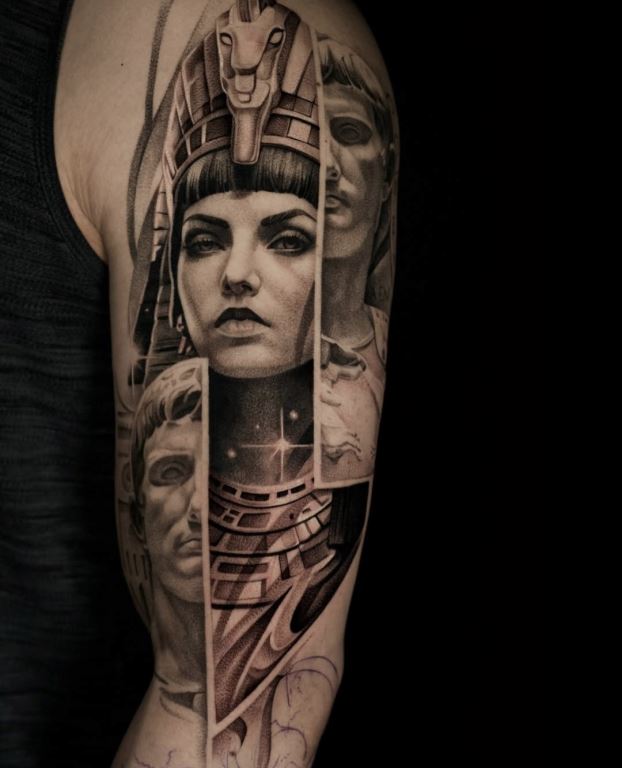
Q: Your work often features textures that look like cold
marble or weathered stone, specifically in your depictions of Roman
statues and Greek gods. How do you adjust your shading technique to
differentiate between the "hardness" of a statue and the "softness"
of a human face?
A: Years of experience have allowed me to develop a level of
technical control that lets me adapt my methods to my creative
goals. When I want to achieve the 'hard' or textured look of
weathered stone, I adjust my machine, specifically the voltage and
speed and compensate for those settings with my hand movement and
needle depth. This allows me to create the 'grain' or noise required
for those specific textures. Conversely, when I am seeking the
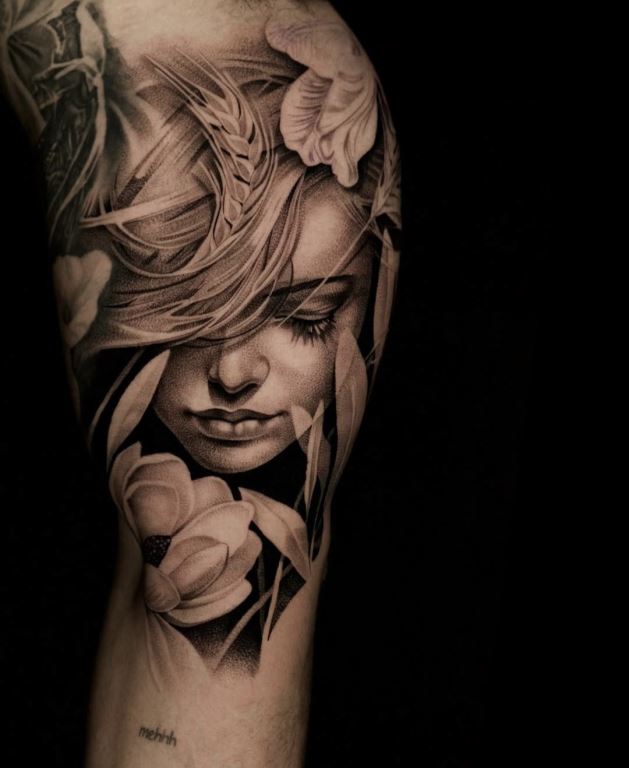
cleanliness and refinement of a human face or hand, I rely on
meticulous layer control and the technical adjustments mentioned
before. Ultimately, I believe that knowing your tools intimately and
being able to command them according to your intention is what
allows you to direct the visual outcome of any piece.
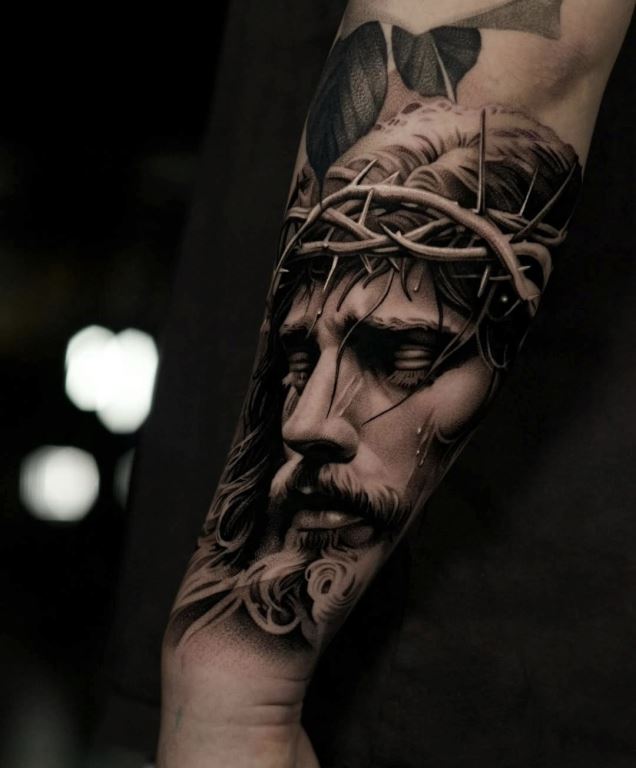
Q: Will you experiment with color inks?
A: There was a period of time when I did, and I enjoyed it very
much, but I don’t fully connect with color in the same way I do with
black and grey. That said, I don’t rule out the possibility of
working with subtle color details within my work.
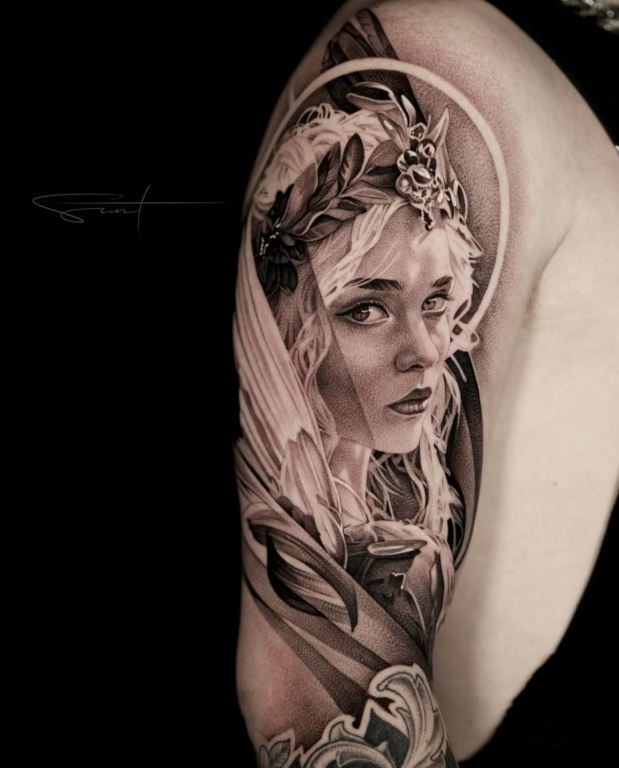
Q: Many of your subjects are lit from a single, dramatic
light source (Chiaroscuro style). When a client brings you a photo
that has "flat" lighting, how do you re-imagine it to fit your
signature dramatic style?
A: In the past, this was very difficult for me because I had to
manually redraw the lighting and shadows directly onto the
photograph while trying to preserve the subject’s original features.
It was a process that required many hours of work.
Today, I utilize Artificial Intelligence tools to achieve this with
higher quality and in much less time, all while carefully preserving
the essential aspects of the original reference. I also use various
applications designed for artists that allow me to manipulate light
in a three-dimensional space. This helps me establish a single,
unified light source that creates a cohesive and dramatic
composition.
Q: How far you are willing to negotiate with your clients
when it comes to design or better body placement while maintaining
your own artistic identity?
A: For several years now, I’ve noticed that the collectors who seek
me out are specifically looking for my particular compositional and
iconographic style. This has granted me a great deal of creative
freedom in my process, whether working on medium or large-scale
formats. Even so, I always value my clients' opinions because they
will carry this art for the rest of their lives. my primary
intention is to create an honest bond between the wearer and the
tattoo. For this reason, I establish mutual respect from the
beginning; if adjustments to certain details or sizes are necessary,
I make them while always sharing my professional and artistic point
of view. When there are no barriers and space is held for dialogue,
the tattoo naturally finds its own meaning.
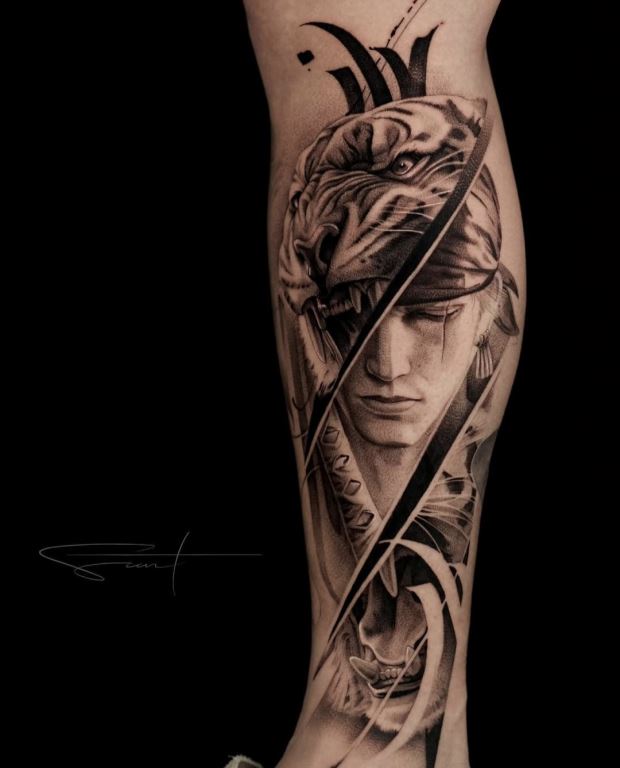
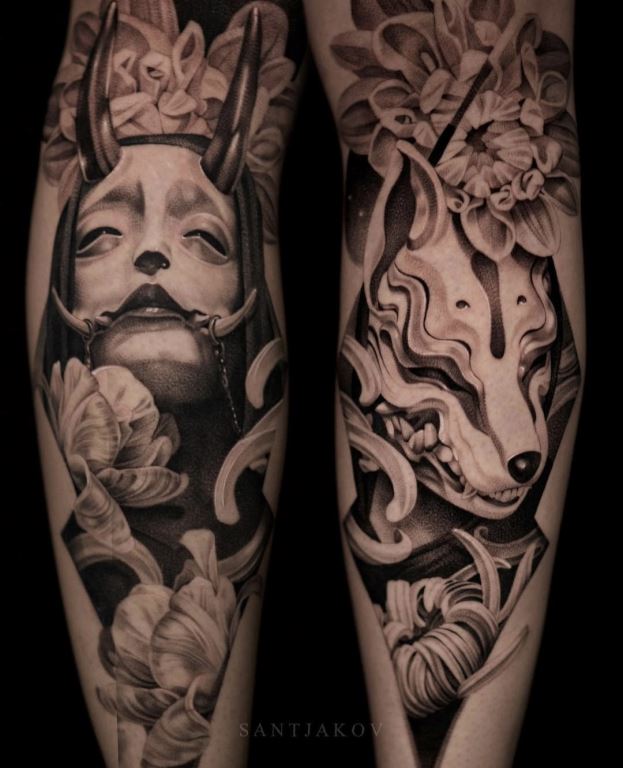
Q: You often blend realistic portraits with abstract "wisps"
or geometric-like structures that frame the face. How do you balance
these abstract elements so they enhance the realism rather
than distracting from it?
A: I focused on exploring image overlays, combining different
elements and textures to find that perfect balance. After designing
and redesigning relentlessly, I began to recognize certain
compositional patterns that conveyed a sense of harmony to me. I
realized that balance is the core of everything: not
overcomplicating the number of elements, and maintaining a clear
'read' of the composition while still keeping it rich in detail.
Today, my philosophy is that a tattoo should be legible from both a
distance and up close. From afar, you should immediately understand
the main figure and feel the harmony of the composition on the body.
As you move closer, you should then discover the fine details and
refined finishes that artistically enrich the work.
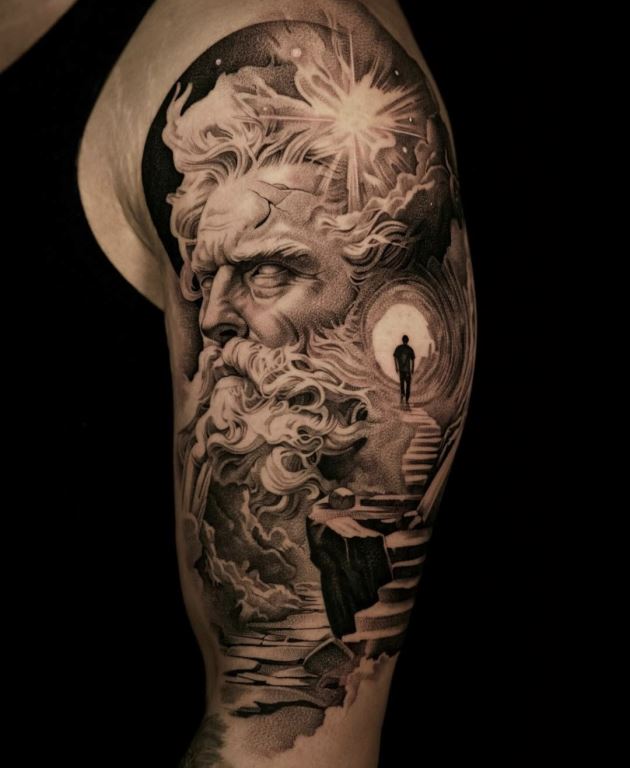
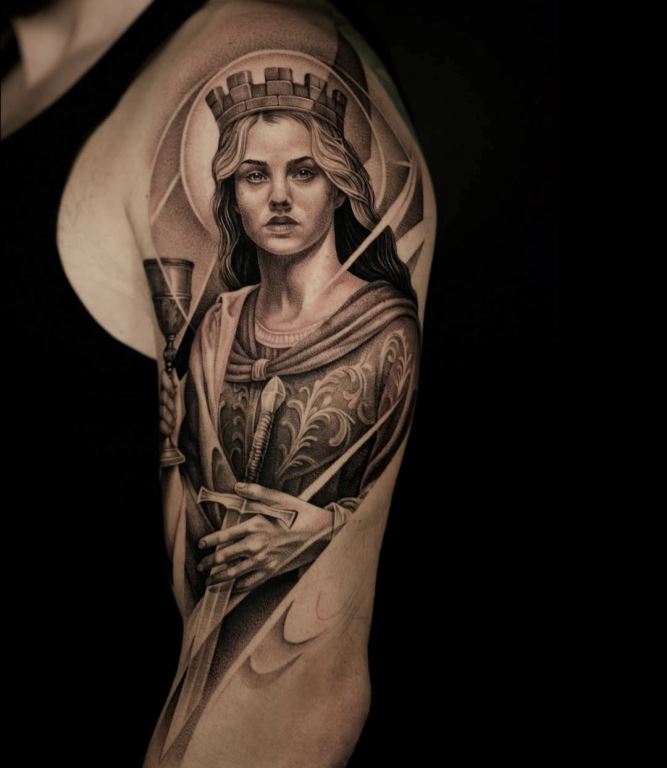
Q: There is a recurring theme of stoicism, divinity, and
classical history in your feed. Is this a personal preference, or do
you find that these specific subjects translate best into the black
and gray realism style?
A: Interestingly, both points are true. First and foremost, this is
a personal philosophy of life. The iconography I work with, the
sage, the thinker, divinity, the human condition speaks to me
deeply. At the same time, I notice a strong modern tendency toward
personal development and self-discovery. There is an internal air of
'revolution' and evolution,of people wanting to explore their
limits.
Because these themes are so profound, they move the emotions and
the psyche. The language we use to represent these philosophical
encounters the angel and the demon, good and evil, heaven and earth,
life and death, provides an infinite range of symbols. This language
allows us to say things without words; in this case, we speak
through images.
Q: Realism is such an intimate style, you are essentially
recreating someone’s memories or deepest beliefs on their skin. Have
you ever had a session where a client’s story behind a piece,
perhaps a memorial or a symbol of a personal struggle was so moving
that it changed the way you approached the art itself?
A: Yes, many times. I have realized that art, being an intrinsic
human need, inevitably creates deep connections because it speaks of
history and perspectives and at our core, we are all made of
stories. When people tell me the meaning behind their tattoos and
the deep significance they hold, it makes me think about the immense
level of responsibility this carries and the degree of trust they
are placing in me. They are not only allowing me to create a
permanent image on their skin; they are allowing me to be part of
their story. They are choosing me as the artist to give life and
form to that representation. The deeper I go into these themes, the
more I realize that the only thing I can offer in return is that
same trust, respect, and love that they place in me and the process.
This is something I understood from the beginning. Approaching my
work in a responsible and honorable way has taught me to love this
art even more. I have learned to value every moment as unique and
unrepeatable; each client is an individual experience that deserves
my full attention and respect.
Q: Realism often looks different in a photo than it does on
skin. How do you handle a client who brings in a "filtered" or
unrealistic reference photo, and how do you guide them toward a
design that will actually work for their skin type?
A: I believe it comes down to speaking with transparency as I’ve
mentioned throughout this interview and with the confidence of
knowing your craft well. Sometimes the best option is to set certain
references aside and explore other possibilities or different ways
of representing what the client is looking for. This often involves
using applications and tools to refine the images into something
achievable. Ultimately, if a reference simply won’t work, the most
professional and appropriate approach is to make that clear to the
client and explore a better option together.
Q: Because your style uses such soft transitions, one bad
scab can ruin a portrait. What is your "golden rule" for aftercare
that you tell every single client before they walk out the door?
A: My golden rule and it is non-negotiable is that the tattoo must
heal naturally during its initial stage: dry. I instruct the client
to let it dry completely and allow the wound to close on its own,
because the body knows how to heal; it is biologically designed for
that. This applies only to the initial stage; afterward, we support
the skin’s regeneration process with the proper products.
Q: You built Kannves into a recognizable brand. What was the
biggest challenge in moving from "working for a shop" to "running
your own space"? How did you ensure the studio reflected your
specific artistic standards?
A: To achieve the impact we had, I kept my vision very clear. I
partnered with two people who were aligned with the vision the
workspace required at that time. Together, we created something
bigger than a studio we built an artists’ collective. We established
a school, workshops, seminars, and a culture centered on the pursuit
of excellence and mutual support. I trained myself in administration
and resource management, developing a natural way of leading spaces
and people. I trusted that vision and simply shared my honest
thoughts and feelings. This allowed others to identify with the
project because everything we envisioned came from a place of
sincerity. I believe that was the differentiating factor: everything
was born from honesty, which is why people believed in our brand and
our philosophy.
Q: Because realism projects often require multiple sessions
over several months, how do you manage your "pipeline" of clients to
ensure a steady career flow while still leaving room for creative
growth?
A: This is something I am still actively working on. In the past, it
was very difficult for me; my schedule was saturated, leaving little
room for creativity or personal care. Now, I respect those
boundaries because I’ve realized they are essential for healthy
growth and development within my career. They are necessary to
maintain a clear and aligned mind for every project. To keep
projects moving forward and avoid postponing their completion, I
work multiple sessions on consecutive days with clients. This allows
me to finish specific areas or even complete entire projects in a
concentrated timeframe. While those tattoos are healing, I work with
other clients. In this way, I am able to create the necessary space
to both rest and remain creative.
Q: New York is one of the most saturated tattoo markets in
the world. What was your strategy for standing out when you first
arrived? Did you have to "re-prove" yourself, or did your portfolio
do the talking?
A: To be honest, it wasn’t very difficult for me to adapt to the New
York market. I have always believed that your work should speak for
you, as it is the first point of contact you make with your clients.
After that, however, your voice carries the full responsibility of
making the relationship work. My approach with clients has always
been honest and attentive. I take the time to listen, to understand
their vision, and I remain open and patient. I don’t see myself as a
tattoo factory selling products; I see myself as an artist. I
respect what I do and the trust people place in me. This approach
has kept me on great terms with my clients throughout my entire
career, and it continues to work today. I believe it is the most
sincere and natural way to do things. My growth has been organic, I
have never tried to 'sell fantasies.' I seek real, solid
relationships. I believe that this transparency, honesty, and
respect, supported by the quality of my work are what opened doors
for me in New York.
Q: You often emphasize networking and collaboration. How
much of your career growth do you attribute to physical networking
at conventions, guest spots?
A: I wouldn’t know how to assign an exact percentage to the
importance of collaborations, networking, or collective development.
What I can say is that you have to give your full commitment and
extract the maximum value from every environment you are involved
in. It is necessary to stay engaged with the context in which your
work and style develop. These environments provide direction,
growth, and expansion for your personal work. Spending time with
artistic references and artists from different styles and schools of
thought enriches you through new ways of creating and seeing.
Conventions have been the best environment for me to expose my work
and experience both my vulnerability and my skill. They show you
where you need to improve and where your strengths lie. Many
approach conventions from a place of ego, but they are actually
spaces for the direct exchange of knowledge for connecting with
brands, sponsors, partners, and mentors. The main prize isn't the
award; it is the experience, which is the most valuable thing an
artist can have. I believe it’s important to be curious and measure
your skills in a healthy way, understanding that while the process
is individual, others act as mirrors, showing you what you may be
overlooking. I’ve had the opportunity to work in studios around the
world, which allowed me to grow exponentially. I’ve worked in
Sweden, Spain, Italy, Germany, Mexico, and Panama, and I currently
reside in the United States. Each country taught me something
unique, skin studies, product variations, and professional contacts.
I have also participated in conventions where I gained extensive
experience, secured sponsorships, and received important awards,
including several first-place recognitions. I see my work in
constant evolution, and staying active in conventions allows me to
stay at the forefront. On other occasions, I’ve served as a judge,
which I enjoy because it allows me to evaluate the global level of
each style and apply those insights to my own work. When I host
seminars, I notice the growing interest in the tattoo world. This
makes me reflect on the responsibility I carry as a teacher. I
emphasize integrity, seriousness, and the real professional scope of
this career. I focus on what has worked for me: deep study,
organization, financial planning, and personal development. I teach
artists to think like a business while feeling like an artist
ensuring these parts complement rather than contradict one another.
My goal is integration.
Q: Doing high-detail realism is physically taxing on the
eyes and hands. What career adjustments have you made to ensure you
can keep tattooing at this level for another 20 years?
A: The main change I made to sustain the high demands of this path
was my diet. Eating healthy is vital for me. I’ve combined this with
daily exercise, good habits, stretching, and frequent massages for
my hands and back. I also work with a physiotherapist to release
muscular tension. These have been the primary changes to take care
of my body. For my eyes, the use of resting glasses and warm
compresses has helped immensely with the visual fatigue caused by
prolonged exposure to intense studio lighting.
Q: You have shared that your seminars are a space to "keep
moving forward" and "expand our way of thinking". What is the
biggest mental barrier you see your students hitting when they try
to transition from traditional tattooing to high-level realism?
A: The biggest mental block I see is that people want to achieve the
highest level of learning in just three hours: one hour of
explanation, one hour of technical demonstration, and one hour of
practice. They arrive believing that once these 'secrets' are
revealed, the results will appear on their own. That is not how it
works. People need to understand that these processes require an
immense amount of study and practice. The greatest barrier I
consistently see is unrealistic expectations. They want results
without the process, and in no area of life do things work that way.
Q: You mentioned that life is more beautiful when you go
"beyond your own name". In your seminars, how much time do you spend
on technical skills versus the artistic philosophy and mindset
required to survive in this industry?
A: I try to remain in a constant state of openness, attentive to all
the learning that life brings through different professions and
social circles alike. When tattooing truly inspires you, it becomes
a safe and calm place to exist. When the passion is real, it doesn’t
generate the levels of stress or internal chaos that other
professions might. That relaxed state of mind and body allows you to
pursue technical study during your daily practice your actual
sessions, while simultaneously listening to an audiobook, watching
an interview aligned with your interests, or perhaps a documentary.
In my experience, life itself is a school. I learn from everyone
through observation and go deeper into what truly interests me. I
can do this without separating it from my technical practice because
there is no pressure, only an openness to receiving knowledge
through different channels while applying my technical process.
Q: You’ve credited your studio, Kannves, as a constant
source of guidance and teaching since the beginning. How do you try
to replicate that "studio-family" learning environment during a
short, intensive seminar?
A: Through my own testimony, I share the philosophy of remaining
both a student and a teacher. First, you listen and receive the
learning, you observe, and then you use that knowledge to question
it and put it into practice becoming, in that way, your own teacher.
This creates an environment of freedom and authority for people,
allowing them to understand that the teaching is being offered on
equal footing. That sense of equality makes the environment feel
familiar and neutral, and that disposition is invaluable for
learning.
Q: When you see the work of artists who attended your 2023
seminars, what is the first improvement you notice in their
portfolios?
A: I always notice that their compositions change first. I can
perceive that they are now aware that composition must have
intention, and this is reflected in how they place designs on the
body. This is the first major visible change. Following that, I see
improvement in their image selection and a deeper understanding of
light and shadow when choosing references. Once these two aspects
are refined, the change in technique naturally follows. I see how
the texture in their shading evolves. This sequence composition,
reference selection, and then technique is always the most
noticeable pattern, occurring in that exact order.
Q: Now that you’ve mastered the art and the education side,
what is the next "unattainable" goal for you? Is it a global studio
expansion, a book, or something entirely different?
A: My vision is for these goals to be attainable. I do want to
publish books in the future to share my personal vision in a way
that can accompany others in their own processes, serving as a
mirror for them. I want to present functional methods for personal
development that apply to both professional and personal areas of
life. Everything ultimately comes down to changes in mindset and the
way we see the world, because that is the origin of all results. In
addition to this, I am currently working on my clothing brand, which
is fully supported by the philosophy we’ve discussed throughout this
interview. By building a community, we can positively impact the
world and make it a kinder place, with more horizons to explore.
The brand carries my artistic name, SANTJAKOV, which essentially
means 'the reward of God.' That is what we all experience: we walk
through an entire life learning from mistakes and successes, and
every experience whether 'good' or 'bad' brings with it a reward:
change, evolution, and growth, if one chooses to see it.
Q: In 2025, the tattoo industry is seeing a "structural
shift" where competition is higher than ever. How do you stay
relevant in a global market that is becoming increasingly saturated
with high-level realism artists?
A: I believe that having your own language and being authentic is
what truly makes the difference. Today, anyone can achieve realism
or shading with an excellent finish, but being an artist involves
other aspects, it has to do with sensitivity and the honesty with
which you work. I believe this is the key to staying active in the
market: being yourself with such authenticity that it becomes
impossible not to notice you.
Q: We are seeing a massive rise in "Micro-Realism" and
"Fine-Line" work globally right now. Do you think the U.S. scene is
leading these trends, or is it following the innovation coming out
of Europe and Asia?
A: I believe that globalization and the speed at which digital
content spreads have made it possible for anyone to reach the top of
the pyramid. For that reason, I think trends now exist on a global
elite level rather than being tied to a specific country or
community though, of course, every movement has its origins. Because
of this, I believe the worldwide artistic level across all styles is
the highest we have ever seen in history.
Q: For an artist just starting out today in a world
dominated by social media algorithms and high-tech gear, what is the
most important "old school" skill they should never neglect?
A: Respect and commitment to your craft.
Interview: Ivana Kancheska
Date: 20/02/2026


