
Interview with Serdar Bolukbasi
Hello Serdar Bölükbaşı! Thank you so much for taking the time to do this interview. Please tell us a bit about yourself and your background. What first sparked your interest in art? My first real interest in art started at a young age, during middle school, through graffiti. Of course, I can’t say I was producing anything particularly impressive back then, but those childish experiments kept my mind busy with the idea of creating my own designs. The moment I’d call my true artistic awakening actually came out of pure boredom, something I’m sure art theorists would love to hear. One hot summer day in high school, while trying to find something to do in my room, I grabbed a pencil and paper and drew the space around me. When I showed it to my friends, I remember being genuinely surprised by how positive their reactions were. Looking back, I think I always had an artistic side in my character, and that moment simply gave it a chance to surface. It led me to make a sudden but decisive move: I left my regular high school and enrolled in an art-focused school instead. Since then, I’ve been continuously creating. For the past two years, I’ve been living in Denver, spending great time with Mile High tattoo enthusiasts.
Q: When and how did tattooing enter your life?
A: While studying Visual Communication and Design at university, I
experienced a turning point that planted the idea of becoming a
tattoo artist. Even as a student, I worked various jobs related to
my field of study. Those experiences made one thing very clear to
me: spending my life behind a corporate computer, moving a mouse all
day and having my work picked apart by editors who valued
functionality over creativity, simply wasn’t for me. Before long, I
found myself asking the question, “What do I really want to do with
my life?” Somewhere in my hazy childhood memories, I recalled seeing
a tattoo artist in a movie and thinking, “Wow, I want to be like
that guy.” I’ve always been someone who makes big, decisive choices
early in life. Choosing to become a tattoo artist is one of the
decisions I’ve been happiest with.
Q: Did you start with a traditional bold-line style, or were
you drawn to fine-detail realism from the beginning?
A: Once I decided to dive into tattooing, I got my first tattoo
machine right away. It was a coil machine - heavy and unforgiving. I
still carry the callus it left on my middle finger with a quiet
sense of pride. At first, my main goal was to develop machine
control. In my early days, I held the machine with a lot of tension
in my fingers and ran it over countless bold-lined designs. I can
safely say that callus owes a lot to that period.
Q: Looking back at your early days, what was the hardest
technical skill to master: steady lines or the patience needed for
smooth shading?
A: After gaining enough confidence, I gradually moved toward shading
and fine detail, which is a common progression for many artists. My
years as an art student before tattooing had already given me solid
control over drawing tools, so adapting to the machine didn’t take
too long. The real challenge was understanding the fundamental
difference between working on flat, two-dimensional surfaces like
paper or fabric and working on living, three-dimensional skin. A
canvas is relatively stable; skin reacts both during the process and
afterward. Those reactions vary greatly from one body spot to
another. For a beginner without guidance, navigating all of this can
feel like a nightmare.
Q: At what point in your career did you decide to specialize
in realism instead of being a “street shop” artist who does
everything?
A: Tattooing isn’t really something you can do without passion.
After reaching a certain technical level, I went through a period
where constantly adapting to every direction the job demanded became
exhausting. I truly love tattooing, and when I’m working on a design
that pulls me in, I completely lose track of time. I never want to
lose that feeling. I realized that the only way to keep it alive was
by constantly pushing my own limits. That phase of burnout helped me
understand that expressing my inner perspective on existence and
connecting with people who resonate with it was something I could
only truly achieve through realism.
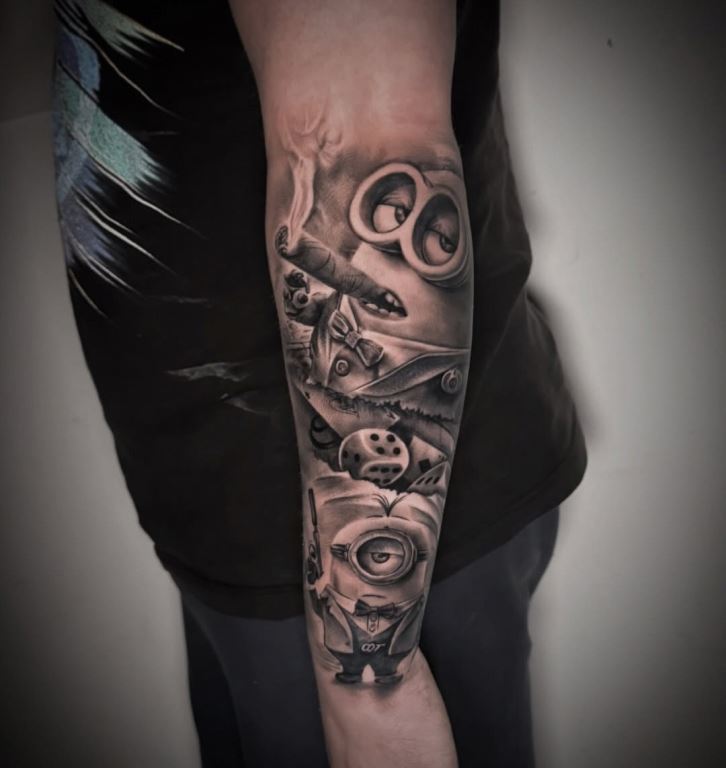
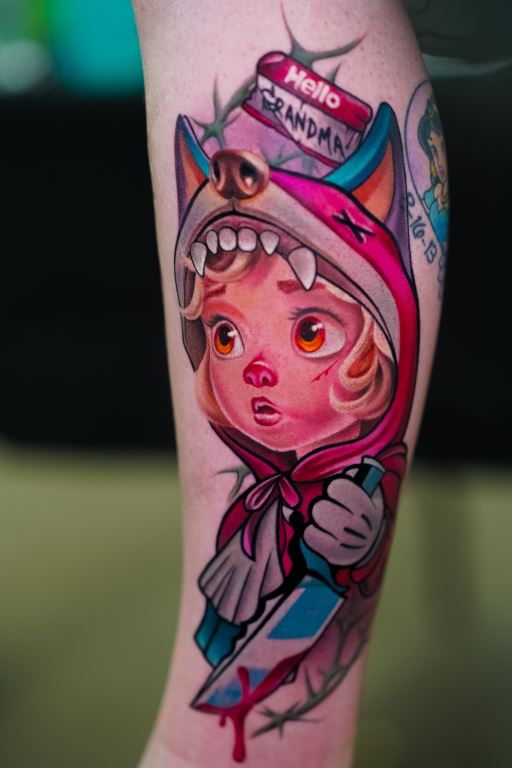
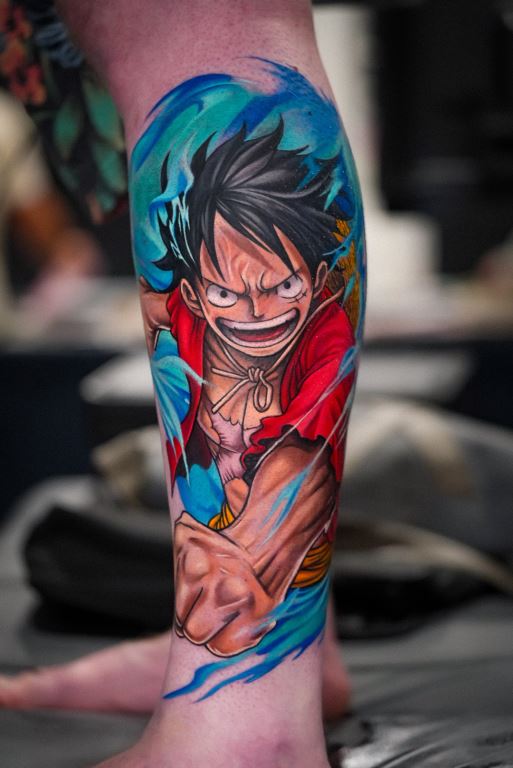
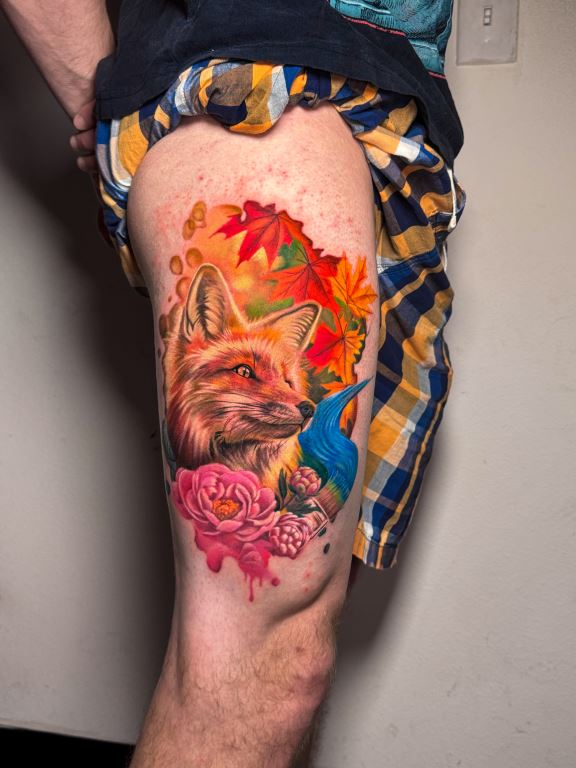
Q: You work in both color and black & grey. Which feels more
natural to you, and which challenges you more?
A: During the early part of my career, I focused mostly on black and
grey work. Working within a limited tonal range felt much more
practical at the time. Even though I was comfortable there, color
was always somewhere in the back of my mind.
As I spent more time thinking about color, I began to realize how
much depth and impact it could add to a design. That’s when I knew
the transition was inevitable. While color work is still more
challenging, it now feels more natural and rewarding for me.
Q: Realism is often criticized for how it ages. How do you
balance soft details with long-term readability?
A: I believe it comes down to choosing the right body placement and
the right technique. A highly realistic design placed on an area
that can’t hold detail won’t last even a year. Likewise, if you
tattoo every fine detail exactly as it appears when you put the
machine down, you’ll notice many of those details disappear once the
tattoo heals. I discuss these nuances with my clients during the
design process and make the necessary adjustments. When everything
is done correctly, a realistic portrait can still smile back at you
twenty years later.
Q: When a client brings a photo, how do you decide what to
keep and what to interpret artistically to match the body’s flow?
A: Many clients walk into the studio unaware of tattooing’s
technical limitations, assuming the image in their mind can be
transferred exactly as is. My priority is always to stay as close as
possible to their vision. A big part of my job is guiding them along
that fine line between expectation and reality. It’s a process of
trimming away what won’t work and enhancing what can truly flourish.
Placement plays the biggest role here, you simply can’t put a
portrait on highly mobile areas like the neck or joints. Once those
constraints are considered, I look at what remains and explore the
creative possibilities. That’s where creativity has room to move,
and I try to keep that space as wide as possible.
Q: Do you prefer collector clients who give you full
freedom, or the challenge of deeply personal requests?
A: Both offer different kinds of satisfaction, but if I had to
choose, I’d lean toward collectors. The process tends to be more
fluid and less stressful, allowing for a smoother journey toward the
final result. Working with highly specific, emotional requests can
also be rewarding, as long as they don’t completely block the
creative process. When we find common ground, the outcome often
becomes even more meaningful for the client. Helping someone express
a deeply personal idea or emotion through tattooing is challenging,
but incredibly fulfilling.
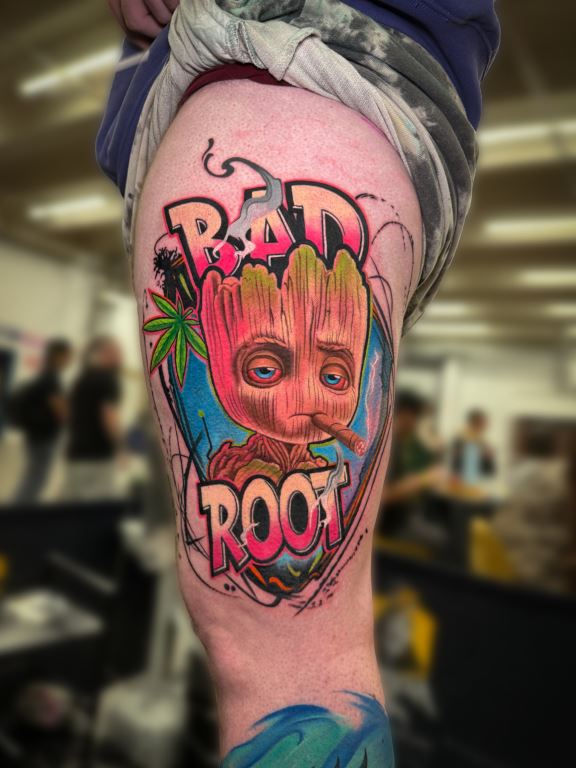
Q: You often frame realism within diamonds, circles, or
sacred geometry. Can you tell us about this combination?
A: There are many ways to try to understand the universe and
existence, even partially. Although I tend to think more verbally, I
see mathematics as one of the most reliable paths toward that
understanding. I’m not talking about anything supernatural, these
are natural patterns that can be observed everywhere, from the
smallest structures to the largest ones. They’re clues we can’t help
but notice as conscious beings in this universe we somehow found
ourselves in. One of my favorite sacred geometry designs features
Jens Kidman of Meshuggah - a band I’ve listened to for nearly twenty
years with his iconic distorted gaze, centered within a perfect
geometric structure. Much like consciousness itself, surrounded by
the unknown.
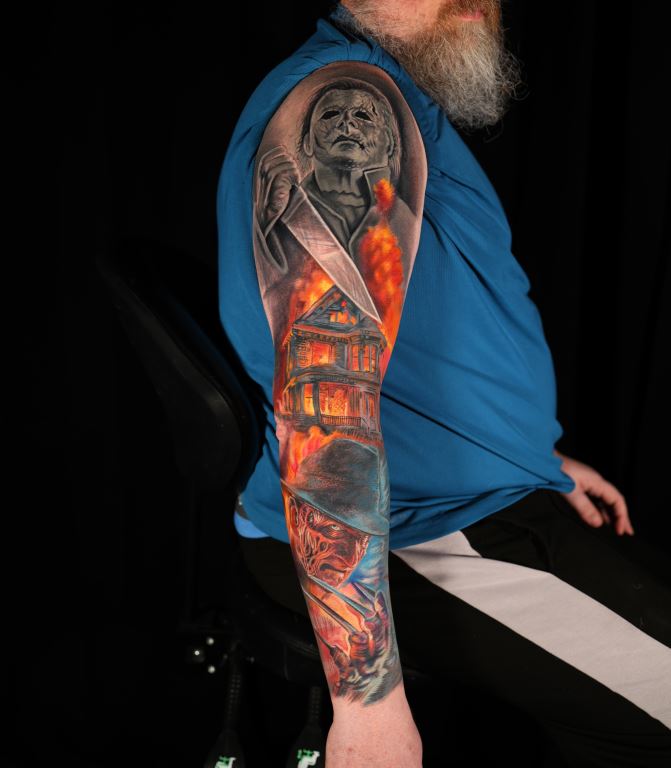
Q: Many of your color pieces feature iconic villains. Why do
these “larger-than-life” figures work so well in tattooing?
A: I think understanding fear is a powerful way to understand the
human psyche. That’s why we have such a rich history of horror
literature and cinema. It’s only natural as humans, we tend to give
form to what we fear, turning the unknown into something the mind
can grasp. Exploring human psychology through iconic embodiments of
evil, and empathizing with what lies beneath their darkness, can be
incredibly revealing. As Carl Jung said, “No tree, it is said, can
grow to heaven unless its roots reach down to hell.”
Q: With the rise of AI-generated art and digital tools, how
do you see realism evolving?
A: Absolutely avoiding the influence of AI is no longer possible,
and that’s inevitable. As long as the mind behind the design is
still human, AI remains just another tool within the artistic
process. I believe artists, myself included, will continue to
integrate it more deeply into their workflows. It's really hard to
predict how it will turn out, but it's likely to be even more
surreal.
Q: How has working at a high-profile studio like Cleopatra
Ink affected the business side of your practice?
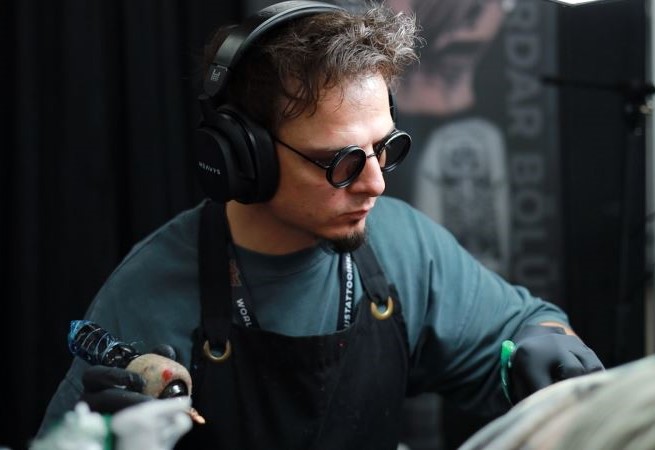
A: Over the past two years at Cleopatra Ink Denver, we’ve done some
great work together. The pace is intense, and keeping up with it has
pushed me to develop a more disciplined and structured approach to
my work, which has been invaluable.
1869 S Broadway 80210 Denver, CO Instagram:@serdarbolukbasi.ink
www.serdarbolukbasi.com
Q: How has being part of the American tattoo convention
circuit shaped your speed and technical precision?
A: The U.S. hosts some incredible conventions. I’ve had the chance
to participate in the 9th and 10th Colorado Tattoo Convention &
Expo, as well as the 8th Villain Arts Denver Tattoo Arts Festival. I
had an amazing time at each of them and gained not only awards, but
also meaningful friendships. Tattooing at conventions is a
performance in itself. For three days, you disconnect from normal
life and try to complete what could easily be three weeks’ worth of
work with maximum precision. Balancing all of that requires learning
entirely new skills beyond the role of a studio artist, and those
experiences have contributed immensely to my growth.
Q: You work on South Broadway, Denver’s “Tattoo Row.” How
does that environment feel?
A: Denver is home to many incredible tattoo artists, and a lot of
them work along Broadway. The competition between us is purely
friendly. We often meet at conventions and cheer for one another
during award ceremonies. Much like the city itself, the artists here
are warm and welcoming.
Q: Ten years from now, what do you want people to instantly
recognize as your signature?
A: I feel fortunate to collaborate with my wife on long, in-depth
artistic concepts. Alongside my previous work, we’re currently
developing several new ideas that still need time to mature, ideas
that genuinely excite me. Ten years from now, I’d love for my
signature to be recognized through those designs.
Q: What’s the next frontier for you in 2026?
A: My focus will be on refining and fully developing the concepts
I’ve been working on. I’d love to showcase them at some of the
biggest tattoo conventions in the United States.
Q: What advice would you give to a young artist dreaming of
realism, beyond “practice more”?
A: If anything I say can be useful, that would be an honor. I
believe the most valuable thing is being able to enjoy what you do.
Stepping back and feeling that your work is alive, that it has its
own voice, is priceless. Overcoming the technical challenges of
tattooing requires extensive practice under proper guidance, that
goes without saying. But once the technical barrier is crossed, I’d
say focus on finding your own voice in tattooing. I can’t emphasize
that enough.
Q: If tattooing didn’t exist, how would you express your
creativity?
A: I’m certain I’d still be creating things with my hands. During
university, I loved traditional printmaking classes where we worked
with engraving and screen printing. I even came close to pursuing an
academic path in that field. If I had taken that route, I imagine
I’d be carving engravings or coating silkscreen frames in an
ink-scented studio even in today’s AI-driven world.


