
Interview with Sianca Carina Densch
Hello Sianca Carina Densch! Thank
you so much for taking the time to do this interview. To kick things
off, could you tell us a bit about your journey and what initially
drew you to the arts? What was that pivotal moment or inspiration
that sparked your passion? I’ve been drawing faces since I
was a little girl, I’d get lost in the details, the expressions, the
soul behind the eyes. But the moment that changed everything? A
friend of mine wanted a tattoo. I didn’t even have one myself, but I
looked at her and said, “I can draw - why not try it?” That single
decision, made in a tiny German town, sparked the journey that
changed my life.
Q: Could you tell us about your artistic journey – did you
primarily learn through self-teaching, or did you have formal
training? And beyond tattooing, what other art forms resonate most
with you?
A: I’m proudly self-taught. I knocked on doors, asked studios for an
apprenticeship, they all said no. So I said yes to myself. I bought
my first (very overpriced) machine and started figuring things out.
What carried me through was years of sketching portraits and
studying light. Outside of tattooing, I love realism. pencil,
digital, anything that lets me bring a face to life.
Q: As you were starting out, was there anyone who really
championed you or completely trusted your abilities, offering
crucial support?
A: Yes, but not in the tattoo world, at least not at first. The very
first person who believed in me was my grandfather on my father’s
side. He was incredibly artistic himself, and when I was just a
little girl, he would sit with me for hours, encouraging me to draw
and be creative. That early support gave me the confidence to
believe in my artistic instincts. Later in life, when I actually
started tattooing, my biggest supporter became my partner Pascal. He
believed in me when I didn’t. He now handles the business side of
everything, so I can focus entirely on creating. That kind of
support is rare, and I’m endlessly grateful for it.
Q: At what point did tattooing become a part of your
artistic journey?
A: After high school, I trained as a foreign language correspondent.
I had no plan to become a tattoo artist, until that one moment with
my friend. Once I touched a machine, everything changed. I found
something I didn’t even know I was missing. And I haven’t looked
back since.
Q: Could you tell us about your journey into professional
studio tattooing? How long have you been in a studio setting, and
what did that evolution from a beginner to a professional entail?
A: I’ve been tattooing for over 11 years. My first studio experience
in Heidelberg wasn’t great, toxic vibes, zero guidance. But I didn’t
give up. I moved on to Falling Bird Tattoo in Hassloch, then Marco
Klose Tattoo, and eventually opened my own studio: Electric07
Tattoo, together with Pascal. That was the turning point - when I
stopped surviving and started thriving.
Q: What was the most significant challenge you faced when
breaking into professional tattooing?
A: Being self-taught and female in a gatekept industry. I had no
mentor, no roadmap. But that meant I built everything from scratch,
my skills, my confidence, my business. And honestly? I wouldn’t
trade that for anything.
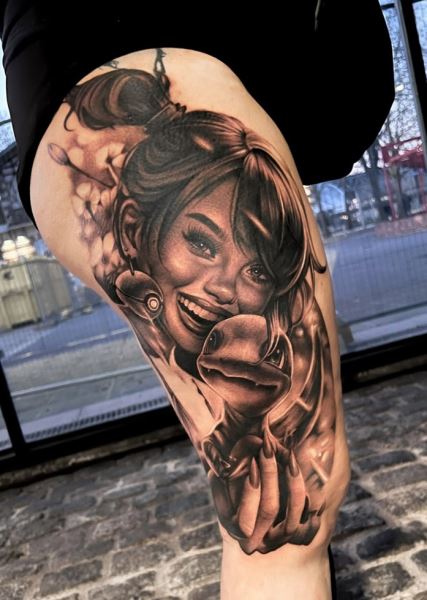
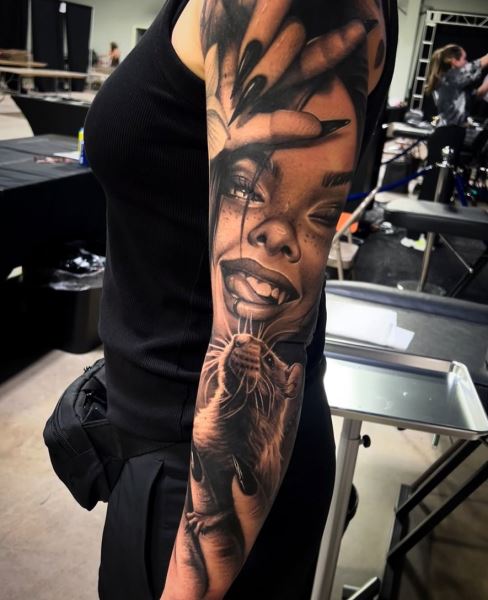
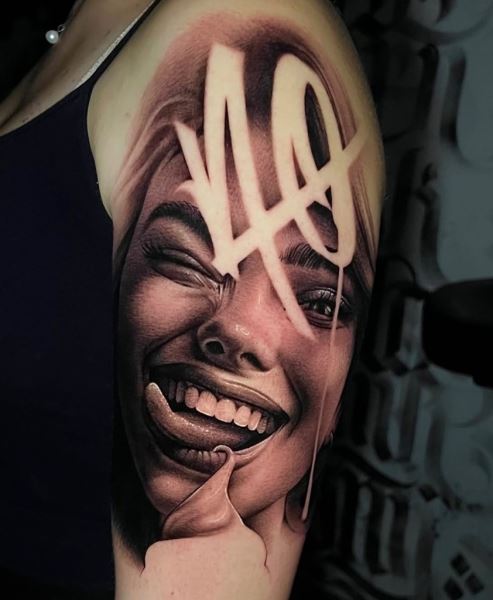
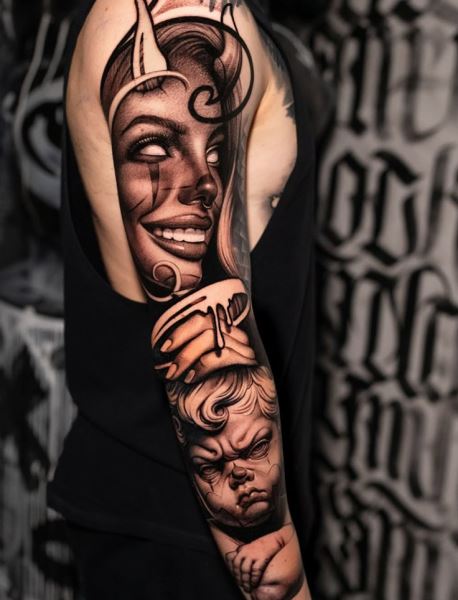
Q: Your style, a captivating blend of realism and
surrealism, is truly striking, especially your girl portraits, which
sometimes echo Chicano art. What drew you to develop this unique
aesthetic, and what aspects of it do you enjoy creating most?
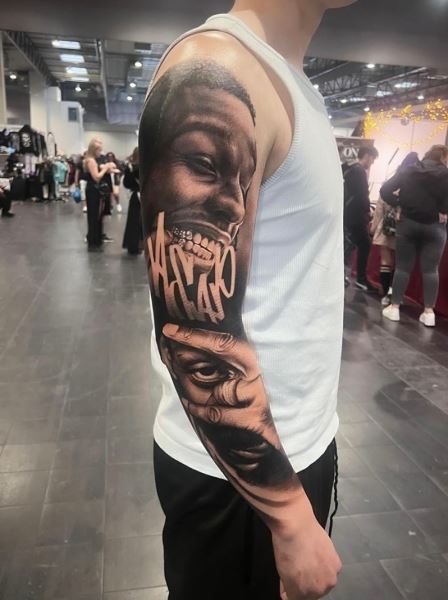
A: Faces are my language. I’m deeply drawn to portraits, children,
grandparents, loved ones, people who’ve passed on. Every wrinkle
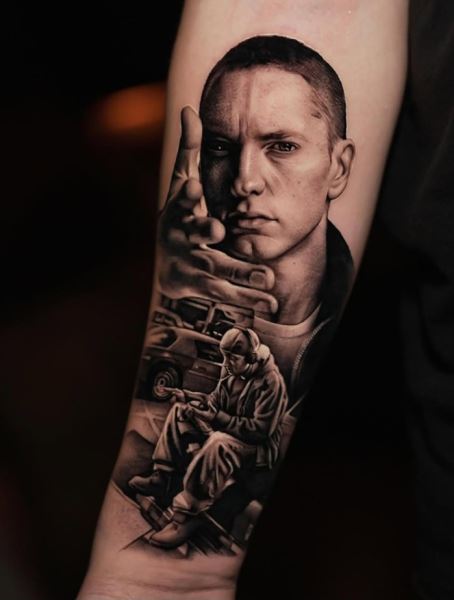
tells a story. I also love working on celebrity portraits, I’ve
tattooed Post Malone, Eminem, Bruce Willis, even characters from
King of Queens. And yes I have a huge love for Chicano-style
portraits. That L.A. culture, the gangsta girl iconography, the
black & grey drama, it speaks to me on a visual and emotional level.
Q: As an artist, do you envision evolving your style to
include different aesthetics or color work, or do you see yourself
continuing to specialize in black and gray realism?
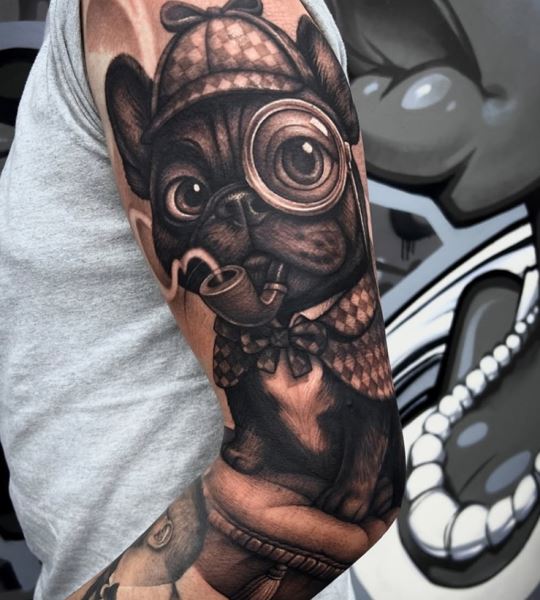
A: Black and grey is home for me. It allows me to tell emotional,
timeless stories in a way that color never quite could. I might play
with surreal elements more in the future, but I’ll always come back
to faces, to depth, to shadow and light.
Q: When tackling large-scale pieces like back tattoos, what
does your typical creative process look like? Is it primarily
developed through your own sketches, or is it a more collaborative
effort with the client?
A: It’s a real collaboration, but I always design the final piece on
the day of the appointment. I want to meet the person, feel their
energy, and see how the design flows with their body. I sketch a
base beforehand, but the magic happens in real time. That’s when the
tattoo becomes truly theirs.
Q: Best memory with a client?
A: That would be Steffi. She was a loyal client for years, we just
clicked. In 2024, I decided to train her personally as a tattoo
artist. Watching her evolve from client to student is incredibly
fulfilling. It’s the full-circle moment I didn’t know I needed.
Q: Have you ever completed a tattoo that, despite being
exceptionally challenging, ultimately became a personal favorite due
to its successful outcome?
A: Yes - a full-back „the Game“ with urban details. It took
everything I had technically, emotionally, creatively. But when it
was done, it felt like a milestone. Like I had broken through a new
level. „The Game“ himself repostet it on his IG, I was super proud.
Q: Any “dream” piece that you have in mind, that just waits
for the perfect client?
A: Oh, yes. A full-body black and grey project, faces, fabric,
mythology, strength. Think cinematic elegance with emotion and
storytelling. The client doesn’t even have to say much - just “Go
for it.” That would be the dream.
Q: What’s your take on the local tattoo scene? Do you see
progress?
A: Absolutely. In Germany, we’re seeing more respect for tattooing
as an art form. Clients are more informed. Artists are pushing
boundaries. And there’s a growing sense of community that I love
being part of.
Q: What about the global tattoo scene? Do you think we as a
collective are heading in a good direction?
A: I think we’re entering a golden era of tattooing. The talent out
there is mind-blowing. But we also need to protect the integrity of
the craft. It’s not about trends, it’s about connection and trust.
Q: Have you ever worked as a guest artist in another studio
either locally or in a foreign country? If so, what was the
experience?
A: Yes I’ve done guest spots and absolutely loved them. Working in
new places keeps me inspired and sharp. A great studio vibe can lift
everyone: the artist, the client, the result. I always look for
respectful, professional environments where the art can truly shine.
Q: How often do you attend tattoo conventions? In your
experience, how valuable are tattoo conventions for artistic growth
and building client relationships?
A: I’ve worked at international conventions like Gods of Ink
(Frankfurt), Mondial du Tatouage (Paris), Icons and Prodigies, and
Milan Tattoo Convention. I’ve also won Best of Black & Grey and Best
of Show at The Storm Tattoo Convention in Luxembourg. Conventions
are where you sharpen your skills, meet your peers, and feel the
energy of the global scene.
Q: You are also a sponsored tattoo artist. Congratulations,
you so deserve it. How much this support helps you to further
develop your career?
A: Thank you! Being sponsored is an honor. It gives me access to top
tools, but more importantly, it means someone believes in what I do.
That keeps me motivated to innovate and evolve.
Q: What’s next?
A: I’m working on my O-1 Visa to bring my art to the U.S. I’d love
to tattoo in places like L.A. or New York, where black and grey
culture has deep roots. At the same time, I’m training new artists,
pushing my own boundaries, and dreaming big. Always.
Q: Given the significant presence and variety within the
American tattoo world, is that a landscape you might be interested
in engaging with professionally at some point in your career?
A: Yes, without question. The American tattoo scene shaped so much
of what I love artistically. It would be an honor to contribute to
that world and learn from it in return.
Q: If you were to consider establishing a presence in the
American tattoo scene, what kind of environment – in terms of
location and studio ethos – do you envision would be most conducive
to showcasing your unique blend of realism and surrealism and
supporting your continued artistic evolution?
A: A space that’s creative, calm, and high-standard. Somewhere where
clients and artists are treated with equal respect. Where every
tattoo is a collaboration, not a transaction. And where I can keep
pushing what black and grey portraiture can be.
Q: What impact do you aspire to have on the tattoo
community?
A: I want to show what’s possible, especially for women and
self-taught artists. You don’t need permission. You need passion,
grit, and vision. If I can be proof of that for someone else, I’ve
done my job.
Q: For those interested in booking a consultation or
appointment, could you please provide the location of your studio
and any relevant website or social media links?
A: I tattoo at Electric07 Tattoo – a private 200 m² studio in the
Odenwald region of Germany, just 30 minutes from Mannheim.
www.electric07tattoo.de
@sissy_ink @electric07_tattoo
Q: If you could go back and give your younger self advice
about pursuing tattooing, what would it be?
A: Don’t wait for a yes. Be your own yes. You’re going to build
something beautiful. And maybe… don’t buy that first machine from a
sketchy shop.


