
Interview with Tiago Carrero
Hello, Tiago Carrero! Thank you so
much for taking the time to do this interview. Please start by
telling us something about yourself and your background. What
sparked your initial interest in art and when did you start
exploring your talent? I started drawing at a very young
age, around five years old. I was passionate about drawing a bit of
everything. I was fascinated by realistic details in anime series,
especially the eyes, which sparked a deep interest in me. I began by
drawing character faces such as Spider-Man, Dragon Ball, Naruto, as
well as singers like Elvis Presley, Oliver Sykes, John Lennon, Kurt
Cobain, among others. Gradually, I started exploring my talent at a
drawing academy. There, I discovered my fascination with portraits.
I challenged myself and thought, “Wow, I want to achieve something
like that!” I began working with pencil, ballpoint pen, and
charcoal, using existing portraits as references and replicating
them with precision. I remember that one of my first portraits
turned out so well that the academy’s owner was impressed. That
moment confirmed my ability in realism and motivated me to focus on
this discipline, practicing every day to refine my technique.
Q: In your early career in Colombia, was there a specific
moment or a particular piece of work where you realized that Realism
was your calling rather than traditional or illustrative styles?
A: From the beginning of my tattoo career, I was certain that
realism was my specialty. Although it wasn’t perfect at first, my
work always stood out for its attention to detail. My first
realistic tattoo was a full-color portrait, and for that stage of my
career, it was a solid result that motivated me to keep improving.
At the same time, I worked in other tattoo styles, always with
respect and admiration for the different techniques and forms of
expression within tattoo art.
Q: Tattooing at this level of detail
requires immense discipline. Can you walk us through how you
developed your technical foundation during your early years?
A: My technical foundation has always been based on drawing every
day, not only for inspiration, but as a constant technical exercise:
anatomy, light, shadow, texture, and proportions. I tend to become
deeply focused on subjects that interest me, which drives me to
continuously challenge myself. When I started tattooing, access to
synthetic skin was limited, so I practiced on fruit and later on
friends and acquaintances, who served as my canvases. Beyond
tattooing, I was passionate about learning how to work the skin
properly, not aiming for speed, but for doing things right from the
start. That discipline and focus are the foundation that has
accompanied me to this day, reflected in the level of detail and
durability of my tattoos.
Q: What were the biggest challenges you faced starting out
in South America, and how did those challenges shape the work ethic
you bring to Tuff Tattoos today?
A: When I began in South America, the biggest challenge was the lack
of resources and formal training, which led me to develop a highly
disciplined, self-taught approach. Those conditions taught me to
value constant study, adaptability, and respect for every
opportunity, an ethic I maintain today in every studio and guest
collaboration.
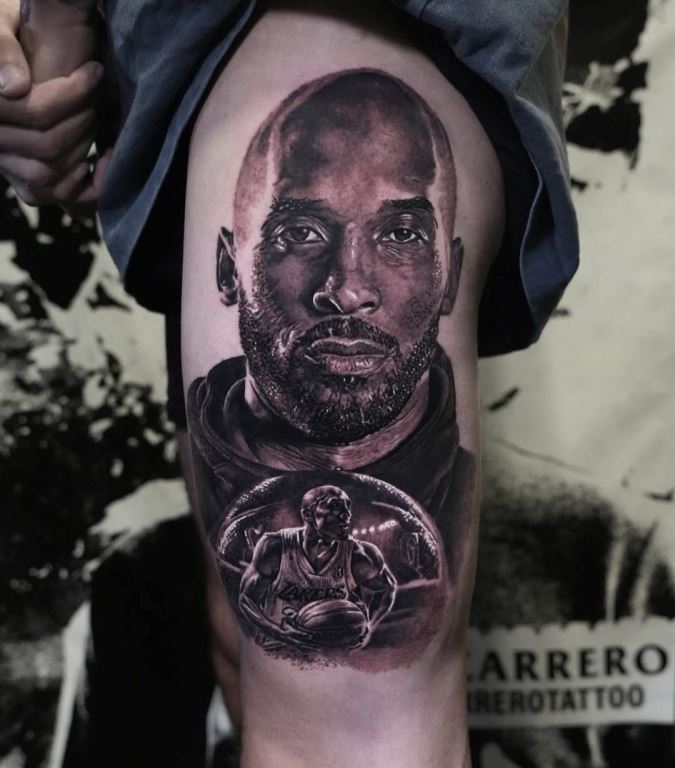
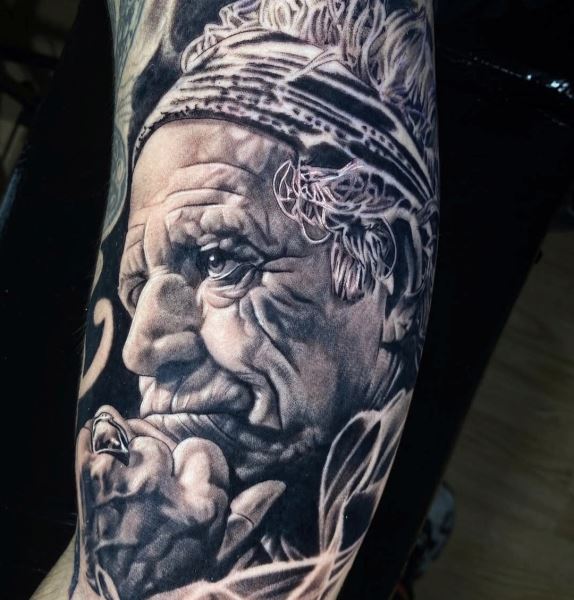
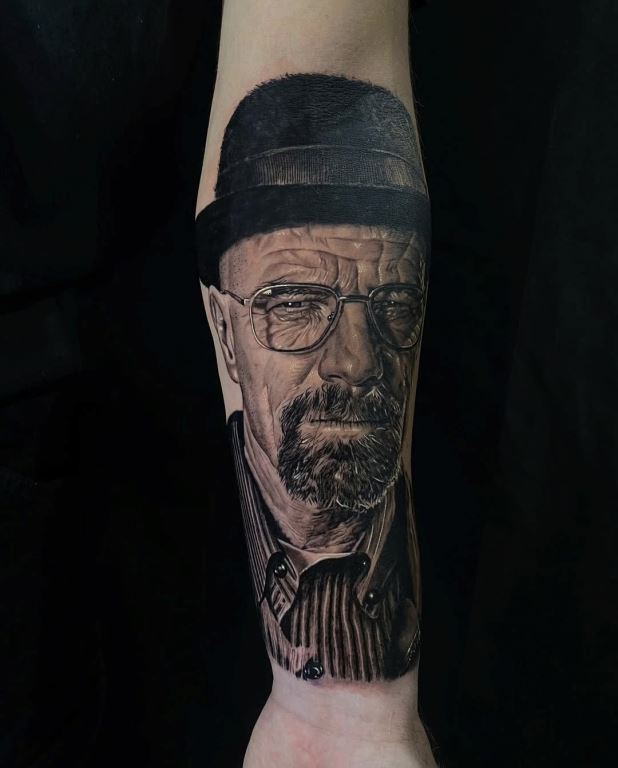
Q: Your portfolio features incredibly lifelike portraits of
icons like Walter White, Rihanna, and Kobe Bryant. How do you
approach capturing the "soul" or the gaze of a subject so it feels
alive on the skin rather than just a static photo?
A: I don’t seek to simply copy a photograph, but to understand what
makes the subject recognizable and human. Before tattooing, I study
multiple references to identify patterns in expression, gaze, and
facial structure. The key lies in balancing technical precision with
intention, knowing which details to emphasize and which to simplify.
During the process, I focus especially on the eyes, the direction of
light, and smooth shadow transitions, because that’s where depth and
emotion are created.
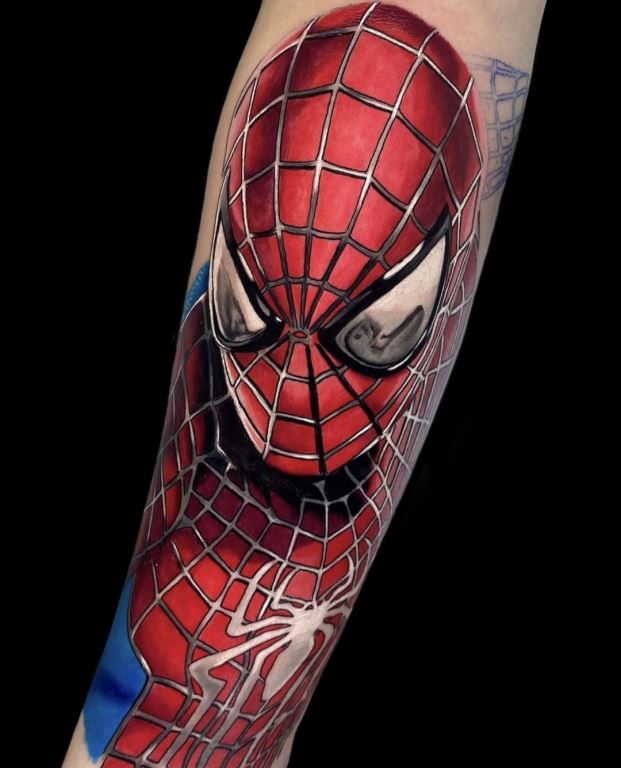
Q: Your Spiderman and Venom pieces show a
high mastery of saturated color. What is your philosophy on using
color to create depth, and how do you ensure these vibrant palettes
remain bold and legible over years of healing?
A: For me, everything starts with knowing how to work the skin:
controlling color saturation and the correct depth so the ink
remains stable over the years. Added to that is a conscious use of
color theory, strategically choosing and combining tones to create
contrast, intention, and solid pieces that stand the test of time.
Q: When a client comes to you for a realism piece, what is
the one signature element or "texture" they can expect that
distinguishes your work from other realism artists?
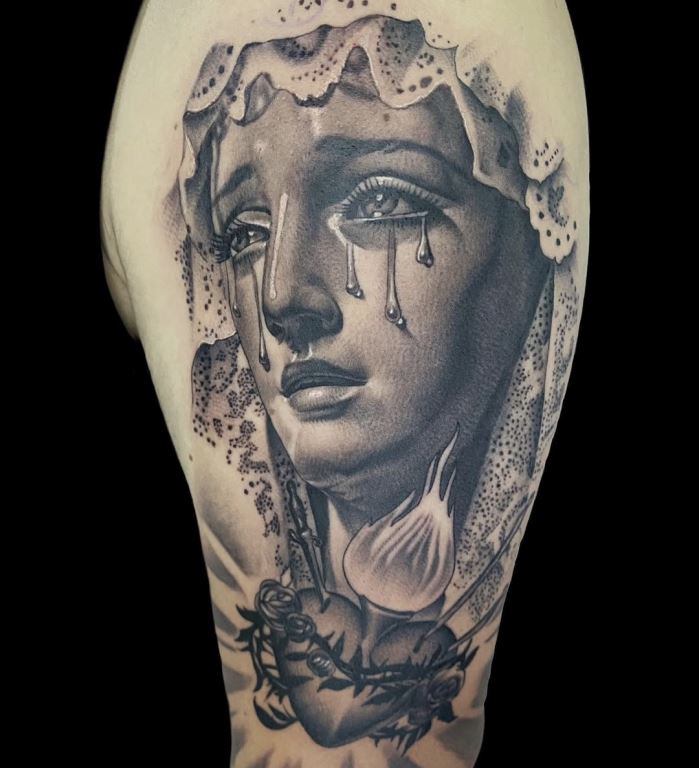
A: When a client comes to me seeking a realistic piece, they can
expect an exceptional level of detail, with clean lines and shadows
and very organic textures that bring life and depth to each tattoo,
distinguishing my work within realism.
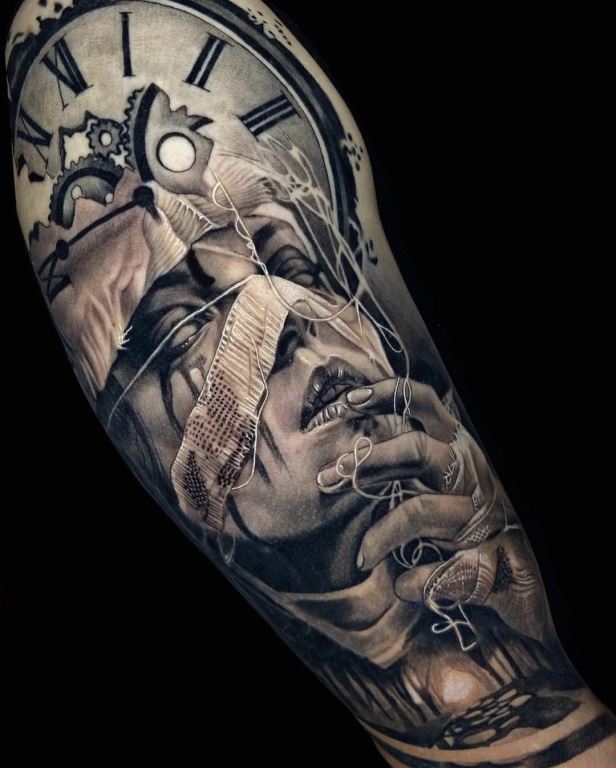
Q: You often blend realistic faces with surreal elements
like clocks, smoke, or geometric patterns. How do you decide which
abstract elements will best complement a portrait without
distracting from the main subject?
A: I choose abstract elements that enhance the emotion of the
portrait rather than compete with it. I keep the face as the focal
point by using less contrast and detail in the surreal elements,
avoiding covering the eyes or expression, and preferring one strong
concept over many. If the portrait works even without the abstract
element, then it is well integrated.
Q: Your tattoos feature a dramatic "strong
light and dark" effect. How do you decide on the "fictional" light
source when you are combining multiple reference photos into one
cohesive scene?
A: Before starting, I define my own fictional light source,
independent of the reference photos. I work as if I were lighting a
real sculpture: a clear main light that defines volume and drama. I
then adapt all references to that light, sacrificing or
reinterpreting information when necessary. On skin, consistency in
light and shadow is more important than copying the photo.
Q: Looking back at your journey so far, is there a favorite
piece or a specific project that was the most challenging to
execute?
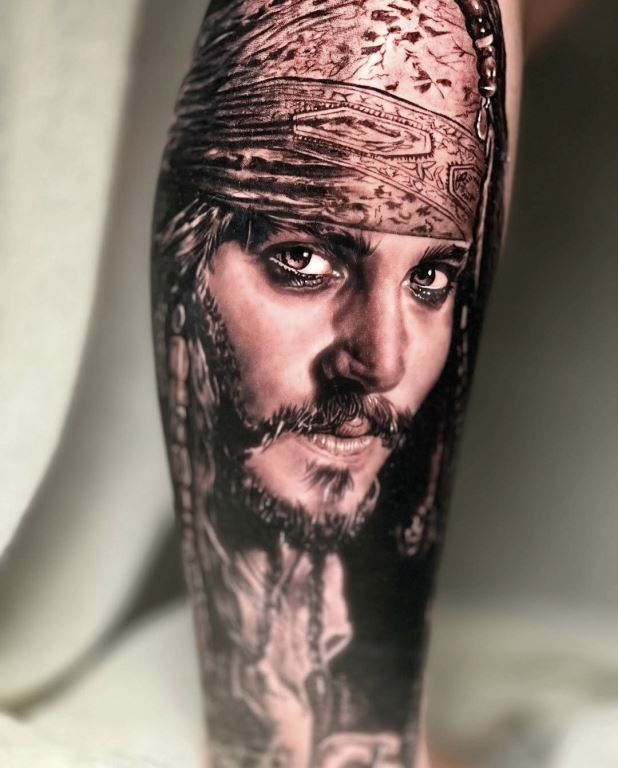
A: Looking back on my career, one of the most challenging and
memorable projects was the realistic portrait of Jack Sparrow that I
created at the Bucarafest International Tattoo Convention. This
tattoo was especially complex due to the high level of detail
required, particularly in the beard and hair. The textures in both
areas presented a significant technical challenge, demanding precise
application of clean, defined shadows while maintaining richness in
detail. Despite the complexity, the project was very well received
by the audience and, to my surprise, was awarded second place in the
Realism and Shading category at the convention. It was a deeply
rewarding piece and an invaluable experience.
Q: Many of your pieces cover large,
sensitive areas of the body. What steps do you take to ensure your
clients feel safe and respected throughout a grueling 8-to-10-hour
session?
A: From the very beginning, I explain the process and timing, and I
make it clear that the client can stop whenever they need to. During
the session, I work in sections, take regular breaks, pay close
attention to posture and environment, and maintain a professional
and respectful attitude at all times. For me, a great tattoo also
depends on the client feeling safe, heard, and supported throughout
the entire process.
Q: When a client has a vision but can’t quite put it into
words, how do you use your "artistic intuition" to translate their
emotions into a visual design?
A: When a client can’t fully explain their idea in words, I use the
context and information they provide to build a visual story. I
interpret emotions, symbols, and atmosphere, translating them into
composition, light, and expression. More than illustrating an idea,
I aim for the tattoo to tell a story the client truly feels is their
own.
Q: You have clients who travel specifically to Tampa to see
you. What is it about the "Tiago Carrero Experience" beyond the
final ink that turns a one-time client into a lifelong collector?
A: The experience goes beyond the final tattoo, it’s built on trust,
consistency, and a genuine connection with each client. Many become
loyal, returning again and again eager to continue tattooing with
me. It makes me very happy to have clients all over the world who
choose my work and follow me, regardless of the country or studio
I’m in at the time.
Q: Realism allows zero margin for error. How do you build
that "contract of trust" with a client before the needle even
touches their skin?
A: Clear communication and mutual understanding are essential:
before touching the skin, we align expectations and references to
ensure each tattoo is accurate, coherent, and truly reflects the
client’s vision.
Q: You’ve participated in major events
like the Allstars Tattoo Convention. How has competing alongside
international talent influenced your professional growth?
A: Yes, I have participated in major events such as the Allstars
Tattoo Convention, most recently in November of last year. There, I
had the opportunity to compete and learn alongside great artists and
international references, which allowed me to elevate my technical
level, open myself to new ideas, and strengthen my artistic vision
within realism.
Q: With a significant following from elite artists, how do
you view your role in the global community? Do you see yourself as
an educator, a trendsetter, or both?
A: I believe my greatest contribution as an educator and reference
comes from being present in spaces of exchange, sharing knowledge
and absorbing new trends directly from the community. This allows me
to grow, inspire others, and stay connected to what is shaping the
future of tattoo realism.
Q: The U.S. has a saturated market. What specific techniques
or cultural perspectives from your background are you introducing to
the Tampa scene to elevate the standard of American realism?
A: My experience in realism, shading, and color, combined with years
of working in different contexts, allows me to introduce a more
narrative and dramatic approach to light and composition, something
not always seen in the U.S. market. I aim for each piece to tell a
coherent and emotional story, using multiple references, fictional
lighting, and extreme contrast to create volume and depth, elevating
realism beyond a literal photo copy.
Q: Now that you are established at Tuff
Tattoos, are there specific American artists or studios you are
looking to collaborate with to further bridge the gap between South
American and North American artistry?
A: Now that I am collaborating with Tuff Tattoos, I seek to
strengthen the connection between South American and North American
realism. I am interested in working with high-level studios such as
INKNation, Ganga Tattoo, and Golden Night, exchanging techniques and
experiences to continue raising the international standard of
realism.
Q: Who are some of your favorite American realism artists
that have inspired your journey? Are there specific elements of
their work that you’ve integrated into your own unique style?
A: Some of my favorite U.S. based artists who have inspired my
journey are Victor Portugal, Nico Hurtado, David Vega, and Noah
Bissi. From them, I have learned a great deal about portraiture,
levels of realism, tonal variety, and cleanliness in every line and
shadow, elements I have integrated and adapted to build my own
style.
Q: Beyond just "inking the world," what is your vision for
your career in the States? Do you plan on opening a specialized
academy or judging the conventions you once competed in?
A: My vision for my career in the United States goes beyond
tattooing. I want to be fully immersed in the tattoo world, serving
as a convention judge, teaching specialized seminars in realism,
shading, and color, sharing knowledge, and, above all, leaving my
art on people. I seek to combine practice, education, and artistic
influence to contribute to the community’s growth and elevate the
level of realism.
Q: Tuff Tattoos has a distinguished reputation. How does
your presence as a realism specialist contribute to the studio's
standing, and how do you influence the artistic standards of the
shop?
A: Tuff Tattoos is a studio with a distinguished reputation, thanks
to the incredible level of its artists and the passion they put into
every piece. I am grateful to be part of this space, where my art
has positively impacted both the studio’s artists and the public,
helping inspire and elevate appreciation for realism in tattooing.
Q: Please write down your studio location
and website/social media links. Also let us know if you are
available for bookings.
A: Website and social media:
Instagram/tiagocarrerotattoo
https://tufftattoos.com/pages/tiago
www.tiktok.com/@tiagocarrerotatto
www.facebook.com/share/1CWakfxN2w/?mibextid=wwXIfr
Q: As an artist who has worked across different continents,
how do you see the global realism scene evolving as we move through
2026?
A: The global scene has advanced tremendously by 2026. Today, we
have more tools, new platforms, artificial intelligence programs,
and cutting-edge technology that facilitate access to knowledge,
practice, and the constant evolution.
Q: For someone looking at your work for the first time,
whether a fan or a professional peer. Ehat do you want them to
understand about the level of discipline required to produce work at
this level?
A: I want those who see my work for the first time to understand
that behind each piece there are years of practice, constant study,
and extreme attention to detail. Realism demands discipline in every
line, shadow, and color, patience to refine textures and volume and
an absolute commitment to quality. It’s not just talent, it’s daily
dedication to maintaining and raising the standard with every
tattoo.
Q: If you hadn't found your calling in tattooing, what other
medium of art or profession would you have pursued?
A: I would most likely have continued in the artistic field,
exploring disciplines such as painting, portraiture, visual media,
or graphic design, always seeking to convey emotions and tell
stories through art.
Q: What is the most important piece of advice you can give
to aspiring artists who want to break into the world of high-end
realism?
A: The most important advice for those aspiring to high-end realism
is to be patient, consistent, and detail-oriented. This style
requires daily practice, deep study of light, shadow, proportions,
color and learning to truly understand the client’s vision. Above
all, they must fight for their dreams, strengthen their art, and
dedicate time to practicing and refining every technique, because
discipline and passion are what truly lead to success at this level.
Interview: Ivana Kancheka
Date: 15/02/2026


