
Interview with Ying Ting
To honor the eighteen anniversary of Skin Artists
Tattoo Magazine, we are spotlighting the visionary creators who are
expanding the definitions of the craft by merging ancient traditions
with modern skin art. YingTing joins this milestone celebration as a
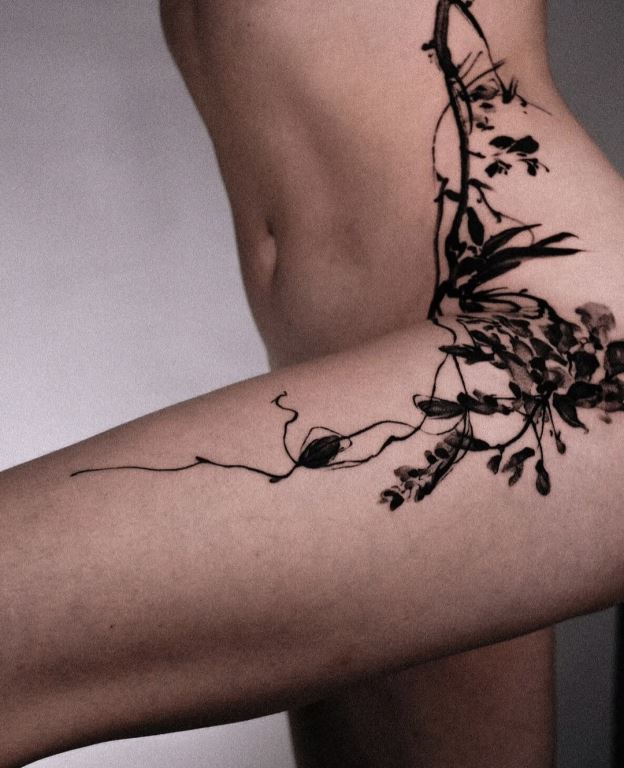
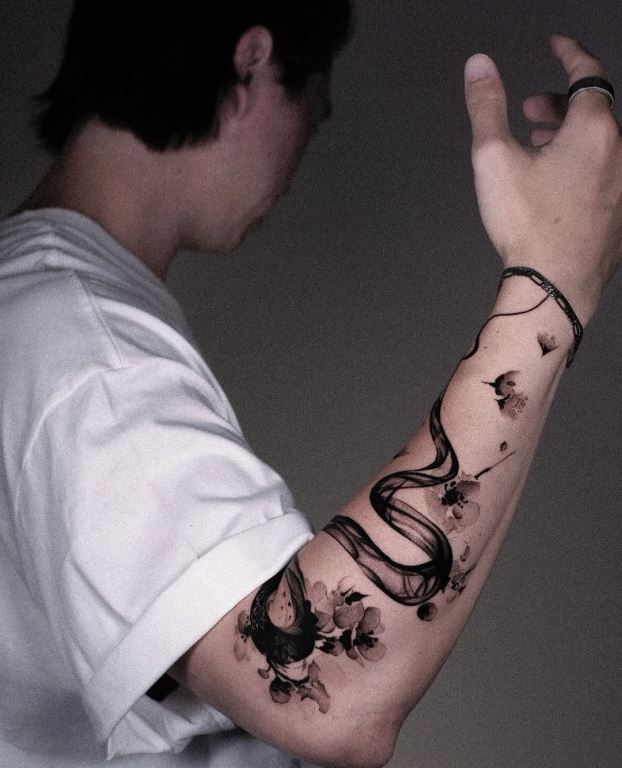
master of the "Shuimohua" style, recognized for bringing the fluid,
soulful energy of traditional Chinese ink painting to the living
canvas.
With a deep foundation in classical calligraphy and ink-wash
techniques, YingTing treats the human body as a "living scroll." Her
work is defined by an ultra-soft precision that replaces heavy
outlines with rhythmic brush-stroke textures and "spirit resonance."
By capturing the "moment of chance" a falling petal or rising smoke,
she creates compositions that feel as though they are reacting to
the movement and anatomy of the wearer in real-time.
The following interview is dedicated to exploring the future of
tattooing. We discuss how classical training in paper and canvas
informs the technical execution of lineless realism, the philosophy
of movement within a static image, and YingTing’s perspective on how
Eastern aesthetic traditions are shaping the global trajectory of
the industry as we look toward the years ahead.
Q: You have a deep background in traditional Chinese
painting. Before you ever touched a tattoo machine, how did that
formal training shape the way you perceive light, shadow, and the
"spirit" of a subject?
A: My foundation comes from practicing traditional Chinese ink
painting as a child in China. My neighbor was a locally known
calligrapher, and I would often sit and practice alongside him. That
early training shaped how I perceive a subject - not just visually,
but emotionally, beyond its physical form. In Chinese painting, it’s
more about interpreting its feeling and inner life, and this guides
how I approach tattooing today.
Q: Many traditional artists stay within the world of paper
and canvas. What was the specific moment or "revelation" that made
you realize your visual language belonged on the human body?
A: It wasn’t a single revelation, more a slow realization. After
working in communication and marketing, I felt creatively distanced
from what I was doing. I missed something tactile and immediate, a
closer relationship between hand, material, and outcome. So when I
found tattooing, it didn’t feel like a career change. It felt like
returning to my roots, just translated onto a living surface.
Q: When you first started, did you try to master the
"standard" tattoo styles (like traditional or realism), or did you
immediately start experimenting with the fluid, brush-stroke style
we see in your portfolio today?
A: I began my apprenticeship at Dropout Studio in Copenhagen under
my mentors Ruben
Riksfjord and Christopher Henriksen, both masters in their
respective fields, black & grey realism and Japanese. They held me
to high technical standards. I was expected to understand and
execute multiple techniques and styles before focusing on my own
voice. My personal style developed later, as I began exploring more
abstract genres.
Q: Growing up in China, what were your
early impressions of tattoo culture? Was it something you always
admired, or did you have to redefine what tattooing meant to you as
you became an artist?
A: Growing up in China, I had a more traditional perception of
tattoos, they weren’t widely normalized in mainstream society. The
first time I became truly curious was during a visit to Miami.
Walking through the city, I noticed how common tattoos were and how
openly they were expressed. That exposure made me pay much closer
attention to tattooing as both a culture and an art form. I began to
see it not as rebellion, but as visual storytelling embedded in
culture.

Q: Your work has an "ultra-soft precision"
that lacks the heavy outlines typical of Western tattooing. How
difficult was it to commit to this style when the industry often
emphasizes "bold will hold"?
A: “Bold will hold” is absolutely valid, longevity is fundamental.
My work doesn’t rely heavily on outlines because of its painterly
nature, but strong black elements are still structurally important
in my compositions. They create contrast and allow the softer
transitions to exist. So the softness people see is actually
supported by deliberate structural planning. It’s less about
rejecting tradition and more about reinterpreting it through a
different visual language.
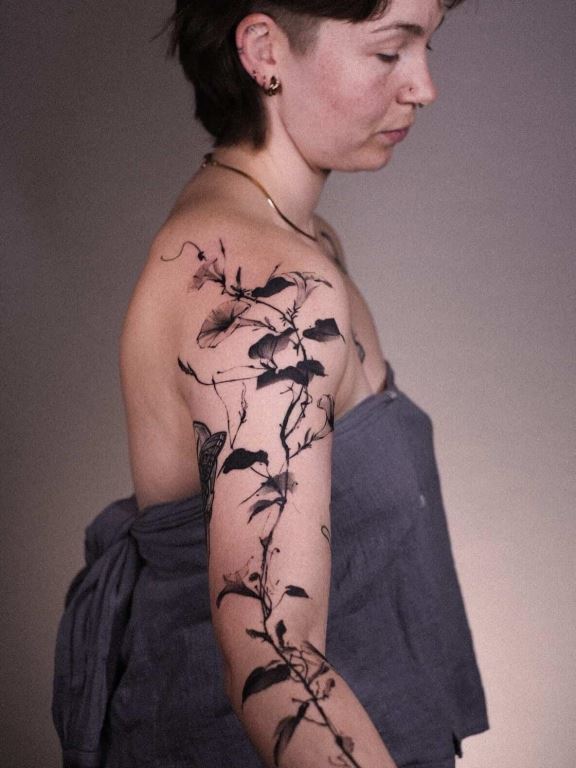
Q: Many of your pieces look like they are
reacting to the movement of the muscles underneath. How much of the
design is planned beforehand, and how much is freehanded to fit the
individual’s body flow?
A: Every project begins with preparation. I ask clients to send
photos of the body area so I can study anatomy, muscle direction,
and natural flow beforehand. On the day, I often incorporate partial
freehand adjustments. Skin is dynamic, designs need to respond to
that in real time.
Q: In Shuimohua, there is a concept called Qiyun Shendong
(spirit resonance), where the artist tries to capture the life force
of the subject. When you choose a botanical or animal subject, how
do you determine its "spirit" before you begin?
A: In many cases, the client selects the motif, but my role is to
interpret how it should look on their body. For me, capturing the
“spirit” is less about symbolism and more about movement, posture,
and flow - how the subject interacts with the wearer’s physical
form. That interaction is not just from the subject itself, but from
its relationship to the body.

Q: Traditionally, Shuimohua was found on
scrolls and fans. By moving this style onto the skin, do you feel
like you are turning the human body into a "living scroll" that
tells a story of the wearer’s own personal growth?
A: Yes, very much so. Clients who come to me usually already
resonate with this aesthetic language. Whether the piece carries
explicit meaning or not, it inevitably shapes how they see
themselves and how they grow into their identity. In that sense, the
body becomes a living scroll, one that continues to evolve as the
person moves through different stages of life.
Q: Your work often looks like it is in the middle of a
movement, a petal falling or smoke rising. Is there a specific
symbolic reason why you prefer "the moment of change" over a static,
still image?
A: Movement creates emotional atmosphere, they feel alive. Static
imagery can be beautiful, but I relate more to movement and
impermanence. I’m trying to capture a fleeting moment that continues
through the person's motion.
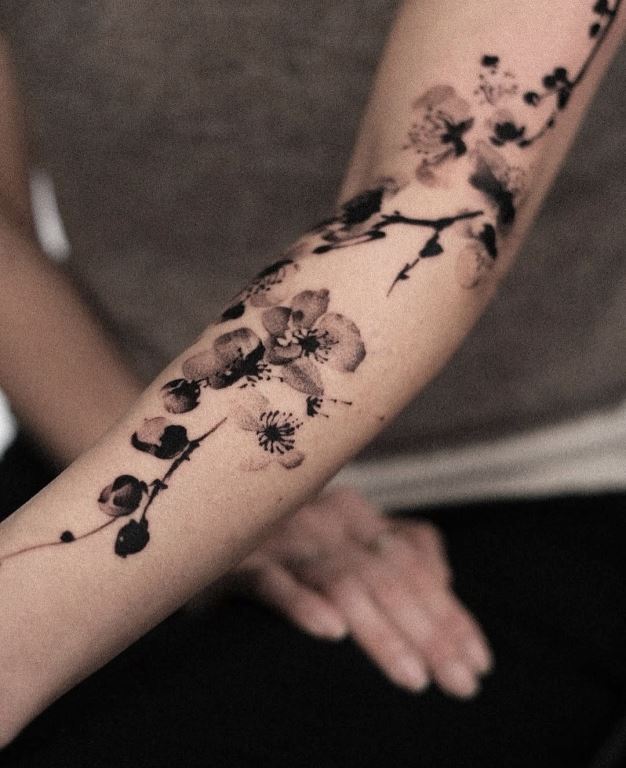
Q: You have mastered the "ink wash" look
in black and grey. Are you planning to experiment more with
traditional Chinese pigments (blues, vermillions, and mineral
greens), or do you feel the soul of your work is strictly tied to
the grayscale of classic calligraphy?
A: I occasionally incorporate touches of red, but grayscale remains
central to my practice, it is where I feel most fluent. It connects
directly back to calligraphy and Shuimohua traditions.
Q: Beyond skin, are you experimenting with other ways to
express this style? For example, are you interested in collaborating
with fashion designers or digital artists to see how your "flow"
translates to movement in other industries?
A: Not actively at the moment, but I’m very open to it. I’ve always
been interested in collaborating with artists from other disciplines
- fashion, digital media, or installation, to see how this sense of
flow could translate into new environment, and open new dialogues
around motion and form.
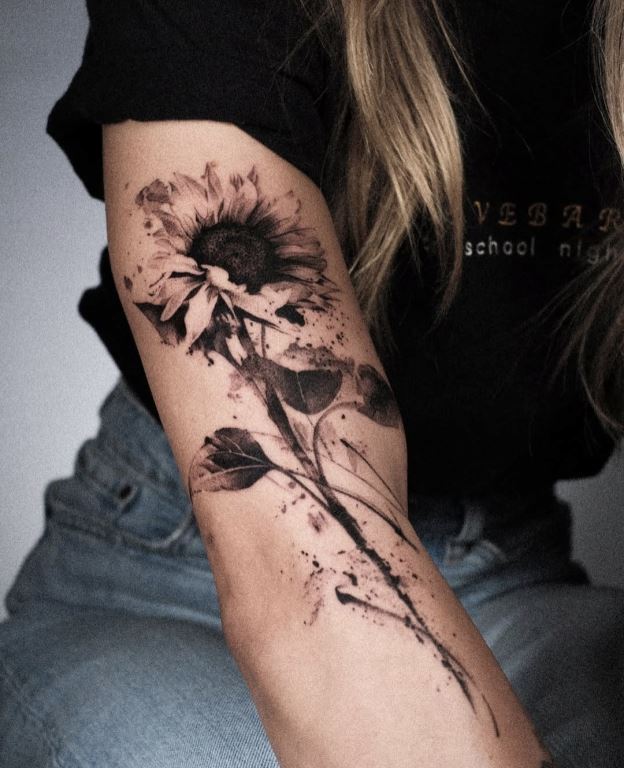
Q: Dropout is known for hosting incredibly
avant-garde artists. How did the environment at the studio push you
to evolve beyond your initial apprenticeship?
A: Dropout is an intense environment, but in the best way. Being
around so many artists with strong individual voices is incredibly
inspiring, and also humbling. Working side by side with so many
great artists broadened my understanding of what tattooing could be.
At the same time, it reminds me to stay a student - to keep refining
both technique and artistic direction.
Q: How do you balance staying true to your Chinese heritage
while adapting to the aesthetic desires of a European clientele?
A: I stay deeply grounded in my Chinese heritage, it’s the
foundation of how I understand aesthetics, composition, and
restraint. At the same time, working in Europe creates a cultural
exchange. Many clients are encountering these visual principles for
the first time, so the process becomes mutual - a dialogue rather
than a translation. I’m not just adapting to them, they’re also
adapting to this visual language.
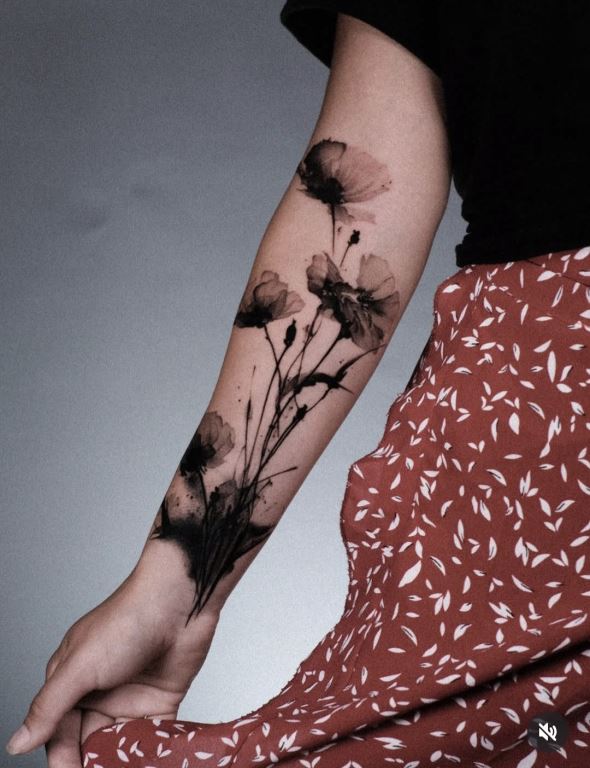
Q: You recently joined the Revolution
Needles Pro Team. Do you see these accolades and convention invites
as a form of "social proof," or do you still feel like a student
when you walk into those rooms?
A: Joining the Revolution Needles Pro Team is definitely a
meaningful form of recognition, and I’m grateful for that trust. But
when I step into industry gatherings, I still feel like a student.
I’m relatively new, and there are countless approaches, techniques,
and philosophies left to learn.
- Do you think these evens serve a valuable purpose?
These events serve an important purpose, not just visibility, but
dialogue. They create space to exchange knowledge, observe evolving
standards, and stay connected to the global craft.
Q: With the rise of social media-driven
"micro-trends," how do you ensure your work remains timeless?
A: I try to keep my focus centered on the work itself. Social media
is an important platform, and I’m grateful for the visibility it
creates. When I share, the priority is always the artwork. Tattooing
lives on the body far longer than it lives on a screen, so for me,
timelessness comes from continuously developing a clear visual
language rather than reacting to short-term trends.
Q: What is your vision for the future of "modern-day
tattooing"? Do you see the line between "Fine Art" and "Tattooing"
disappearing entirely?
A: Tattooing is expanding far beyond its historical boundaries,
stylistically, culturally, and socially. It’s becoming more accepted
across professional and academic spaces that once distanced
themselves from it, and that shift is redefining what tattooing
represents. I do see the line between fine art and tattooing
continuing to blur. Whether it disappears entirely is uncertain,
bringing those worlds together requires deep technical understanding
of both disciplines, as well as respect for the wearer.
Q: Every industry has room for improvement. Is there
anything about the current tattoo world, perhaps regarding its
inclusivity, its pace, or how it treats non-Western styles that you
think needs to change or evolve?
A: The pace of the industry today is incredibly fast. While that
creates exposure, it can also compress the time artists spend
developing foundational skills. Growth should happen both
artistically and structurally, protecting that process is essential
for the future of tattooing.
Q: In your bio, you mention being
"unafraid to explore." What is your ultimate vision for the tattoo
world? Do you see it becoming a place where the "story and
environment" matter as much as the ink itself?
A: Definitely. I see tattooing is moving toward a space, where
narrative, environment, and client experience hold equal weight to
the tattoo itself. From consultation to placement, the entire
process becomes part of the artwork’s narrative.
Q: As a Chinese artist working abroad, how do you want your
work to be remembered? Do you hope to be seen as a pioneer who
brought Shuimohua aesthetics into the modern global mainstream?
A: As a Chinese artist working abroad, I see my role as a bridge
between visual cultures. I hope my work shows that traditional
visual languages can travel, evolve, and remain relevant on a global
stage.
Q: For other artists who have a very "distinct, interesting
style" but are afraid it might not be "commercial" enough, what
would you say to encourage them to stay true to their unique vision?
A: Commercial trends move in cycles. From my perspective, constantly
chasing what’s popular can make it difficult to develop an authentic
voice. I would encourage artists to stay patient with their vision.
Building something personal takes consistency and technical
discipline, but that individuality is what ultimately creates
lasting impact.


